


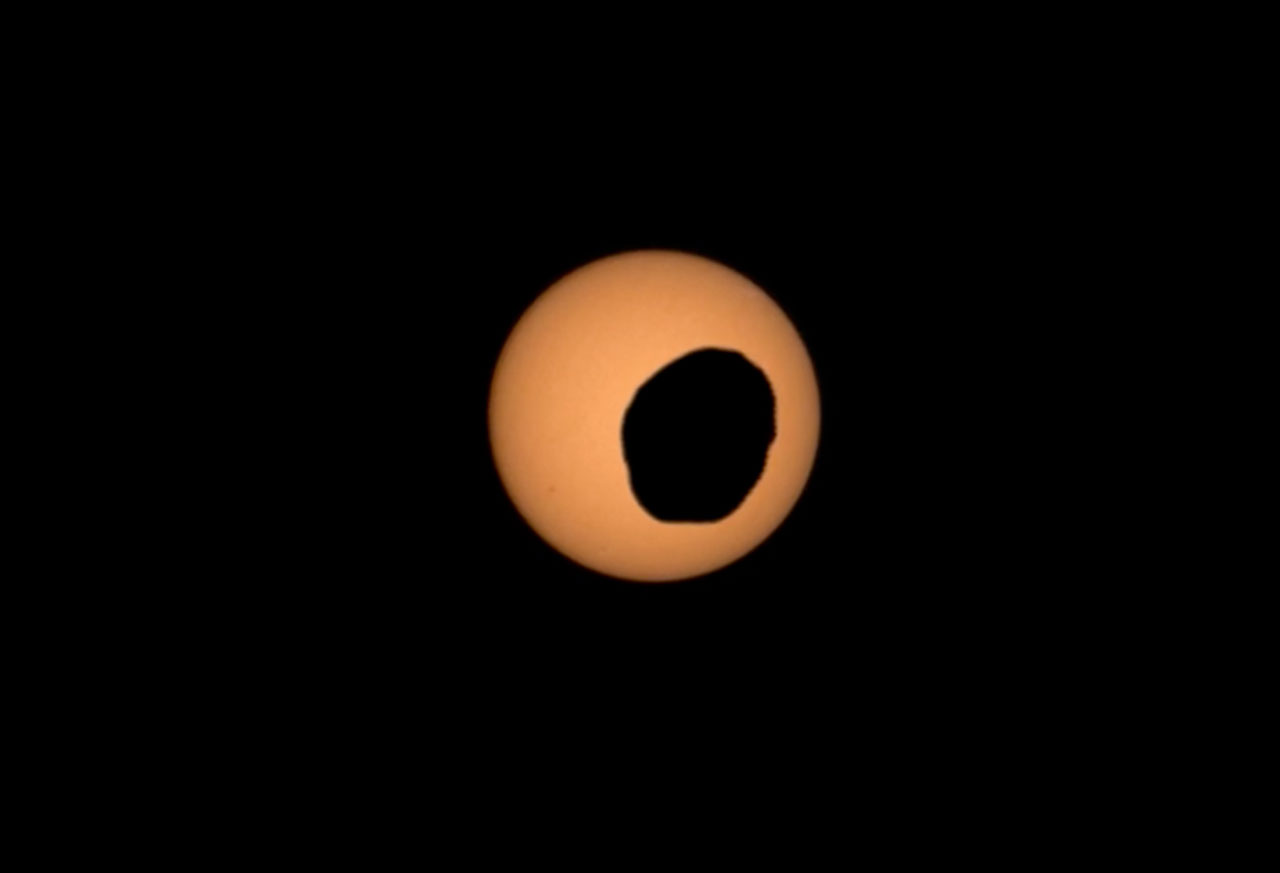
NASA’s Perseverance Mars rover captured a stunning view of Phobos, one of Mars’ two moons, passing directly in front of the Sun. Using its Mastcam-Z camera, the rover photographed the solar transit on August 12, 2026, during the 1,948th Martian day, or sol, of its mission.
The animation is colorized to recreate how the Phobos transit would appear to human observers on the Martian surface while viewing the Sun through eclipse-protection glasses. This rare celestial event highlights the unique appearance and motion of Mars’ potato-shaped moon.
Since landing in Jezero Crater in February 2021, NASA’s Perseverance rover has recorded several Phobos solar transits. By comparing these observations over time, scientists can refine their understanding of Phobos’ orbit and track how it is gradually changing. In the distant future, Phobos is expected to spiral closer to Mars and eventually move toward the planet’s surface.
Arizona State University leads operations for the Mastcam-Z instrument in partnership with San Diego’s Malin Space Science Systems, which helped design, manufacture, test and operate the camera. The University of Copenhagen’s Niels Bohr Institute designed, manufactured and tested the instrument’s calibration target.
NASA’s Jet Propulsion Laboratory, managed for NASA by the California Institute of Technology in Pasadena, California, oversees the construction and operations of the Mars 2020 Perseverance spacecraft.
For more information about NASA’s Perseverance rover and its exploration of Mars, visit science.nasa.gov/mission/mars-2020-perseverance.
Source: science.nasa.gov