


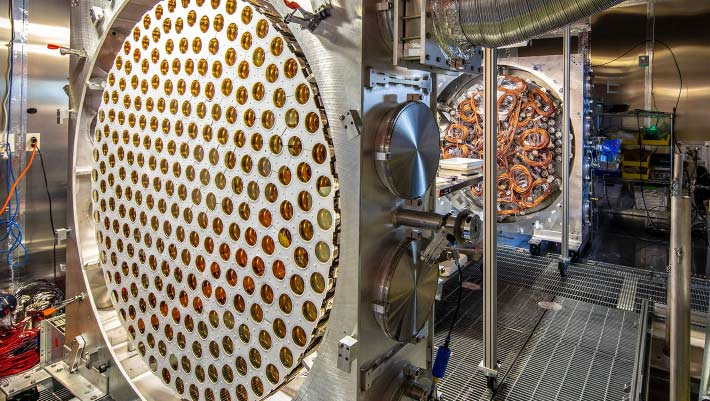
Researchers with the LUX-ZEPLIN (LZ) dark matter detector have recorded an unexplained single-particle interaction deep underground at a former gold mine in South Dakota. However, the team says it is far too early to claim a dark matter discovery.
To search for dark matter, LZ uses photomultiplier tubes, shown here before installation, to capture light produced by particle interactions. Image credit: Matthew Kapust/Sanford Underground Laboratory.
The LZ experiment is an international collaboration involving 250 scientists and engineers from 39 institutions.
The LZ dark matter detector contains 10 tons of ultra-pure liquid xenon and is located approximately 1 mile underground at the Sanford Underground Research Facility in South Dakota.
Managed by Lawrence Berkeley National Laboratory, the experiment is designed to search for WIMPs, or weakly interacting massive particles, one of the leading hypothetical candidates for dark matter.
“Dark matter interactions are expected to be very rare, so we won’t need large numbers to show the first real detection of dark matter,” said Dr. Carmen Carmona, leader of the Penn State LZ Experiment Group.
“That’s why even a single event stands out to us. In fact, this particular signal came from a region of the dataset that we had never investigated before. It took our team several months of additional work to understand the possible background sources and rule out conventional explanations.”
The LZ team analyzed 220 days of live data collected between March 2023 and April 2024. The analysis examined a broader range of potential WIMP interactions that could deposit more energy in the detector than the interactions targeted in earlier studies.
If the signal was caused by dark matter, the responsible particle would likely have a mass of at least 200 GeV/c2 (gigaelectronvolts), or more than 200 times the mass of a proton. This could point to more exotic dark matter interactions than those predicted by the simplest theoretical models.
However, the signal remains well below the five-sigma threshold required for a discovery in particle physics. The analysis produced a significance of 2.6 sigma, corresponding to approximately a 0.5% chance that the event is a statistical fluctuation caused by known background processes.
“We are very intrigued that the data confirm this event in a region where dark matter is expected to appear and where the competing background is so low,” said LZ spokesperson Rick Gaitskell, a professor at Brown University.
“We don’t want to get ahead of ourselves with just one event. We do not claim to have detected dark matter.”
“But we have discovered something interesting and would like to share it with the scientific community and ask for their input.”
The team’s results will be submitted to the journal Physical Review Letters.
Source: www.sci.news