


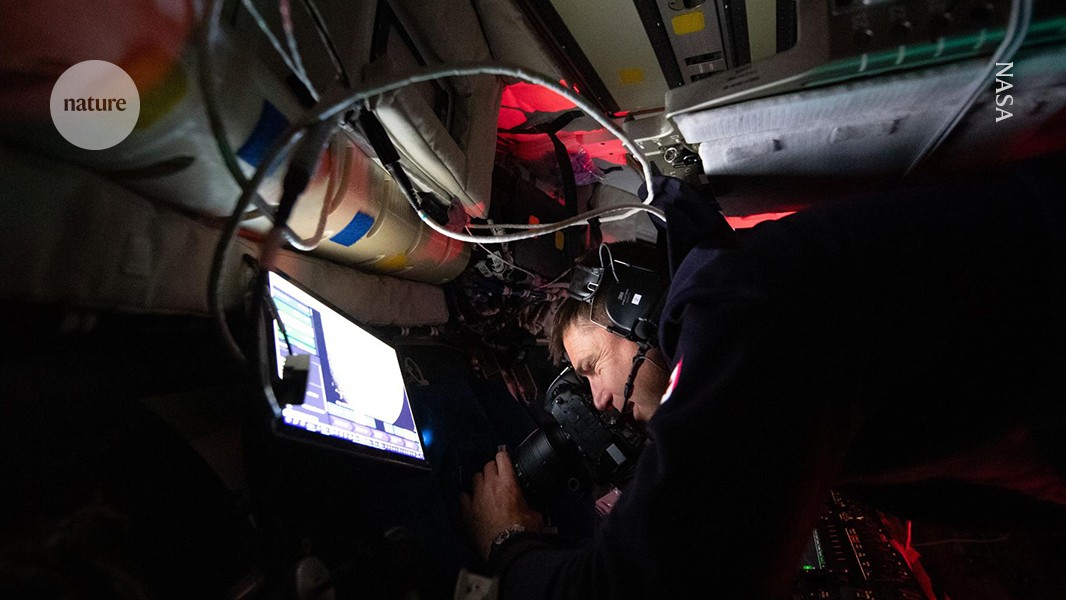
Artemis II astronaut Jeremy Hansen takes this image during his flight to the Moon.
Credit: NASA
NASA Releases 800 Gigabytes of Artemis II Moon Data, Revealing How the Lunar Surface Looks to Human Eyes
Planetary scientists can now explore one of the most detailed collections of human observations from the Moon in decades. On October 7, NASA released more than 800 gigabytes of Artemis II data, including images, audio recordings, notes and other material collected by astronauts during their historic flight past the Moon in April.
The accompanying report records the first human observations of the Moon up close since 1972. It includes astronauts’ descriptions of the lunar surface’s colors and accounts of flashes seen when micrometeorites struck the Moon.
The report also highlights the challenges of sending people to explore the lunar surface, as both the United States and China plan to do. As lighting conditions changed, so did the Artemis II astronauts’ perception of the terrain. At times, sunlight obscured their vision, showing how difficult it can be to assess the Moon’s topography accurately. Understanding these visual challenges could help future astronauts identify hazards such as craters and rocks while traveling across the lunar surface.
Artemis II traveled farther from Earth than any humans before it
Artemis II launched on April 1, returned to Earth on April 10 and carried four astronauts on a round trip around the Moon. The crew traveled 400,171 kilometers from Earth—the farthest distance humans have ever traveled from their home planet.
The mission’s main goal was to test how long the Orion spacecraft could keep humans alive in deep space. During the April 6 lunar flyby, however, the astronauts also carried out more than six hours of lunar observations, collectively known as “Moon Delight.”
“We’re really excited for the community to embrace this and run with it,” says Marie Henderson, a planetary scientist at the University of Maryland, Baltimore County, in Baltimore, and one of the mission’s deputy lunar science leaders. “A lot of new eyes will make a big difference.”
The Artemis II collection adds to observations gathered over the years by orbiting satellites and flyby spacecraft from multiple countries. Comparing the astronauts’ in-person observations with data collected by robotic probes could help scientists develop a better understanding of the Moon.
What color is the Moon? Artemis II astronauts describe the lunar surface
Astronauts’ descriptions of lunar colors provide valuable records of human perception, says Elisha Jyoti, a planetary scientist at the University of California, Los Angeles, who plans to study the data.
“The images we see from the Moon are not accurate representations of what our eyes see,” she says. Astronaut Christina Koch reported brown, tan and green colors in different areas of the lunar surface, including shades that resembled “sandwich bread mold.”
The dataset also documents how astronauts’ perceptions of darkness in some craters changed as the spacecraft passed the Moon and the angle of illumination shifted. That information could be especially important for future missions to regions near the lunar poles, where lighting conditions can be extreme.
“It must be difficult to be in such a dark environment,” Henderson says.
Source: www.nature.com