


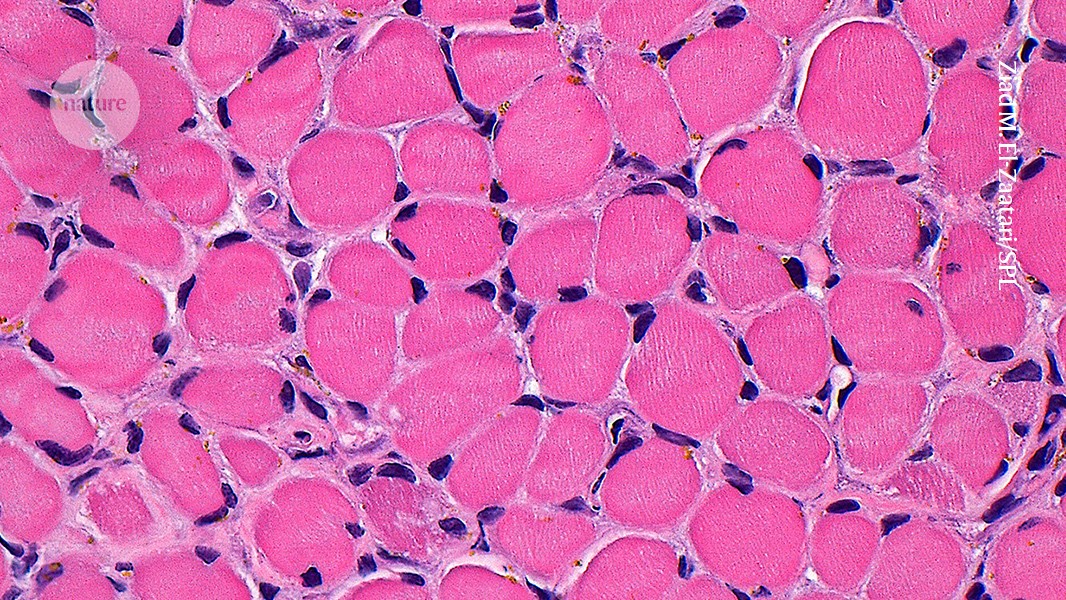
Muscle cell transplantation leads to cognitive and physical improvements in mice.Credit: Ziad M. El-Zaatari/Science Photo Library
Researchers have developed a contractile muscle implant that may replicate some of the benefits of exercise. In mice, the implant increased muscle mass, improved strength and bone density, and slowed several age-related changes in skeletal muscle.1
The findings provide an early proof of concept for using muscle-cell grafts to combat age-related muscle loss. If the approach can eventually be adapted for people, it could help address muscle wasting linked to ageing, chronic disease and prolonged bed rest. However, further research is needed before the treatment can be tested in humans.
Muscle wasting affects millions of people, particularly older adults, yet exercise remains the main effective strategy for improving muscle health, says study co-author Shi Zhang Ng, a biologist at the Institute of Stem Cell and Regenerative Medicine in Beijing. “But it turns out that the people who need to exercise the most are the ones who can’t exercise,” he says.
James White, a physiologist at Duke University in Durham, North Carolina, says the use of muscle grafts to mimic some of the body’s responses to exercise is an interesting idea. However, reproducing the effects seen in mice might require multiple muscle transplants throughout the body. For frail, bedridden or elderly patients—the people most likely to need such a treatment—undergoing several invasive procedures could be impractical, White says.
Muscle-cell grafts
To create the implants, known as muscle grafts, the researchers collected stem cells from the quadriceps muscles of mice. They isolated and cultured the cells in the laboratory to produce new muscle tissue. The researchers then injected the cells beneath the skin on the animals’ backs. Because each mouse received cells from its own body, the grafts were less likely to be rejected by the immune system.
The transplanted cells developed into organized muscle tissue close to the injection site. The tissue contracted continuously and formed its own blood vessels. The grafts survived for several months, allowing the researchers to collect samples and assess their effects.
Adult mice aged 8 to 10 weeks that received muscle grafts developed thicker muscle fibres than control mice that did not receive the treatment. Their muscle tissue also showed molecular changes associated with lower inflammation and reduced fat accumulation.
In a separate experiment, older mice aged about 1.5 years had a higher proportion of lean body mass eight weeks after receiving the muscle-cell transplant than untreated mice. After 15 weeks, the transplanted mice also had greater bone density. They performed better in physical-function tests, running farther and demonstrating stronger grip strength than the control animals.
Benefits beyond muscle health
The researchers also tested the muscle implants in mice fed a high-fat diet to induce obesity. After 16 weeks, mice that received muscle grafts had a higher proportion of lean body mass and less body fat than control animals. The treatment was also linked to lower blood sugar levels and a smaller increase in cholesterol.
Muscle transplantation was associated with fewer signs of systemic inflammation, including lower white blood cell counts. The treated mice also had lower triglyceride levels, less liver damage and higher energy expenditure than control animals. In older mice, the implants were linked to improved cognitive performance: during maze tests, mice with muscle grafts spent more time exploring unfamiliar areas than mice without grafts, Ng says.
Source: www.nature.com