


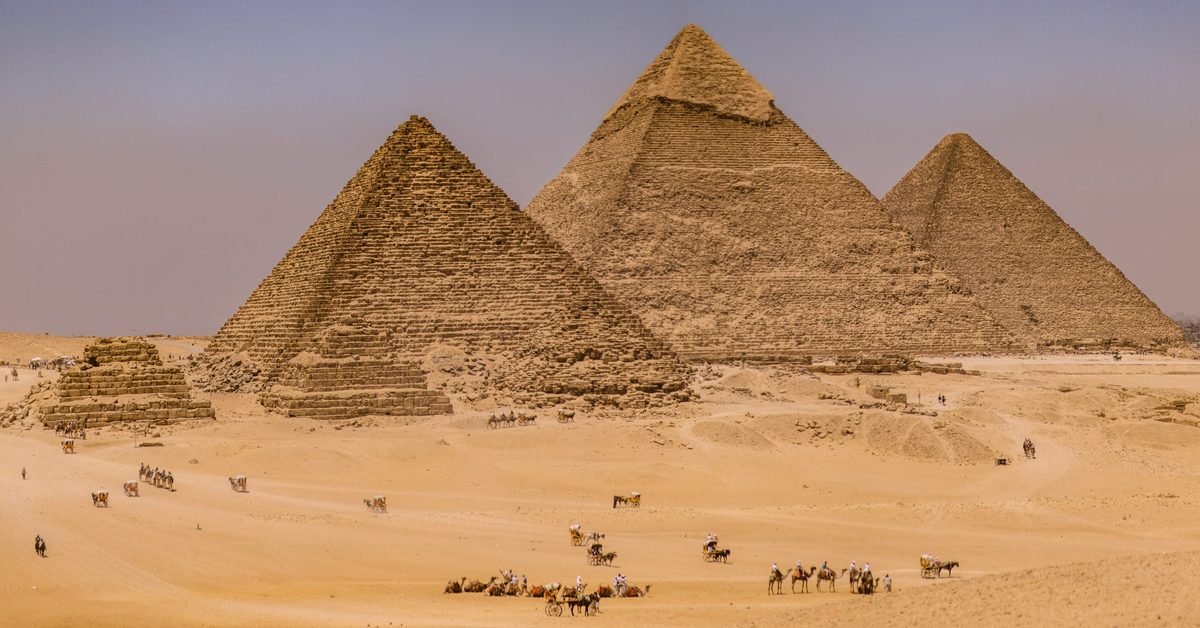
The construction of the Great Pyramid of Giza by ancient Egyptians, without modern machinery, has intrigued and baffled experts for centuries.
Recent research by Vicente Luis Rosell Roig may illuminate this age-old mystery. His findings propose that nature an innovative system of spiral, uneven ramps was used to transport the massive stones for construction.
The Great Pyramid, built around 2,560 BC for Pharaoh Khufu, consists of 2.3 million stone blocks, each weighing between 2.5 and 15 tons. This monumental structure serves as a testament to the architectural prowess of ancient Egypt.
In order for the pyramid to be completed during Khufu’s 27-year reign, blocks would need to be laid at an astounding rate of one every three minutes. However, the debate continues on how this gigantic feat was achieved in such a limited timeframe.
Some researchers propose the use of external lamps; however, the materials required for such ramps are substantial, and clear archaeological evidence remains elusive.
Others suggest a single ramp spiraled upward through the pyramid, which would be filled in from the top during construction. Yet, Roig’s mathematical modeling indicates that using just one ramp would have prolonged construction to nearly half a century.
Instead, Roig suggests that four concave ramps spiraled around the pyramid concurrently, each originating from different points near the base. These ramps could be filled in once the main structure was finalized. His computer-generated simulations demonstrate that this method could enable completion within Khufu’s 27-year timeline.
“This provides a fascinating explanation for the structure of the pyramids,” stated Dr. Roland Enmarch, a reader in Egyptology at the University of Liverpool. “Further verification through additional evidence and scans of structural anomalies at the corner points of the ramps will be necessary.
“However, it appears very plausible. The Great Pyramid of Giza is neither the oldest nor the most recent of the pyramids, so this insight could also provide valuable information about the construction of other pyramids.”
Read more:
Source: www.sciencefocus.com