


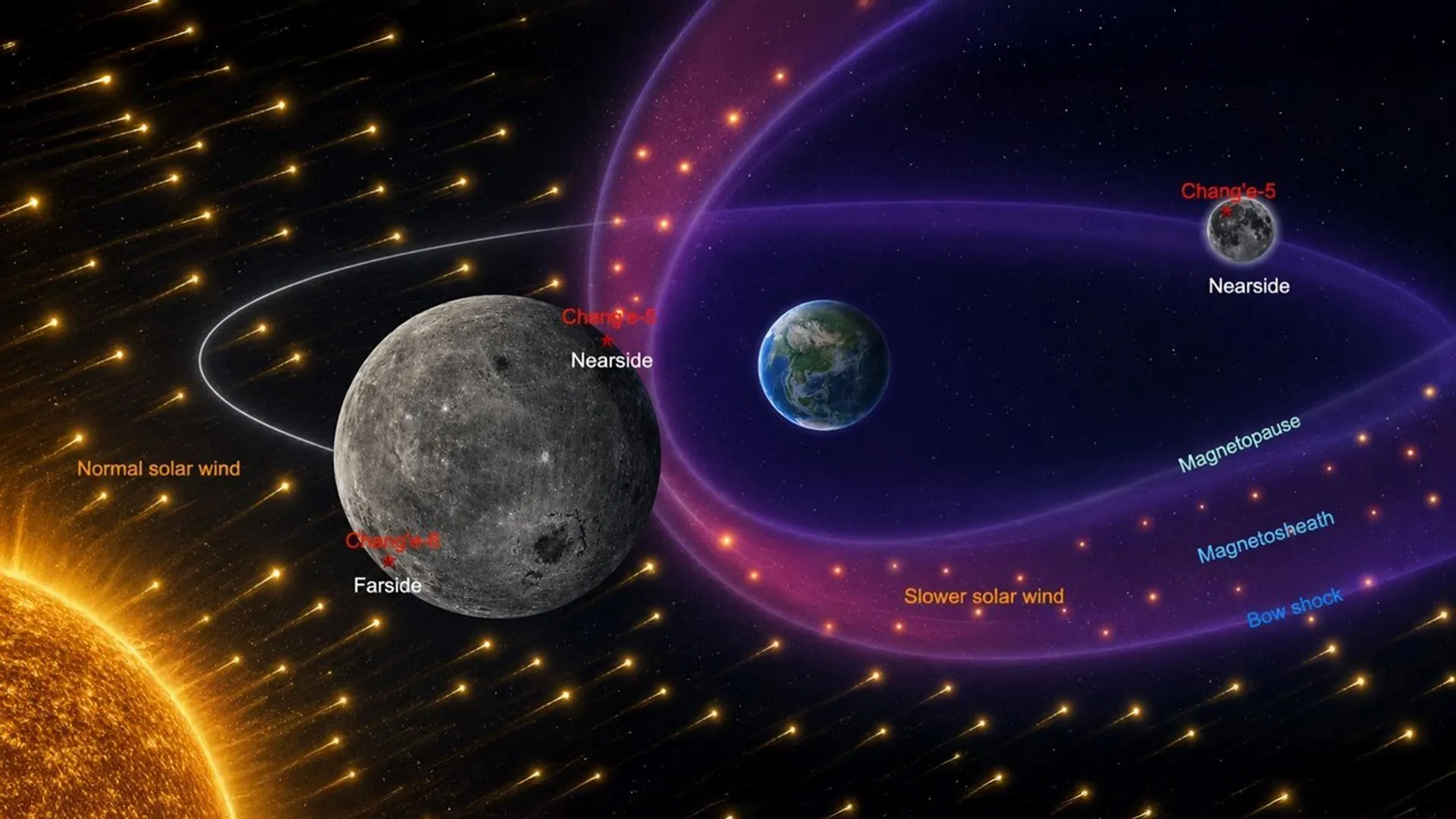
The moon has been bombarded by solar wind for billions of years, but emerging evidence indicates significant differences in how each hemisphere is affected. Particles striking the moon’s near side and far side arrive at varying velocities and energy levels.
Recent analysis of samples retrieved by China’s Chang’e 6 mission suggests that Earth’s magnetosphere plays a critical role in this disparity. The findings are significant contributions to the field of natural earth science.
How Moon Dust Preserves Solar Wind Records
The solar wind, a continuous stream of high-speed charged particles emitted by the Sun, directly impacts the Moon due to its lack of a thick atmosphere and global magnetic field. This unfiltered exposure allows lunar regolith to serve as a natural archive of volatile substances, including noble gases (He, Ne, Ar, Kr, Xe) carried by the solar wind. These elements, which exhibit minimal chemical reactivity, serve as reliable markers of solar wind particle accumulation in lunar soil.
Historically, researchers could only study samples from the Moon’s near side. The absence of far side samples hindered direct comparisons of solar wind injection across both hemispheres.
This changed with the Chang’e 6 mission, which successfully returned 1.935 grams of lunar regolith from the Antarctic Aitken Basin on the Moon’s far side. This sample offers the first opportunity to compare solar wind particle injection between both lunar hemispheres directly.
Isotopic Differences Discovered in Chang’e 6 Samples
A research team from the Institute of Geology and Geophysics (IGG) at the Chinese Academy of Sciences (CAS) analyzed the concentrations and isotopic composition of helium, neon, argon, krypton, and xenon in the Chang’e 6 samples.
Conducted under the guidance of Professor HE Huaiyu and managed by IGG postdoctoral researcher Xuhang Zhang, this project also involved collaboration with the University of Science and Technology of China and the Chang’e 7 volatile payload team.
One noticeable difference was found in neon isotopes. The average 20Ne/22Ne ratio in the Chang’e 6 regolith stands at 11.34±0.22, significantly lower than measurements from all previous near-side samples—aligning closely with theoretical expectations following solar wind fractionation.
This isotopic pattern suggests that the far side experienced more intense fractionation, resulting in a greater abundance of heavier neon isotopes.
Solar Wind Reaches Further
Additional evidence from krypton and xenon supports the hypothesis that the two hemispheres were exposed to solar wind particles of varying energies.
In heating experiments, xenon captured by the solar wind was primarily released from Chang’e 6 samples at high temperatures, presenting a single pronounced peak. In contrast, Chang’e 5 samples from the near side exhibited a distinctly different release pattern, with significant amounts of xenon released at both low and high temperatures.
This contrast implies that solar wind particles penetrated deeper into the regolith on the far side, requiring higher-energy particles for deeper injections, indicating faster, more energetic solar winds influenced the far side of the Moon.
The Earth’s Effect on Solar Wind
Researchers attribute these differences to the “velocity-controlling” effect of Earth’s magnetosphere.
As the Moon orbits Earth, it traverses a magnetic sheath, a buffer zone that envelops the magnetosphere. In this region, the solar wind’s velocity decreases from approximately 400 km/s to around 200 km/s.
This deceleration predominantly affects the Moon’s near side, which faces Earth, preventing low-energy particles from penetrating deeply and resulting in their predominance near the top of the regolith.
The far side, shielded from this effect, remains subjected to unimpeded solar wind, allowing faster particles to penetrate more profoundly into lunar soil.
Researchers estimate that around 25% of the solar wind exposure recorded at the Chang’e 5 landing site is due to this slowed flow, while the Chang’e 6 site shows no evidence of similar protective influence.
Moon’s Soil as a Record of Earth’s Magnetic History
The samples from the far side provide the first concrete evidence that Earth’s magnetosphere modulates the speed of solar wind particles impacting the Moon. This effect is recorded in the depth of particle penetration and the isotopic signatures of the noble gases trapped in the lunar soil.
Moreover, researchers suggest that heavy noble gases within the Moon’s regolith could act as a “fossil record,” offering insights into early interactions between the solar wind and Earth’s magnetosphere. Analyses combining these gases with paleomagnetic data could reveal new approaches to understanding variations in Earth’s magnetic environment over time.
These discoveries illustrate that the interactions between the Sun, Earth, and Moon are more complex than previously understood. They further imply that the Moon conceals significant historical evidence of these ancient interactions, providing researchers with novel avenues to explore the long-term dynamics of Earth’s magnetic field.
Source: www.sciencedaily.com