


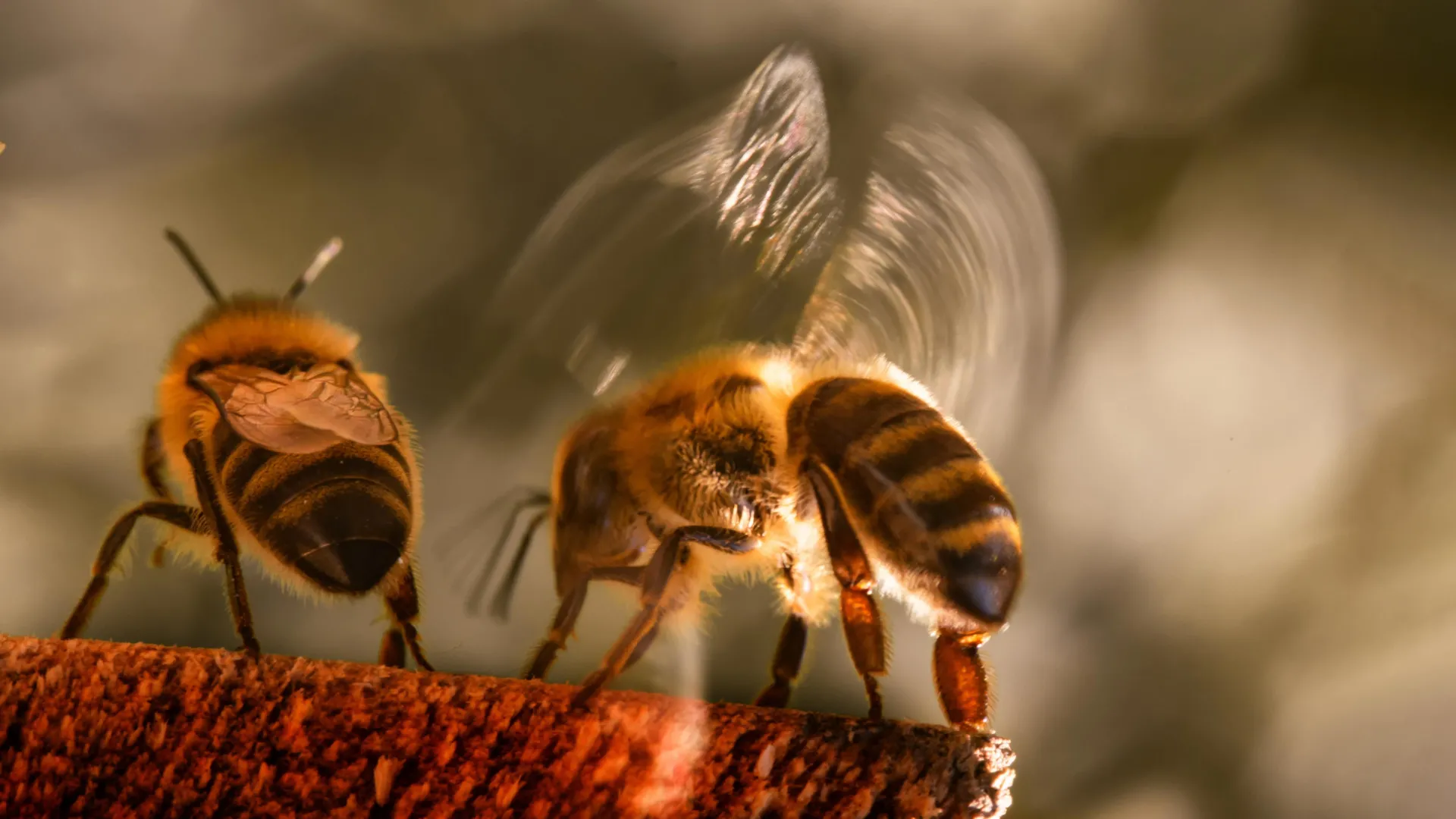
Honey Bees Chase Away Rival Pollinators in Competition for Flowers, Study Finds
Honeybees are formidable competitors for food in the UK, and scientists have found that they frequently use aggression to drive other pollinators away from flowers. A new study provides the first detailed evidence of how extensively honeybees disrupt other species’ access to nectar and pollen by chasing, scaring and intimidating rival insects.
Researchers at Anglia Ruskin University (ARU) tracked pollinator activity at five locations in and around Cambridge, England, for two years. The findings were published in Ecological Entomology. Each study site was located within 300 metres of an established honey bee colony.
The researchers observed insects visiting brambles (Rubus genus) and ivy (Hedera helix), two flowering plants that provide important sources of nectar and pollen. Both plants attract large numbers of insects during flowering, making them useful locations for studying competition among pollinators.
Honey bees win more competition for flowers
To investigate how pollinators interact, the researchers divided flower visitors into five groups: honey bees, bumblebees, solitary bees, hoverflies, and an “other” group that included butterflies, beetles and other insects.
During more than 93 hours of observation, the scientists recorded encounters in which one insect interfered with another’s feeding or access to a flower. Each interaction was classified according to its outcome. A “win” occurred when one insect gained access to a flower at the expense of another, causing the second insect to lose the feeding opportunity. A “shared” interaction meant both insects could access the flower without competition.
The results revealed a clear pattern: where honey bees were concentrated, there were generally fewer other pollinators and more competition for flowers. Honey bees also won a greater proportion of encounters with other insects.
In bramble flowers, doubling the density of honey bees resulted in a 14% decrease in bumblebee numbers. On ivy, the number of solitary bees and hoverflies decreased as honey bee numbers increased.
Honey bees chase away rival pollinators
Honey bees did not simply reach flowers before their competitors. They also frequently initiated aggressive encounters, scaring away other insects and securing feeding opportunities for themselves.
Other pollinators actively avoided honey bees in 28% of observed interactions on brambles and 36% of interactions on ivy. In at least 20% of encounters involving honey bees on either plant, the bees physically pushed away or chased competing insects.
Aggressive behaviour by species other than honey bees was unusual, although one insect stood out as an exception.
First recorded in the UK in 2001, the solitary non-British poison bee was the only pollinator observed to actively challenge honey bees. Unlike most other insects, tree bees successfully competed for access to flowers and defended their feeding grounds by chasing honey bees away.
Climate change could intensify competition among pollinators
The discovery forms part of a broader research effort to understand competition among pollinators and identify ways to reduce its impact on ecosystems.
The findings come as beekeeping continues to expand across the UK. The number of registered beekeepers increased from 19,000 in 2010 to 47,000 last year, reflecting a rise in the number of managed honey bee colonies.
Researchers warn that rising temperatures could place additional pressure on wild pollinators. Their observations showed that warmer temperatures led to more frequent competitive encounters.
One possible explanation is that heat stress changes floral nectar production. When plants experience heat stress, they may produce less nectar, forcing more insects to compete for limited food.
Temperature also affects different pollinators in different ways. Bumblebees and hoverflies are sensitive to high temperatures and forage more efficiently in cooler conditions. Honey bees, in contrast, generally become more active as temperatures rise. Previous research has found that a 12°C increase in temperature can increase the number of bees leaving their hives by a factor of 10.
Taken together, these differences suggest that continued warming could give honey bees an even greater competitive advantage over some wild pollinators.
Protecting wild pollinators as honey bee numbers rise
Lead author Victoria Buckle, a PhD student at Anglia Ruskin University in Cambridge, stressed that the study was not intended to discourage people from keeping bees. Instead, the research aims to improve pollinator conservation practices.
“The aim of our study was to better understand how competition occurs between wild pollinator and managed pollinator species, with the aim of conserving wild pollinators, which play an ecologically important role, rather than hindering beekeeping,” Buckle said.
“We found that most interactions when competing for food are caused by bees, leading to more ‘wins’ for bees, resulting in a loss of food for other pollinators.” Bumblebees, solitary bees and hoverflies avoided, drove away and sometimes chased away honey bees.
“An interesting exception was the poison bee, which often won out in competition with the honey bee. To our knowledge, this is the first time such behaviour has been observed, showing that the poison bee is able to ‘hold its own’ in such encounters.”
“However, bees outnumber all other wild pollinators, and our findings suggest that future predicted warming in the UK is likely to only further intensify interference competition with dominant bees. It is therefore important to find ways in which bees and wild pollinators can continue to coexist, especially in places where there are high densities of nests, such as urban areas.”
Source: www.sciencedaily.com