


OpenAI’s Navier–Stokes Claim Raises Questions About AI, Credit and Academic Integrity
Mathematicians celebrate insights gleaned through discussion, but AI tools are not set up that way.
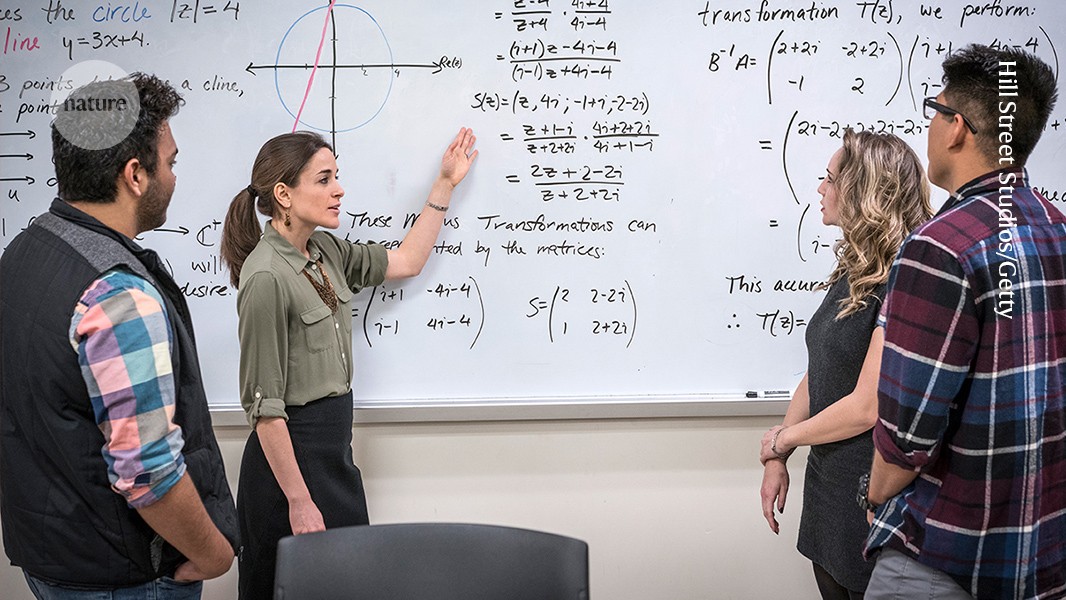
Credit: Hill Street Studios/Getty
OpenAI’s announcement that an artificial intelligence model solved a major problem in fluid mechanics—the Navier–Stokes problem—could change the way mathematics is done. The claim, made by the San Francisco-based AI company on September 8, also sparked controversy over whether the tool learned from human mathematicians who were independently using AI to work on the problem.
Researchers warn that the credibility of academic work could be at risk as AI models become widely used across research fields. It can be difficult to trace the origin of information used to train these systems or determine whether researchers’ interactions with AI contributed to a later result.
“It’s entirely possible that academic researchers don’t fully understand the implications of uploading data and knowledge to their personal AI model accounts,” said Luke McDonagh, an intellectual-property law researcher at the London School of Economics and Political Science.
In an open letter condemning AI companies’ entry into mathematical problem-solving, 25 recipients of the Fields Medal—the equivalent of the Nobel Prize in mathematics—wrote that AI tools are undermining researchers’ ability to give appropriate credit. “As in all creative professions, this raises serious questions about attribution and plagiarism,” they wrote.
Why OpenAI’s Navier–Stokes claim is controversial
The day before OpenAI confirmed rumors that it had solved one of mathematics’ most important open problems, a researcher had already raised concerns. Tristan Buckmaster, a mathematician at New York University in New York City, and his collaborator Levent Arposi, a mathematician at Harvard University in Cambridge, Massachusetts, had been using tools from OpenAI and Anthropic to investigate an aspect of the Navier–Stokes problem.
They were told that OpenAI was preparing to announce a solution. Buckmaster wrote on social media that the company may have pursued the problem after learning about his and Alpöge’s work. He also suggested that OpenAI’s models might have learned from interactions with ChatGPT.
An OpenAI spokesperson told Nature: “Based on our investigation, we can confidently say that no user input since July 3rd may have had any effect on this system.” The company said it began working on the problem on September 1st and “had not seen their work done by any means until publicly disclosed.”
Buckmaster said he had been using OpenAI tools to work on the problem for a year. He told Nature that he had three separate OpenAI ChatGPT accounts, and that only two had opted out of settings allowing the company to use chatbot conversations to train its models.
Even if OpenAI’s solution is independently verified, questions remain about how the mathematics community will allocate credit and who will qualify for the US$1 million prize offered by the Clay Mathematics Institute for solving one of the seven Millennium Prize problems selected at the turn of the century.
OpenAI says it used the programming language Lean to verify its proof. The Clay Mathematics Institute, which has its scientific headquarters in Oxford, UK, says it will consider the solution only after the results are published in a peer-reviewed publication and subjected to further scrutiny by the mathematical community.
Researchers studying the Navier–Stokes equations say that, in addition to Buckmaster and Arposi, much of the credit should also go to Diego Córdoba of the Institute of Mathematical Sciences in Madrid and Luis Martínez Zoroa of CUNEF University.
How AI could change credit in mathematical research
Andreas Thom, a mathematician at the Technical University of Dresden in Germany, says that assigning credit will become increasingly complicated in the age of AI. He believes that group-theory brainstorming sessions he held with OpenAI’s ChatGPT over the past year may have helped train the chatbot, because the concepts involved are widely used in mathematics and physics.
Thom said he was using a particular strategy to construct a type of group called non-Sophic, which many mathematicians had long thought impossible. In August, OpenAI published a preprint reporting the first example of such a group, using a strategy similar to Thom’s. In Thom’s view, it is unclear whether credit was properly given. OpenAI did not comment directly on the question.
Thom says the OpenAI paper accurately references earlier work by him and his collaborators. However, he did not opt out of model training until late June. That makes it impossible to know whether the company’s tools benefited from his work in addition to his published papers.
He says it is a problem if this type of brainstorming is used to train AI models without recognition. If a human mathematician wanted to enter the field of non-Sophic groups, Thom says, they would probably speak with experts and learn specialized techniques that had not been expressed in the literature. Those conversations would normally be acknowledged in a research paper.
“If a human was sitting in my office writing that paper, and they didn’t acknowledge our arguments and explanations, I’d be mad,” Thom says. It has not been established whether OpenAI’s model was actually influenced by his conversations.
OpenAI did not directly answer whether its model had done so in this case. The company’s spokesperson said users decide whether their conversations can help improve the model and emphasized that OpenAI will not use the data for that purpose if a user opts out.
Individual guidance from AI chatbots
Source: www.nature.com