


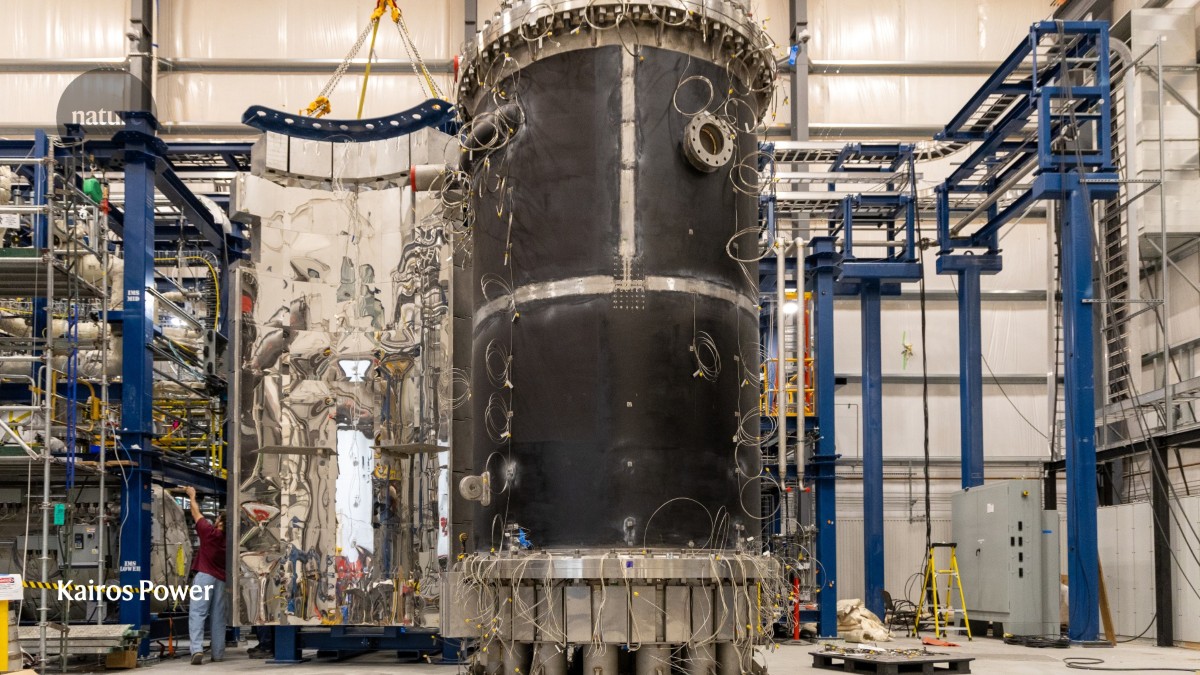
Companies are building test units for small modular reactors, which could provide reliable electricity to rural communities and remote locations.Credit: Kairos Power
Nuclear power has expanded slowly across the United States. The country’s first commercial nuclear reactor of the twenty-first century did not begin operating until 2016, when Unit 2 of the Watts Bar Nuclear Plant in Tennessee came online — two decades after Unit 1.
That long pause, along with a similar slowdown in Europe, could now be coming to an end. Two reactors near Baxley, Georgia, began operating in 2023 and 2024, while governments and private investors around the world are increasing funding for nuclear-energy developers. Some projects focus on conventional light-water reactors, which use ordinary water as a coolant and remain the only reactor type operating commercially in the United States. However, significant investment is also flowing into advanced small modular reactors (SMRs) that use alternative fuels and coolants — technologies that require new structural materials and manufacturing methods.
Nature Outlook: Nuclear power
Small modular reactors can generate up to 300 megawatts of electrical power (MWe), enough to supply roughly 300,000 homes. That is considerably less than the approximately 1,000 MWe produced by many conventional light-water reactors. Supporters say SMRs could be less expensive and easier to build because their components can be manufactured in factories. Conventional reactors are “very efficient, very good for the grid, but also very expensive to build”, says Jacopo Buongiorno, a nuclear engineer and director of the Center for Advanced Nuclear Energy Systems at the Massachusetts Institute of Technology in Cambridge.
The main advantage of SMR technology is its modular design. Rather than constructing an entire nuclear plant on site, manufacturers can produce major sections in a factory and transport them to the power station for assembly. Buongiorno compares the process with building with Lego: “I have my prefabricated bricks and I connect them to make my reactor.”
Government support for advanced nuclear power is also growing. In March 2025, the US Department of Energy (DoE) announced US$900 million in grants to help deploy small modular reactors. A year later, the European Commission said it would invest up to €200 million (US$228 million) in SMR construction.
Critics question whether small modular reactors will ultimately be more economical than large nuclear power plants. Edward Lyman, a physicist and director of nuclear-power safety at the Union of Concerned Scientists, a non-profit organization in Cambridge, Massachusetts, argues that SMR manufacturers might need to produce dozens of units before achieving meaningful cost advantages. He has also warned that some advanced reactor designs could introduce additional safety risks because they use unfamiliar fuels and coolants.
Despite those concerns, the prospect of faster construction, lower operating risks and rising demand for low-carbon electricity is attracting commercial interest. Demand is increasing particularly from data centres that support artificial-intelligence systems. Kairos Power, based in Alameda, California, is developing a test reactor called Hermes 1 in Oak Ridge, Tennessee. The company began constructing its 50-MWe demonstration plant, Hermes 2, in April and expects commercial operations to begin in 2030. Kairos also has an agreement to sell electricity to Google.
Developing safer nuclear fuel
Hermes 1 is the first non-light-water reactor approved by the US Nuclear Regulatory Commission (NRC) in more than 50 years. Conventional light-water reactors use water for cooling and generally rely on ceramic uranium-dioxide pellets enclosed in zirconium-alloy tubes known as fuel rods. Hermes 1 uses tristructural isotropic, or TRISO, fuel. These poppy-seed-sized uranium particles are enclosed in a carbon-ceramic coating and formed into fuel pebbles. Instead of water, the reactor uses FLiBe, a molten salt made from lithium fluoride and beryllium fluoride.
TRISO fuel is the oldest and most extensively studied example of what researchers call accident-tolerant fuel, says Nicholas Brown, a nuclear engineer at the University of Tennessee, Knoxville. Each uranium-dioxide kernel is approximately 350–600 micrometres in diameter. It is surrounded by porous carbon, which helps retain fission products that escape from the kernel. A denser carbon layer and an outer silicon-carbide coating provide additional protection, effectively creating a miniature containment vessel around every fuel particle.

TRISO nuclear fuel consists of uranium particles surrounded by protective carbon and ceramic layers.Credit: Kairos Power
Thousands of TRISO particles are packed into each golf-ball-sized graphite pebble. When the pebbles are placed inside the reactor, nuclear fission generates heat that transfers to the molten-salt coolant. Used fuel pebbles can move out of the reactor while fresh pebbles are added from above, allowing continuous refuelling without shutting down the plant.
FLiBe coolant offers another potential advantage. Water boils at 100 °C, so the water in a conventional light-water reactor must be held at pressures of roughly 150 atmospheres to remain liquid at operating temperatures of 250–325 °C. FLiBe boils at approximately 1,430 °C, far above Hermes 1’s operating temperature of about 650 °C. This allows the reactor to operate near atmospheric pressure, reducing the need for large, expensive pressure vessels. If a leak occurs, the coolant is not forced out at high pressure, reducing the risk of radioactive material being dispersed into the atmosphere. Molten-salt reactors can also operate at higher temperatures, which could improve thermal efficiency.
Are advanced reactors walk-away safe?
TRISO fuel is designed to withstand temperatures well above those expected during reactor operation. In one test, the fuel survived for more than 12 days at 1,800 °C — considerably hotter than temperatures expected in even a severe accident. This characteristic has led the nuclear industry to describe TRISO as “walk-away safe”. “You can throw the keys away, walk away and not worry about a progression towards a severe accident like a Fukushima or Chernobyl,” Brown says.
However, TRISO fuel requires high-assay low-enriched uranium (HALEU), which contains approximately 15–20% uranium-235. In January, the DoE awarded a total of $2.7 billion to three companies to develop domestic HALEU-enrichment capacity. Until that supply chain is established, Brown says, manufacturing TRISO fuel will remain slow and expensive.
Researchers are also developing alternative fuels for both conventional reactors and SMRs. Brown’s group is studying a 3D-printed molybdenum insert that could be placed at the centre of a uranium-dioxide pellet. Because molybdenum conducts heat efficiently, the insert could improve heat transfer from the fuel by an order of magnitude, lowering the risk of overheating and fuel melting.

A scientist handles liquid sodium, a coolant being developed for advanced nuclear reactors.Credit: TerraPower
TerraPower’s Natrium reactor uses a different fuel and coolant combination. The company is building the reactor in Kemmerer, Wyoming. With an electrical output of 345 MWe, Natrium is slightly larger than the conventional definition of an SMR, says Eric Williams, a mechanical engineer and TerraPower’s chief operating officer in Bellevue, Washington.
Natrium uses a uranium-zirconium alloy as fuel and liquid elemental sodium as its coolant. Sodium boils at nearly 900 °C, well above the reactor’s operating temperature of approximately 500 °C. Nuclear fission heats the sodium, which then transfers energy to molten sodium chloride. The molten salt stores thermal energy when electricity demand is low and later uses that heat to boil water and drive electricity-generating turbines when demand increases.
The fuel, cladding, sodium coolant and reactor vessel are all metallic, giving the system strong heat-conduction properties, Williams says. Even after a reactor shuts down, radioactive decay continues to produce heat — initially equivalent to about 7% of the reactor’s full-power output. Natrium’s metallic design helps manage this decay heat. “We can actually cool the outside of the vessel by just having air flow by natural circulation,” Williams says. Liquid sodium can burn if it comes into contact with air or water, but TerraPower says the design includes additional barriers and sensors to prevent such incidents.
The 2011 Fukushima Daiichi accident demonstrated the importance of reliable emergency cooling. After a tsunami damaged the plant, operators attempted to use seawater to cool the reactors. The earthquake had also disrupted the electrical grid and damaged much of the backup power infrastructure, making it impossible to cool the reactors sufficiently. Radioactive material was subsequently released into the environment. TerraPower says its air-cooled system could continue removing heat without requiring pumps, external water or grid power.
Liquid sodium may also help retain certain radioactive fission products. Caesium-137 and iodine-131 are among the most hazardous by-products because they can contaminate water and food supplies after a serious release. Sodium bonds with both elements, Williams says, helping keep them inside the reactor tank. “Even if the fuel were to all fail and all of the caesium and iodine generated gets into the sodium, it stays in the sodium,” he says.
Conventional light-water reactors are not necessarily more dangerous than advanced SMRs such as TerraPower’s, says Raluca Scarlat, a nuclear engineer at the University of California, Berkeley. Nuclear plants can combine active safety systems, such as electrically powered coolant pumps, with passive systems that use gravity to deliver water from elevated tanks or drain fuel from the reactor. Some SMR designs, however, incorporate more inherent safety features based on physics rather than active engineering systems. These include operation at atmospheric pressure and greater opportunities for passive cooling.
Those safety characteristics could allow some SMRs to operate with smaller emergency planning zones. Smaller reactors produce less radioactive material, while their designs could also reduce the likelihood of a release. In the United States, conventional light-water reactors have traditionally required a 16-kilometre emergency-planning radius, where people might need to evacuate or shelter immediately after an accident, and an 80-kilometre ingestion-planning zone, where radiation could contaminate soil and groundwater. In 2023, the NRC issued a rule allowing SMR planning zones to be determined on a case-by-case basis according to each reactor’s technology. Smaller zones could make it possible to build nuclear plants closer to communities and major electricity users, Williams says.
How molten-salt reactors could improve nuclear power
Molten salt can serve purposes beyond cooling and thermal energy storage. When a radioactive element such as uranium or thorium is dissolved in the salt, the liquid can act as both the reactor fuel and coolant. The term “molten-salt reactor” often refers to designs that use this liquid-fuel mixture.
TerraPower is focused on commercializing its Natrium technology, which is not a molten-salt reactor. However, the company has also worked on the Molten Chloride Reactor Experiment at the DoE’s Idaho National Laboratory in Idaho Falls. That experimental system uses a mixture of molten sodium chloride and uranium chloride.
Both chloride and fluoride salts are promising for liquid-fuel reactors, says radiochemist Patricia Paviet, who leads the DoE’s molten-salt-reactor research. “We love them because it’s a higher temperature, more efficiency,” Paviet says. “We love them because it’s low pressure, so accident scenarios with pressure will not happen.”

Salt crystals produced at Idaho National Laboratory in Idaho Falls for the Molten Chloride Reactor Experiment.Credit: Idaho National Laboratory
Like Kairos Power’s Hermes 1 pebble-bed reactor, a liquid-fuel molten-salt reactor could be refuelled while operating. Spent fuel could be removed continuously while new fuel is added. Molten-salt systems could also use actinides — radioactive elements created during nuclear fission — as additional fuel.
Molten-chloride reactors sustain the fission chain reaction with higher-energy neutrons. In conventional light-water reactors, water slows neutrons down and acts as a moderator. Because molten-chloride systems use faster neutrons, they could consume actinides that light-water reactors cannot use as fuel.
Molten-salt reactors could also reduce the volume and long-term burden of nuclear waste, Paviet says. Spent fuel from a light-water reactor contains approximately 95% uranium and 1% plutonium. France and Russia operate extensive nuclear-fuel recycling programmes, whereas the United States does not currently recycle its commercial nuclear waste, partly because disposal is less expensive. Paviet says liquid fuel may be easier to process than solid fuel, which must be manufactured, dismantled or reprocessed.
Operating molten salts at high temperatures creates engineering challenges, particularly corrosion. Scarlat says oxidation could be controlled if reactor systems are designed to exclude water and oxygen. Other chemical reactions can still degrade structural materials. Molten salts, for example, tend to dissolve chromium, the element that gives stainless steel its corrosion resistance. Reactor components may therefore need to contain no more than approximately 7% chromium, says Steven Zinkle, a nuclear engineer and materials scientist at the University of Tennessee, Knoxville.
Materials used in high-temperature advanced reactors must also withstand intense radiation. Radiation can displace atoms and create defects in a metal’s crystal structure. At high temperatures, those defects can move and form clusters, making the material more brittle. Of thousands of known alloys, only six are currently qualified for high-temperature reactor applications by the American Society of Mechanical Engineers, Zinkle says. None is qualified for the highest-temperature reactors that researchers hope to develop.
Zinkle is leading a DoE-funded project to develop additional reactor materials, including a magnetic steel and a vanadium-based alloy. Both are strengthened through precipitation hardening, in which repeated heating and cooling cycles create tiny particles within the material. These particles can block radiation-induced defects and improve resistance to damage. Other researchers are engineering the boundaries between grains in a material’s crystal structure so that they can capture and contain defects.
Developing new nuclear fuels, structural materials and reactor designs will take time, Brown says. However, he believes the investment will be worthwhile. Nuclear power is “really important for the future of the country and also for the future of the world. It’s very safe. It is really the next-generation energy source that is going to enable us to move beyond fossil fuels.”
Source: www.nature.com