


Seashells are more than beautiful beach souvenirs: They are intricate homes and protective fortresses built by clams, mussels, snails, and other marine mollusks.
Devon Matthews
A mollusk’s life is recorded in the architecture of its shell. These marine animals use calcium carbonate crystals to build protective coverings, adding new layers as their bodies grow. Bands, ridges, and changes in shell thickness can reveal seasonal shifts, diet, and stages of the animal’s life cycle.
The extraordinary variety of seashell shapes reflects more than 500 million years of mollusk evolution. Early mollusks had relatively simple cap-shaped or coiled shells. Today, the group includes fan-shaped scallops, ridged clams, spiny snails, spiral nautiluses, and thousands of other species. Learn more about mollusks and their remarkable adaptations.
Yet many people who find seashells on the beach rarely think about the animals that created them. “The average citizen would say, ‘Oh, I thought they were just there,’” says José H. Leal, science director and curator of the Bailey-Matthews National Shell Museum on Sanibel Island, Florida.
Shells are not simply shaped by waves, wind, and sand. Mollusks absorb calcium and carbon from seawater and combine those materials with proteins in a specialized body part called the mantle. Bivalves—including clams, oysters, mussels, and scallops—protect themselves between two hinged shells. Gastropods, such as snails and whelks, produce a single shell that typically curls into a spiral.
/https://tf-cmsv2-smithsonianmag-media.s3.amazonaws.com/filer_public/20/2e/202eeef8-e22a-48e7-a9cf-ed29dbdbff43/djm_3976.jpg)
Devon Matthews
/https://tf-cmsv2-smithsonianmag-media.s3.amazonaws.com/filer_public/ee/8e/ee8ec0dc-9a66-40a5-9d94-cb8060a8c275/djm_6780.jpg)
Devon Matthews
/https://tf-cmsv2-smithsonianmag-media.s3.amazonaws.com/filer_public/7e/2a/7e2ad50c-7b76-4217-be30-30546a179c6f/djm_4544.jpg)
Devon Matthews
How do mollusks produce such a wide range of shell colors and patterns? “That’s the $64,000 question,” Leal says. Color is embedded in the protein matrix that holds calcium carbonate crystals together. Researchers, including Suzanne Williams of London’s Natural History Museum, have studied pigments such as porphyrins, melanin, and carotenoids.
Specific genes control when these pigments are produced, creating spots, stripes, bands, and other shell patterns. In some species, the markings provide camouflage. In others, bold patterns may help members of the same species recognize one another. Scientists still have much to learn, however, especially because many mollusks have limited color vision.
By the time a seashell reaches the beach, it is usually empty. The mollusk may have died, shriveled inside the shell, or been removed by a seabird or another predator. Once the animal is gone, the shell is exposed to sunlight, salt water, waves, and abrasion. Its crystals gradually deteriorate, causing the shell to weather, fade, and lose some of its original luster. Tiny mollusks with translucent shells may leave behind coverings that become cloudy or opaque.
Fun fact: Seashells are living records of mollusk biology, evolution, and coastal ecosystems.
/https://tf-cmsv2-smithsonianmag-media.s3.amazonaws.com/filer_public/f7/90/f7904b26-7935-4d15-bb17-58d2659ae5c5/djm_3691.jpg)
Devon Matthews
/https://tf-cmsv2-smithsonianmag-media.s3.amazonaws.com/filer_public/5f/aa/5faab0ad-423b-48f0-8eae-786af49f1754/djm_3727.jpg)
Devon Matthews
/https://tf-cmsv2-smithsonianmag-media.s3.amazonaws.com/filer_public/d3/bd/d3bd3fb5-93c4-43c5-ac2a-5e00cd2e51e4/djm_3089.jpg)
Devon Matthews
/https://tf-cmsv2-smithsonianmag-media.s3.amazonaws.com/filer_public/b7/e5/b7e5f74e-e74f-4f52-b314-c23e61ff68e1/djm_8331.jpg)
Devon Matthews
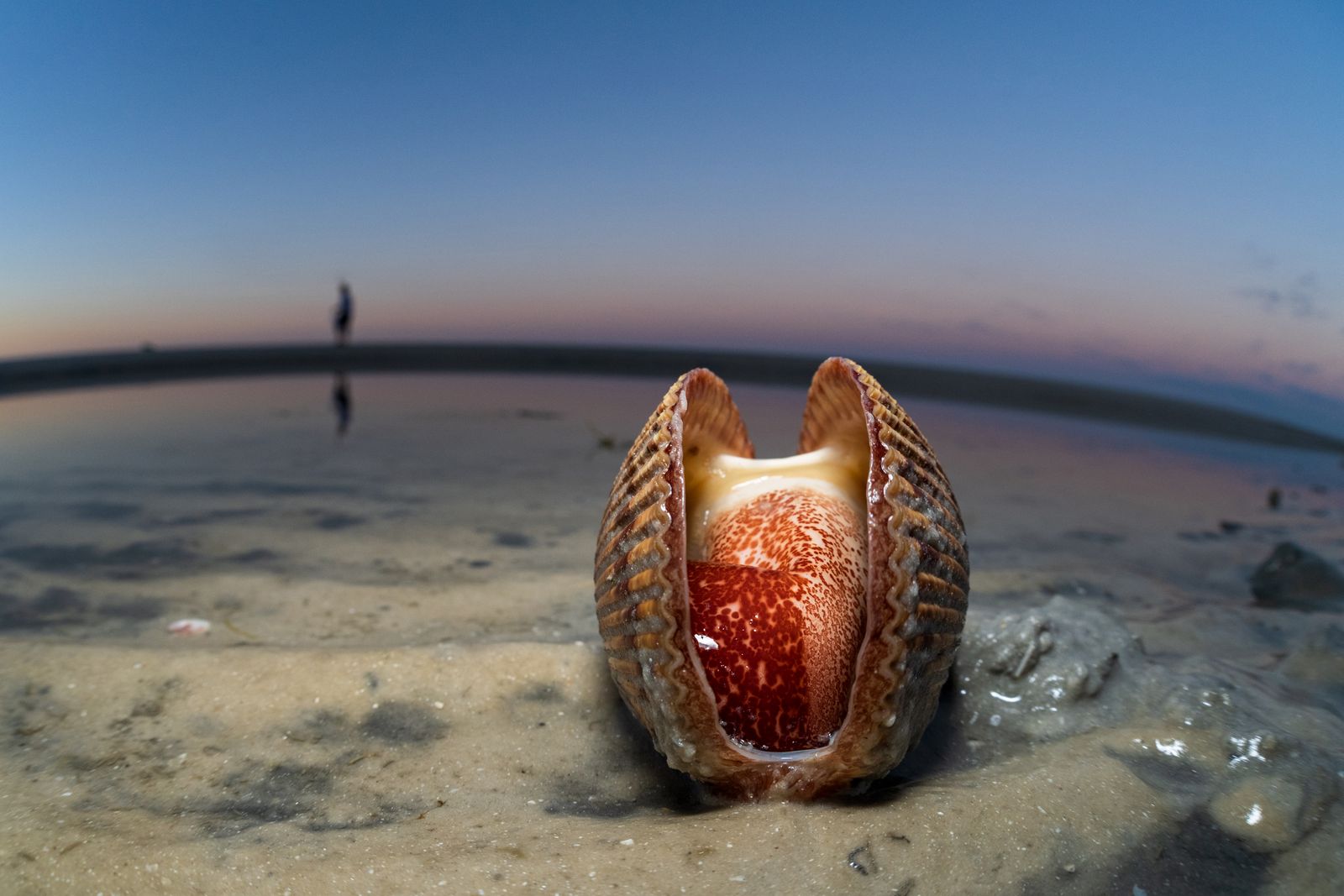
At low tide, beachgoers may occasionally see the living foot of a mollusk extending from a shell. These flexible muscles help different species crawl, burrow, swim, anchor themselves, or capture prey. Clams use their feet to dig into sand and secure themselves, while snails use their muscular feet to glide across rocks and sediment.
“Kids keep paying attention to those things,” says wildlife photographer Devon Matthews, who traveled from Minnesota to Sanibel Island to document the animals. “But sometimes it’s easy to just walk by without looking at things too closely.”
Matthews is an experienced macro photographer who usually photographs small insects up close. Using specialized camera attachments and natural light, he captured detailed images of mollusks as they emerged from their shells. “I think that by looking at their photos up close, we can rekindle that sense of wonder as adults,” he says.
/https://tf-cmsv2-smithsonianmag-media.s3.amazonaws.com/filer_public/23/31/2331d802-fcc8-470c-9705-87d80f562432/djm_3805.jpg)
Devon Matthews
/https://tf-cmsv2-smithsonianmag-media.s3.amazonaws.com/filer_public/12/2b/122bf76c-f433-4461-9a98-1c1b8652a9b9/djm_6859.jpg)
Devon Matthews
Leal remembers developing his own fascination with marine life while growing up in Rio de Janeiro. “In the late ’50s and early ’60s, that place was paradise,” he says. “There were a lot of creatures that we don’t see anymore because of human encroachment and water pollution.” Exploring the rocky shore and finding live crabs, worms, and mollusks, he says, was “mind-boggling.”
/https://tf-cmsv2-smithsonianmag-media.s3.amazonaws.com/filer_public/9e/f7/9ef7db8b-7988-45c8-aa50-a8b3e4fd03ea/dsc_0059.jpg)
Devon Matthews
/https://tf-cmsv2-smithsonianmag-media.s3.amazonaws.com/filer_public/26/2e/262e415c-a9c0-4bf9-af73-ed04f36f09df/djm_3298.jpg)
Devon Matthews
/https://tf-cmsv2-smithsonianmag-media.s3.amazonaws.com/filer_public/90/73/90731847-e983-4d9f-9f09-204837a1122f/djm_4037.jpg)
Devon Matthews
Leal spent two years as a postdoctoral fellow at the Smithsonian National Museum of Natural History in the 1990s, studying deep-sea mollusks. He later joined the Bailey-Matthews National Shell Museum on Sanibel Island, where much of his work focuses on educating the public about marine biodiversity and conservation.
Sanibel Island is famous for shell collecting because its unusual east-west orientation allows ocean currents to deposit shells from more than 400 species along approximately 25 miles of beaches. The island’s rich assortment of shells attracts visitors from around the world.
That abundance also highlights the importance of protecting the animals and habitats that produce these shells. As carbon dioxide from the atmosphere enters the ocean, seawater becomes more acidic. Ocean acidification can make it harder for mollusks to build and maintain strong calcium carbonate shells.
Leal encourages visitors not to take living mollusks home. Collecting live shells is illegal on Sanibel Island. The most sought-after shells include tulip snails, horse conchs, and lightning whelks. If a shell feels unusually heavy or a living foot, mantle, or animal is visible, beachcombers should leave it where they found it.
“If you think seashells are cool, you find out there’s a cool animal that made them,” Leal says.

Source: www.smithsonianmag.com