Total Solar Eclipse Over Greenland: A Spectacular View From Scoresby Sound
SCORESBY SOUND, Greenland — There is no better sight for a solar eclipse chaser than a clear blue sky just before totality. On Wednesday, August 12, 2026, after more than two years of planning, I stood aboard the Aurora Expeditions cruise ship Sylvia Earle in the remote Scoresby Sound fjord system of eastern Greenland. The ship was moving slowly toward Ukatipu Kungashva, also known as Hafjord, deep inside Ofjord.
I climbed to the observation deck and scanned the sky for clouds. There were none. “Are you kidding me?” I said to the Earth, smiling with disbelief. It had been 1,210 days since I had last seen the Sun’s corona during a total solar eclipse. For an avid eclipse chaser, that felt like an eternity.
My previous attempt, a 2024 total solar eclipse expedition in Texas, was clouded out. Since then, I had been waiting for another chance to witness the Moon completely cover the Sun.
The 117 eclipse chasers aboard the expedition were depending on several people to make the crucial decision about our location: the captain, the expedition team and expedition leader Greg Mortimer, a renowned Arctic adventurer and mountaineer. We took a calculated risk and positioned the ship at the meeting point of four fjord channels, where icebergs drift beneath mountains covered in ancient ice.
Our location was almost directly on the centerline of the August 12, 2026 total solar eclipse. Totality would last for 2 minutes and 16 seconds—just two seconds shorter than the longest possible duration anywhere along the eclipse path. We had asked Mother Nature for perfect conditions, but the only certainty was that the Moon’s shadow would eventually sweep across the landscape.
Jamie Carter
Jamie Carter is a freelance science journalist based in Cardiff, UK, and a regular contributor to Live Science. He is the author of Stargazing for Beginners and co-author of The Solar Eclipse Effect. His work appears in Space.com, Forbes, New Scientist, BBC Sky at Night and Sky & Telescope. He also edits WhenIsTheNextEclipse.com.
The day before the eclipse, we explored a towering wall of ice along the shores of Scoresby Sound. Sol Glacier lived up to its name, with thousands of tons of melting ice cascading toward the ocean. The sound was unforgettable, but I was hoping for an even more dramatic experience the following day: a total solar eclipse above the Greenlandic fjords.
The weather forecast showed a clear patch, or “blue hole,” near Greenland’s Blosseville Coast—the area we had sailed from after leaving Iceland. The question was whether the ship could reach it in time.
At sea, chasing a total solar eclipse creates additional challenges. Ocean swells can make a ship unstable, while sea fog and rapidly changing clouds can ruin an otherwise promising view. Our original target was a narrow off-fjord directly along the centerline, but forecasts had shown clouds there throughout the week. On eclipse day, however, the clearing trend improved slightly.
As the forecast updated, I headed to the bridge—the ship’s command center. The news was encouraging.
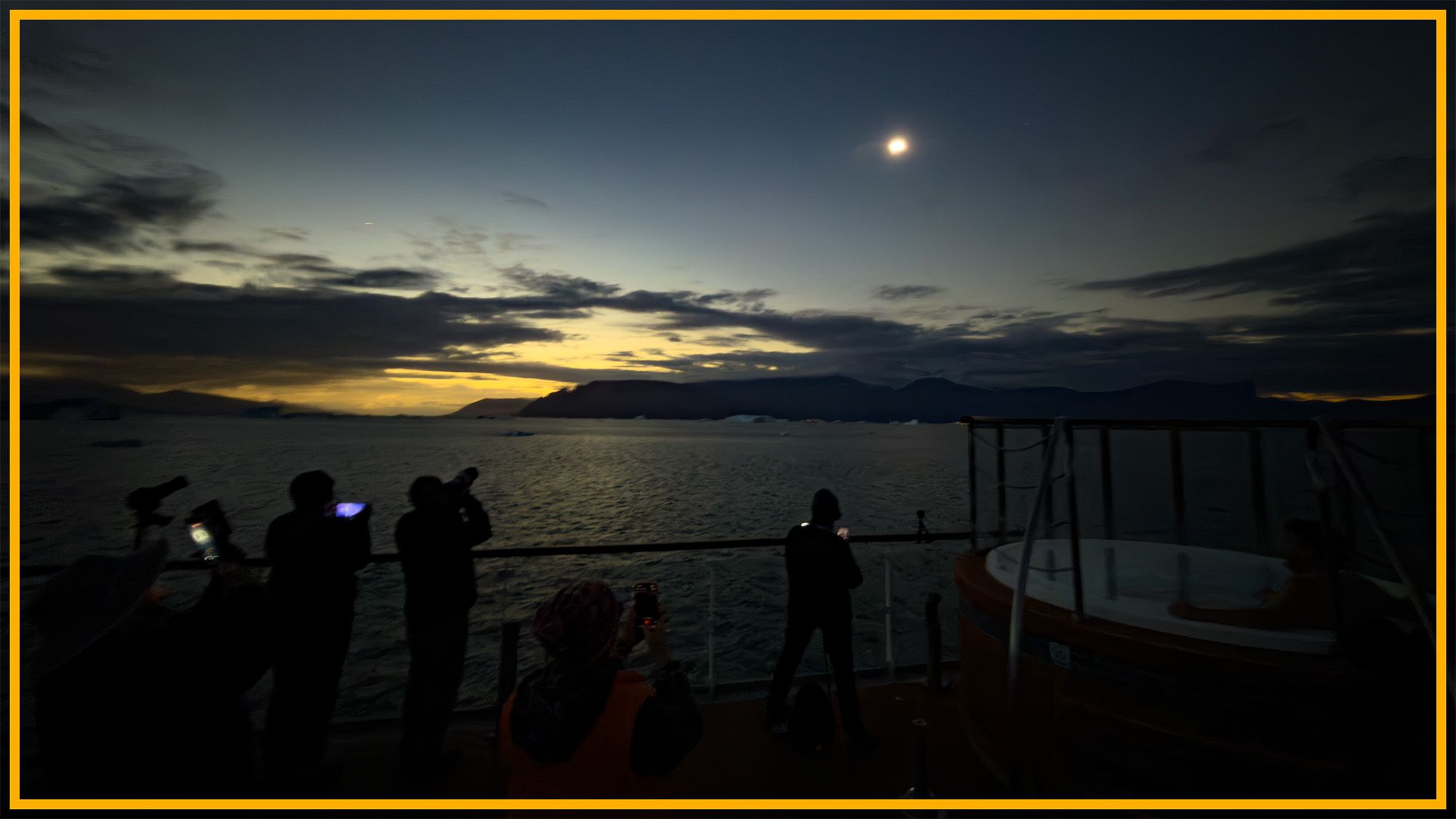
View from the Sylvia Earle at Ukatipu Kungashva, or Hafjord, in eastern Greenland during the August 12, 2026 total solar eclipse.
Image credit: Jamie Carter
“We’re seeing a trend of Ofjord clearing,” Mortimer said. His experience as both an expedition leader and mountaineer made him comfortable taking a calculated risk when conditions offered a chance of success.
Entering the Scoresby Sound channel was not without complications. Because of narwhal activity, the ship’s speed was limited to 3 knots—about 3.5 mph, or 5.6 km/h—and there was no easy way to turn around. We committed to the route.
We asked Mother Nature for everything, but there were no guarantees except for the dark shadow of the Moon that enveloped us and blocked out the light.
Jamie Carter
Repositioning aboard a cruise ship proved to be the right decision. We hugged the northern side of the fjord, which helped keep rising clouds from obscuring the Sun. Two other cruise ships joined us as the eclipse approached.
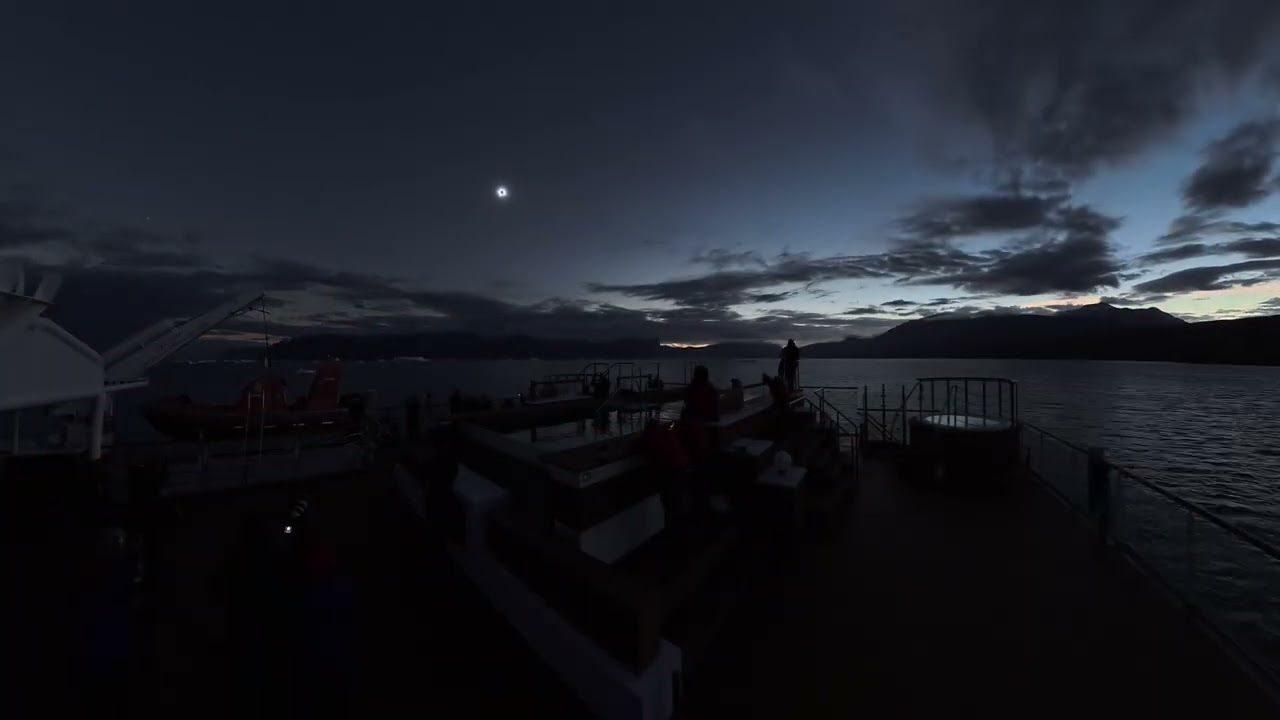
The temperature dropped rapidly. Three eclipse chasers watching from the ship’s outdoor hot tub suddenly seemed to have chosen the perfect vantage point.
Watch totality from the Sylvia Earle in eastern Greenland during the August 12, 2026 total solar eclipse
At exactly 5:33 p.m. on August 12, the Sun’s bright disk began disappearing behind the Moon’s silhouette above the reddish rocks of Lode Fjord. As the final sunlight faded, a diamond ring appeared around the Moon. Then bright reddish-pink prominences emerged along the edge of the lunar disk—loops of hot gas and magnetic fields extending from the Sun’s chromosphere.
It was one of the sharpest, clearest and most beautiful total solar eclipses I have ever seen. For 2 minutes and 16 seconds, all 117 guests watched the corona surround the black disk of the Moon. The Arctic landscape fell into an eerie twilight, creating a scene that felt both otherworldly and intensely real.
Every total solar eclipse is different, but the Greenland eclipse offered an important lesson for future eclipse expeditions: mobility can make the difference between success and disappointment. The next major opportunity comes on August 2, 2027, during an eclipse sometimes called the “Solar Eclipse of the Century.”
For that event, I will once again be near the centerline—this time aboard a river cruise ship in Egypt. Totality will last approximately 6 minutes and 20 seconds, with the eclipsed Sun positioned high overhead at midday. It may be hard on the neck, but the experience should be worth it.
The 2027 eclipse may also offer a rare chance to observe totality from a swimming pool on deck. Although Egypt will be scorching hot, temperatures can fall noticeably during the minutes when the Sun disappears. With a very low chance of cloud cover, there may be little need to move the ship at all.
Totality is more than something you see. It is an environment you briefly inhabit. In 2027, the darkened Nile River, busy with ships and traffic, will become the setting for one of the longest-lasting total solar eclipses visible from land or water for many decades.
This time, there should be far less risk—but the reward could be even greater.
Opinionon Live Science offers insight into the most important issues in science, written by experts and leading researchers.
How much do you know about the Sun? Test your knowledge with our Sun quiz!