


- RESEARCH BRIEFINGS
FNIP1 Gene Variants Linked to Lower Cardiometabolic Disease Risk
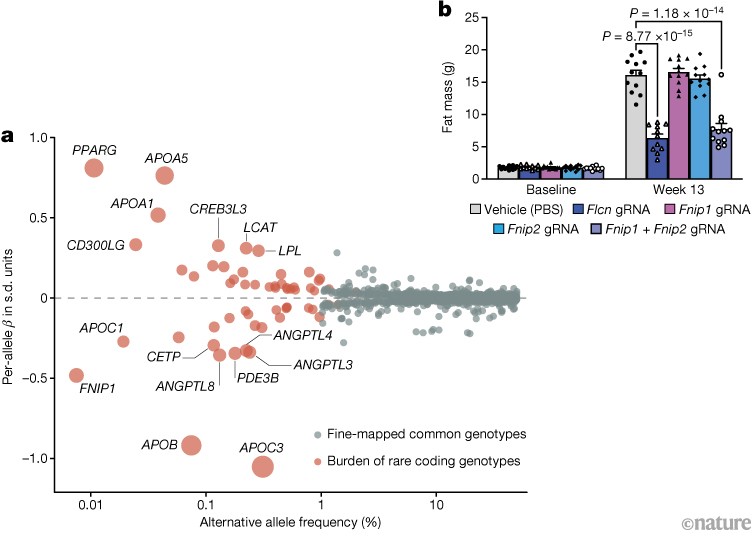
A large genetic study involving more than one million people has found that rare variants that disrupt the FNIP1 gene are associated with a healthier metabolic profile and an approximately 60% lower risk of cardiometabolic disease compared with the general population. Experiments in mice suggest that silencing genes in the FNIP1 pathway increases fat breakdown and may reproduce some of the metabolic benefits observed in humans.
Key findings on FNIP1 and metabolic health
Researchers analysed genetic and health data from more than one million individuals to investigate how rare FNIP1 gene variants affect metabolism and cardiometabolic disease risk.
Participants carrying rare variants that disrupt FNIP1 showed a favourable metabolic profile. Their risk of cardiometabolic disease was approximately 60% lower than that of the general population, although the findings show an association and do not establish that the variants directly prevent disease.
Mouse experiments reveal a possible biological mechanism
To explore how the FNIP1 pathway might influence metabolism, the researchers silenced genes involved in the pathway in mice. This intervention induced fat breakdown, a process known as lipolysis, and reproduced metabolic effects that were consistent with the human genetic findings.
The results identify the FNIP1 pathway as a potential target for future research into obesity, metabolic disorders and other cardiometabolic conditions. Further studies are needed to determine whether these findings could lead to new treatments or preventive strategies.
Why this genetic research matters
Cardiometabolic diseases, including cardiovascular disease and metabolic disorders, are major causes of illness worldwide. Identifying genetic pathways linked to improved metabolism could help researchers understand disease biology and develop more targeted approaches to treatment.
Because the study combined human genetic analysis with experiments in mice, it provides evidence about both the association between FNIP1 variants and health outcomes and a possible mechanism behind that association. However, the findings require additional validation before their clinical significance can be established.
Access options
Access Nature and 54 other Nature Portfolio journals
Get Nature+, the best-value online access subscription
27,99 € / 30 days
Cancel at any time
Subscribe to this journal
Receive 52 print issues and online access
196,21 € per year
Only 3,77 € per issue
Rent or buy this article
Prices vary by article type
from$1.95
to$39.95
Prices may be subject to local taxes, which are calculated during checkout.
doi: https://doi.org/10.1038/d41586-026-02391-x
“Expert opinion” is published under a CC BY 4.0 licence, and Figure 1 is published under a CC BY-NC-ND 4.0 licence.
References
-
Naghavi, M. et al. Lancet 403, 2100–2132 (2024).
-
Cohen, J. C., Boerwinkle, E., Mosley, T. H. Jr & Hobbs, H. H. N. Engl. J. Med. 354, 1264–1272 (2006).
-
Malik, N. et al. Science 380, eabj5559 (2023).
-
Saettini, F. et al. Blood 137, 493–499 (2021).
-
Sattler, E. C. & Steinlein, O. K. in GeneReviews (eds Adam, M. P. et al.) (University of Washington, 2024).
Related Articles
Subjects
Source: www.nature.com