


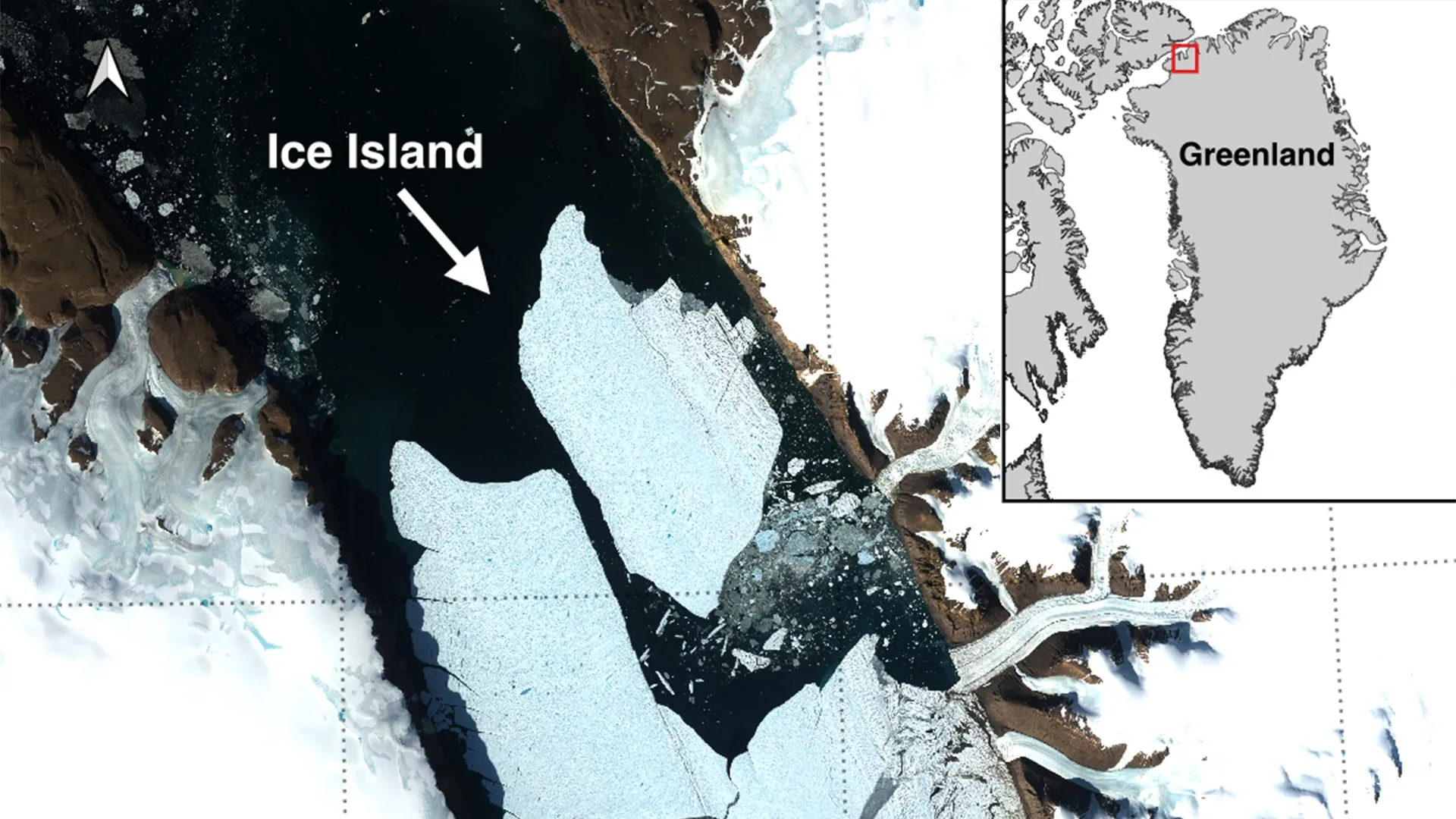
An international research team involving the University of Ottawa has documented a major calving event at Petermann Glacier in northwestern Greenland. On August 4, 2026, approximately 76.4 km2 of ice broke away from the glacier, creating new ice islands. It was the largest Arctic ice-calving event since 2020 and the most significant loss of Petermann Glacier ice since 2012.
The newly calved iceberg broke away from Petermann Glacier’s floating ice tongue and may be up to 150 meters thick. With a surface area roughly comparable to Manhattan, the massive ice island offers scientists a rare opportunity to study how large Arctic ice formations develop, drift through the ocean and eventually break apart.
The event was identified by Adam Garbo, a doctoral student in glaciology in the Department of Geography, Environment and Geology at the University of Ottawa. The discovery is part of an ongoing research collaboration involving the University of Ottawa, the University of Stirling, the Canadian School of Environment and Climate Change, Lancaster University and the University of Leeds.
Satellite monitoring reveals growing instability at Petermann Glacier
Scientists have monitored changes at Petermann Glacier since 2019 using long-term satellite observations. During this time, researchers tracked the condition of the glacier’s floating ice tongue, documented the widening of cracks and observed signs that a large section could eventually break away.
“Petermann Glacier has long been one of the largest remaining ice tongues in Greenland,” Garbo said. “We have been predicting this break for years, and it is amazing that it has finally happened.”
Images collected by the European Space Agency’s Sentinel-1 mission revealed significant deterioration along the centerline of the ice tongue on August 3. By 20:00 UTC on August 4, the newly formed ice island had completely separated from the eastern side of the glacier.
Rare Arctic ice islands provide insight into polar climate change
Although large, flat-topped icebergs are relatively common around Antarctica, comparable ice islands are rare in the Arctic. Their scarcity and ability to remain intact for many years make them especially valuable to scientists studying glacier retreat, changing ocean conditions and the long-term effects of Arctic climate change.
“While large slab icebergs are relatively common in the Southern Ocean surrounding the Antarctic ice sheet, ice islands in the Arctic are much rarer,” explained Dr. Anna Crawford of the University of Stirling. “Studying Arctic ice islands will provide knowledge that can be applied beyond the polar regions.”
Scientists do not expect the August calving event to be Petermann Glacier’s final major change. Two additional large sections of the floating ice tongue could break away in the near future as cracks that have formed over several years continue to spread through the ice.
The future ice islands are expected to measure approximately 94 km2 and 84 km2, respectively. If both sections separate, the three calving events together would remove approximately 254 km2 from Petermann Glacier’s ice tongue—equivalent to about 22% of its area.
Arctic ice islands could pose risks to shipping
Newly formed ice islands are important not only for scientific research but also for maritime safety. Massive pieces of floating ice can remain intact for years as they drift through Arctic waters before breaking into smaller, more difficult-to-track fragments.
Environment and Climate Change Canada is monitoring the movement of the ice islands, as it has done following previous Arctic ice-shelf calving events. Officials are also assessing potential risks to shipping routes, vessels and marine infrastructure.
“These are thick chunks of ice that can float around for years,” said Dr. Abigail Dalton of the Canadian Glacier Service and Environment and Climate Change Canada. “Over time, they break into smaller, harder-to-track pieces, posing a risk to vessels and resource operations.”
Garbo and his collaborators will continue monitoring the aftermath using satellite imagery, aerial observations and tracking data. Their research is part of a broader effort to understand the processes driving Arctic ice-shelf collapse, glacier retreat and the formation of large ice islands.
Source: www.sciencedaily.com