


Complex Modes in Lightly Damped Structures
Even when overall damping is low, complex mode shapes can appear in linear structures. This behavior occurs when two structural modes are close in frequency and coupled through non-proportional damping.
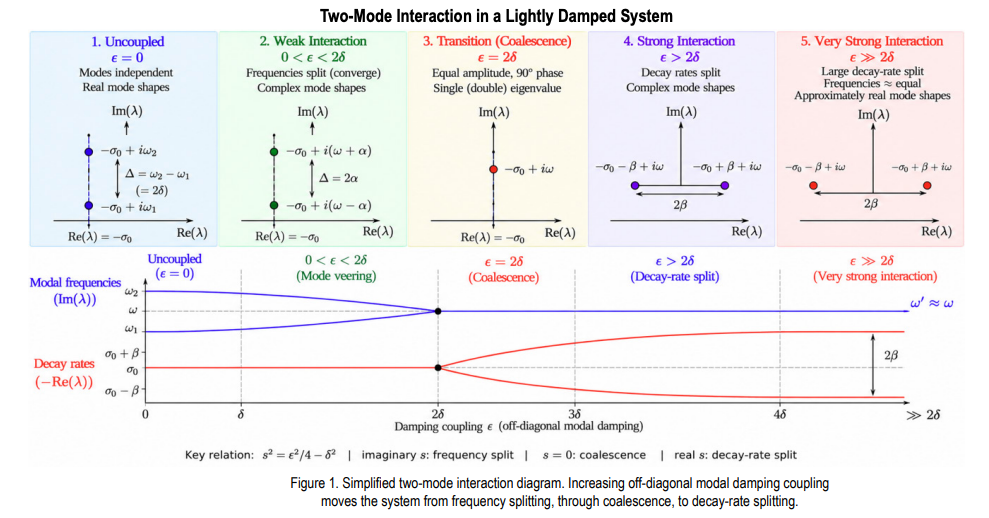
As the damping interaction increases, the two mode frequencies move closer together and the mode shape becomes increasingly complex. At the critical interaction level, the two frequencies coalesce. Beyond this point, the frequencies remain approximately equal, while the modal damping rates separate.
For very strong interactions, the mode shapes become almost real again, but in different combinations of the original unbonded modes. This framework provides a simple physical interpretation of mode deflection, complex mode formation, eigenvalue merging, and damping-rate splitting in lightly damped structural systems.
Why Complex Modes Appear at Low Damping
Classical modal analysis often treats lightly damped structures as approximately proportional systems with real mode shapes. When two modes are closely spaced, however, this interpretation can be misleading.
In modal coordinates, non-proportional damping introduces an off-diagonal coupling term, ε. Therefore, the key question is not simply whether the damping is small, but whether the coupling is large relative to the baseline half-frequency separation:
δ = (ω2 - ω1)/2
Perturbation Reduction Framework
For close mode pairs, the central eigenvalue is defined as:
λ0 ≈ -ζω + iω
The joint eigenvalues are then written as:
λ1,2 = λ0 ± s
Under optical attenuation and closed-mode asymptotic assumptions, the local fourth-order eigenvalue problem reduces to:
s2 = ε2/4 - δ2
As summarized in the figure, this relationship determines the direction of eigenvalue separation in the complex plane.
For more information, contact Joel W. Sills at Langley Research Center at [email protected].
Download PDF version
Source: www.nasa.gov