



8
The global robotaxi market is reaching a major commercial milestone. Powered by physical AI, the market is projected to reach $400 billion by 2035, with more than six million commercial autonomous vehicles expected to be in operation.
Operating a driverless vehicle is challenging. Scaling a safe, reliable robotaxi fleet across thousands of vehicles is an even greater computing challenge. Robotaxi developers need powerful infrastructure across the entire autonomous vehicle lifecycle, including AI model training, simulation, safety validation and real-time in-vehicle processing.
NVIDIA provides an open robotaxi technology stack that includes AI training, simulation, safety verification and in-vehicle computing. These platforms include software development kits, models, datasets and workflows that developers can integrate with their own technology stacks.
Leading robotaxi programs use one or more of these technologies to develop, validate and deploy autonomous vehicle fleets at commercial scale.
What Is the Robotaxi Technology Stack?
The robotaxi technology stack is an end-to-end system for developing and deploying autonomous vehicles. It connects data processing, AI model training, simulation, safety validation and real-time onboard computing.
NVIDIA’s autonomous vehicle platform organizes these capabilities into three core computing systems: a training computer, a simulation and validation computer, and an onboard vehicle computer.
1. AI Training Computer: NVIDIA DGX
Robotaxi intelligence improves as developers transform growing volumes of vehicle and sensor data into more capable AI models. NVIDIA DGX systems provide the accelerated computing infrastructure required to train autonomous driving models.
NVIDIA Alpamayo provides open Vision-Language-Action models, simulation frameworks and physical AI datasets for autonomous vehicle development. Its reasoning models are designed to help address complex, long-tail driving scenarios by analyzing situations, evaluating possible actions and selecting safer trajectories.
NVIDIA also offers physical AI datasets, reinforcement learning blueprints, and post-training and distillation recipes. These tools help developers optimize models for specific vehicles, sensors and operational environments.
2. Simulation and Validation: NVIDIA Omniverse and Cosmos
Physical road testing alone cannot capture every rare or dangerous driving scenario. Robotaxi developers use simulation to test long-tail situations involving unusual traffic behavior, weather, lighting, road conditions and sensor failures.
NVIDIA Omniverse NuRec reconstructs real-world driving environments from sensor data. NVIDIA Cosmos can then generate physics-based variations of those environments, turning real-world edge cases into thousands or millions of synthetic training and validation scenarios.
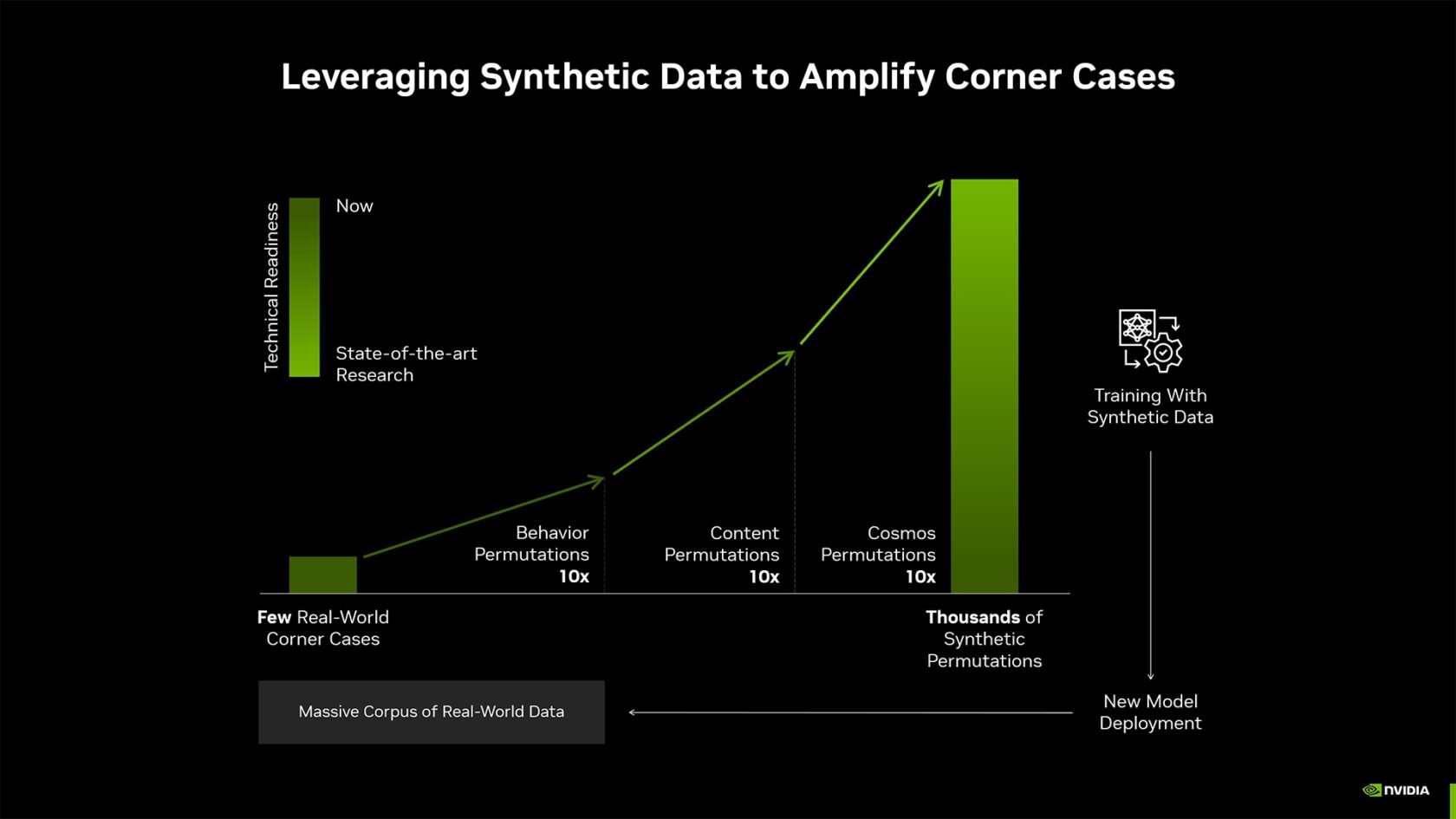
Running on NVIDIA RTX PRO Servers, NVIDIA Omniverse and Cosmos support closed-loop simulation and safety verification. The NVIDIA AlpaSim framework helps developers train and evaluate inference-based autonomous driving models while identifying weaknesses before deployment.
3. Vehicle Computer and Sensor Architecture: NVIDIA DRIVE Hyperion
NVIDIA DRIVE Hyperion is a modular reference architecture for Level 4-enabled robotaxis. It combines redundant computing, advanced sensors and software designed for real-time autonomous driving.
DRIVE Hyperion 10 pairs dual NVIDIA DRIVE AGX Thor systems-on-chip with a sensor configuration that includes 14 high-resolution cameras, nine radars, three lidars and 12 ultrasonic sensors. This architecture supports 360-degree sensor fusion and redundant operation if a critical computing or sensing component fails.
NVIDIA DRIVE AGX Thor is designed to run demanding AI workloads, including perception, sensor fusion, path planning and driving-action models.
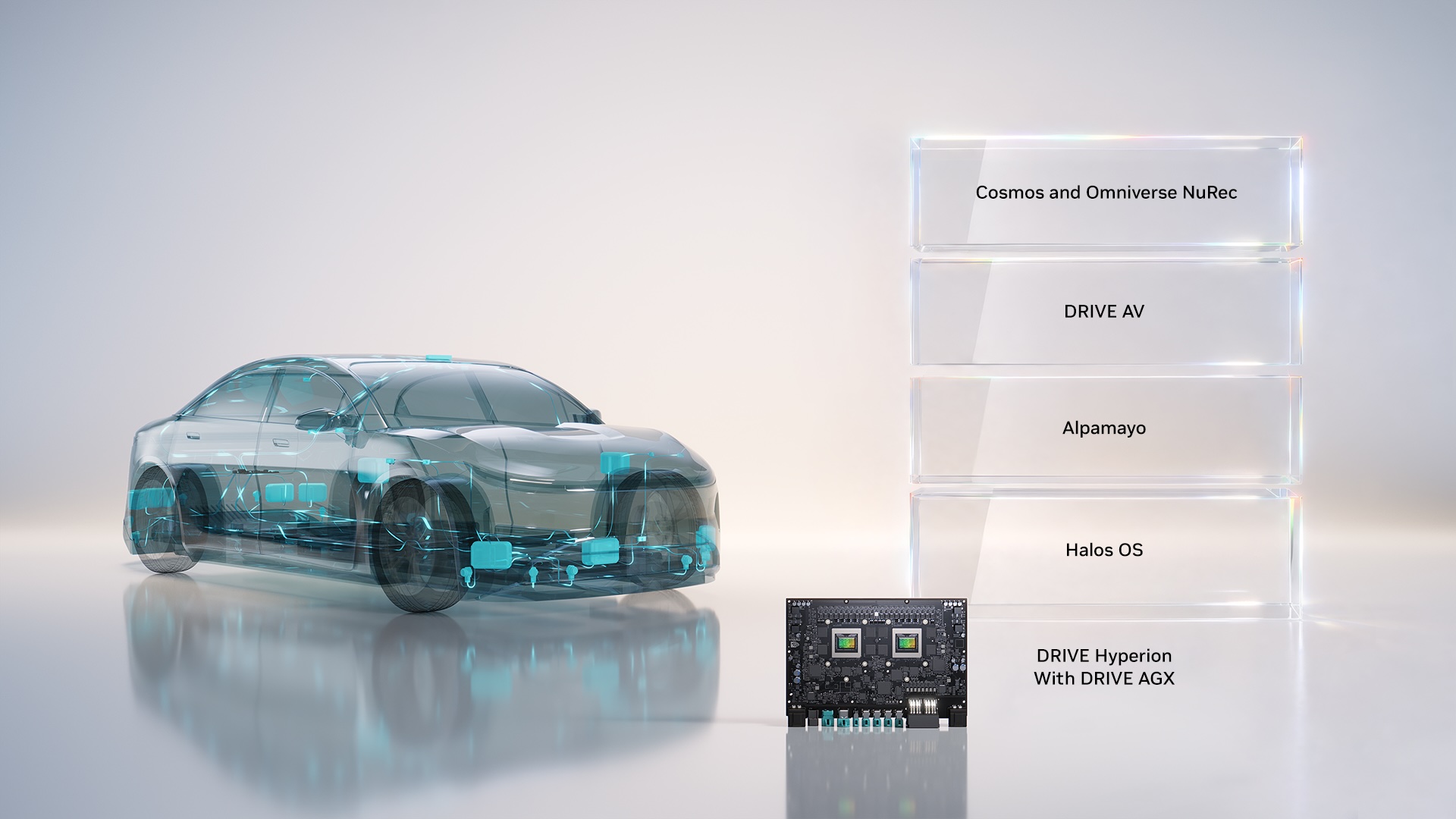
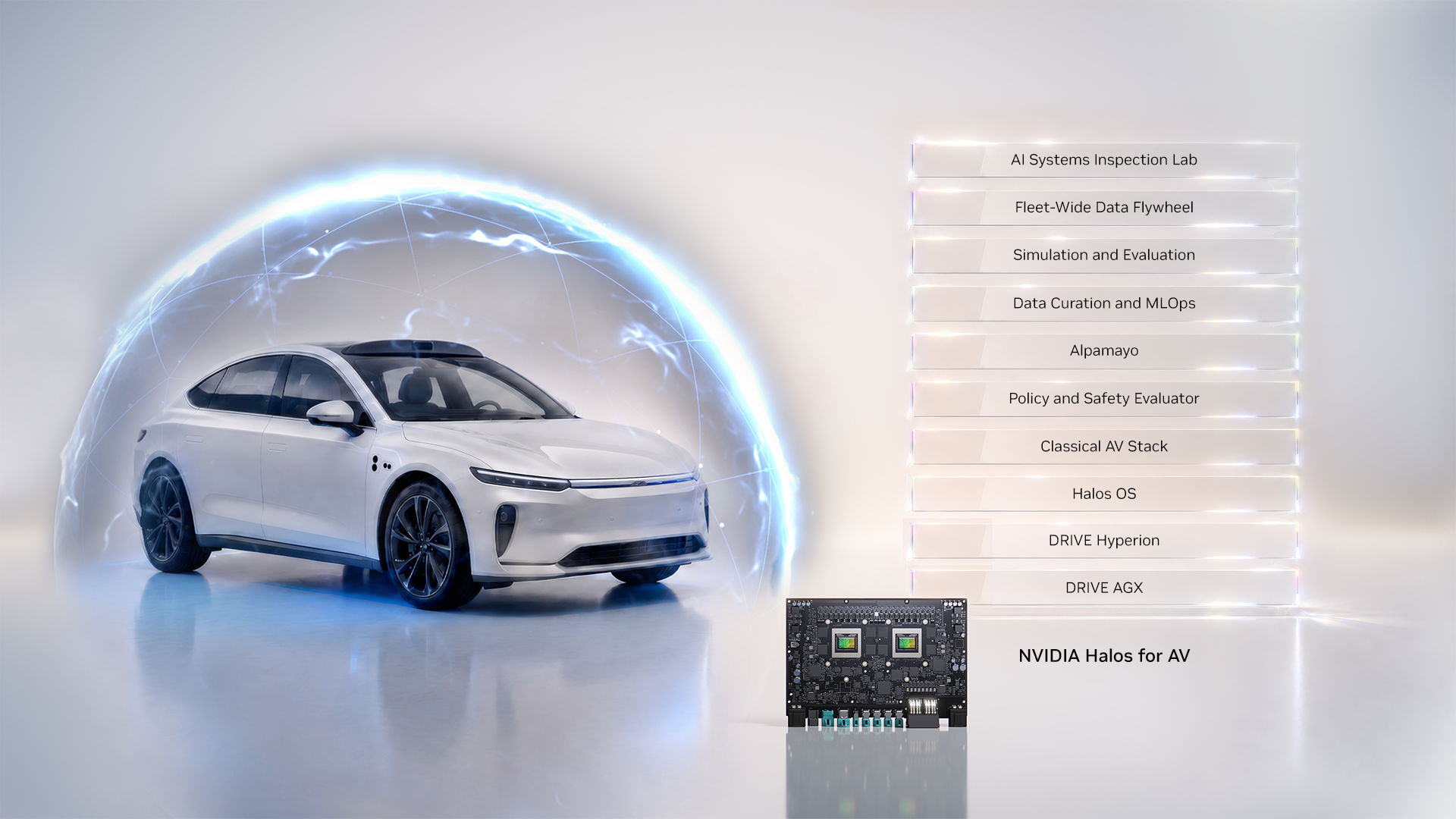
NVIDIA Halos provides a security and safety foundation for autonomous vehicles. The framework supports independent testing, system validation, large-scale simulation and continuous testing from cloud infrastructure to the vehicle.
Robotaxi Companies Adopting NVIDIA Technology
NVIDIA’s robotaxi ecosystem spans Asia, Europe, the Middle East and North America. Mobility providers, autonomous vehicle developers and automakers are using NVIDIA accelerated computing, simulation and in-vehicle platforms to build and deploy autonomous fleets.
Global Robotaxi Service Expansion
- Uber plans to expand NVIDIA DRIVE Hyperion-powered robotaxis across 28 cities by 2028 and is working with NVIDIA on a robotaxi AI data factory using NVIDIA Cosmos.
- May Mobility plans to operate autonomous ride-hailing services through Uber’s network while developing its software stack on NVIDIA DRIVE.
- Bolt is developing autonomous vehicle services using NVIDIA technology for European markets.
- Lyft plans to use NVIDIA DRIVE Hyperion as a reference architecture for future autonomous fleets.
- WeRide plans to launch DRIVE Hyperion and DRIVE AGX Thor-based robotaxis in selected Southeast Asian markets.
- Waymo is partnering with NVIDIA to support the development of autonomous computing systems.
Developing Robotaxi Intelligence
Behind each autonomous mobility service, developers use accelerated computing, simulation and vehicle platforms to build the AI systems that power robotaxis.
- Wayve and Nissan are developing a global robotaxi program using Nissan vehicle engineering, Wayve’s AI technology and NVIDIA DRIVE Hyperion.
- Autobrains is developing robotaxi programs in partnership with Uber and VinFast using NVIDIA DRIVE Hyperion and agentic AI technology.
- Zoox uses NVIDIA DRIVE for in-vehicle computing as well as cloud-based training and simulation.
- Momenta is developing an autonomous driving software stack based on NVIDIA DRIVE AGX and DriveOS.
- Pony.ai is developing autonomous driving domain controllers using NVIDIA DRIVE Hyperion and DRIVE AGX Thor.
- Tensor is developing a Level 4 autonomous vehicle featuring multiple NVIDIA DRIVE AGX Thor systems-on-chip.
- Waabi is expanding into the robotaxi market with a driver platform built on NVIDIA DRIVE AGX Thor.
- Tier IV and Isuzu are introducing Level 4 autonomous buses built on NVIDIA DRIVE Hyperion and DRIVE AGX Thor.
- Lenovo is delivering DRIVE AGX Thor-based Level 4 domain controllers for next-generation robotaxi programs.
- DeepRoute.ai is developing robotaxis based on NVIDIA DRIVE Hyperion and DRIVE AGX Thor.
Deploying Robotaxis in Production
As autonomous driving systems move from research to commercial deployment, automakers and mobility companies are integrating NVIDIA technology into production vehicle programs.
- Tesla trains self-driving neural networks on NVIDIA supercomputing infrastructure.
- Mercedes-Benz is developing a new S-Class-based robotaxi ecosystem using NVIDIA DRIVE Hyperion, NVIDIA DRIVE AV software and NVIDIA Alpamayo models.
- Stellantis, Wayve and Uber are collaborating on Level 4 autonomous mobility services using NVIDIA DRIVE Hyperion and accelerated AI computing.
- Lucid, Nuro and Uber are developing a global robotaxi service using NVIDIA DRIVE AGX Thor.
- Hyundai Motor and Kia are expanding their collaboration with NVIDIA to develop data-driven autonomous driving systems based on NVIDIA DRIVE Hyperion.
- Geely plans to work with ecosystem partners to develop and commercialize robotaxis using DRIVE Hyperion.
- ZEEKR, a Geely brand, has adopted DRIVE AGX Thor as its centralized vehicle domain controller.
The Future of Robotaxi Development
From cloud-based AI training to high-fidelity simulation and real-time vehicle computing, every layer of the robotaxi technology stack requires advanced accelerated computing. NVIDIA’s integrated platform helps developers move from data collection and model development to safety validation and commercial fleet deployment.
Explore the complete NVIDIA robotaxi development platform.
Source: blogs.nvidia.com