


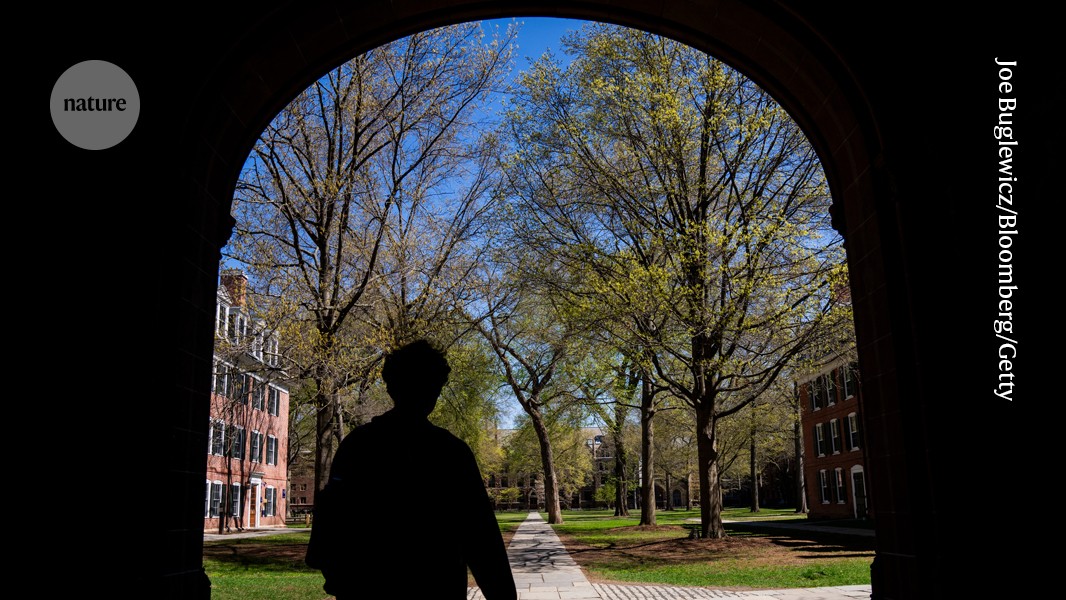
Yale University in New Haven, Connecticut, is under federal investigation over its hiring of J-1 visa holders.
Credit: Joe Buglewicz/Bloomberg/Getty
US Investigates J-1 Visa Hiring at Nine Universities, Raising Alarm Among Researchers
A US investigation into the employment of foreign researchers at nine universities is raising concerns among academics and international scientists on campus.
The investigation focuses on the use of the J-1 visa, the main visa used by overseas postdoctoral researchers. Vice President J.D. Vance said the purpose of the investigation is to reduce “visa fraud.”
“They are overusing these visas,” Vance said when announcing the study on October 8. “They are using them to lower the wages of American graduate students and American researchers, and that has to stop.”
Critics say the study’s rationale is flawed. They argue that foreign postdoctoral researchers play a key role in US laboratories and that the announcement has deepened concerns among international scientists.
US proposes to pay international students $100,000 to get a job after graduation
“For people who aren’t US citizens, that’s pretty distressing. It makes people really anxious,” says Theresa Desrochers, a neuroscientist at Brown University in Providence, Rhode Island. Her laboratory has hosted many postdoctoral researchers with visas over the years.
“It just adds to the whole atmosphere of ‘you don’t belong here,’” Desrochers says.
The US Department of Labor said it does not comment on active investigations.
The nine universities surveyed are Harvard University, Stanford University, Arizona State University, Yale University, Brown University, the Massachusetts Institute of Technology, the California Institute of Technology, the University of California, Davis, and the University of Pittsburgh.
All the universities except Harvard University in Cambridge, Massachusetts, responded to requests for comment before Nature’s deadline. Many said they had already received subpoenas for information and stressed that they were complying with all visa rules and regulations.
“Brown University’s international scholars, students, and employees make essential contributions on our campus, including teaching and research that advance America’s innovation, competitiveness, and economic vitality,” said Brian Clark, vice president of strategic campus communications at Brown University.
What are J-1 and H-1B visas?
J-1 visas allow people from outside the United States to study or work in an educational or cultural exchange for a limited period before returning to their home country.
Another visa used by postdoctoral researchers and faculty members from abroad is the H-1B. This visa allows employers to hire people in specialized fields, including academia, when jobs cannot be filled by the US workforce.
Foreign researchers make up a large share of postdocs
The nine universities said that about 61% of postdoctoral fellows and researchers supported by federal grants are “foreign nationals,” compared with 38% at other universities. “There’s something strange going on at these universities,” Vance said. The ministry did not respond to questions about the source of these numbers.
The US Department of Labor’s Office of Inspector General press release about the investigation provides further information.
Nobel Prize-winning chemist leaves US to lead China’s AI materials research institute
According to the National Science Foundation, of the approximately 70,000 postdoctoral researchers in science, engineering and health sciences hired by US universities in 2024, 58% had temporary visas. The National Postdoctoral Association also says its data shows that the average across all fields is about 60%.
Stanford University in California reports that 66% of its postdoctoral researchers are foreign nationals. The University of Pittsburgh in Pennsylvania reported 58%, while MIT in Cambridge reported between 65% and 70%.
“A university’s proportion of foreign researchers compared with the national average does not prove that someone was underpaid or that the visa programme was abused,” says Veena Duvall, general counsel for the American Association of University Professors, a union and membership organization for academic professionals in Washington, DC.
Sheldon Evans, a legal scholar at Washington University in St. Louis, Missouri, said that although these nine universities recruit proportionately more international students than other universities, they still have the potential to attract large numbers of international students.
Following the money
Source: www.nature.com