


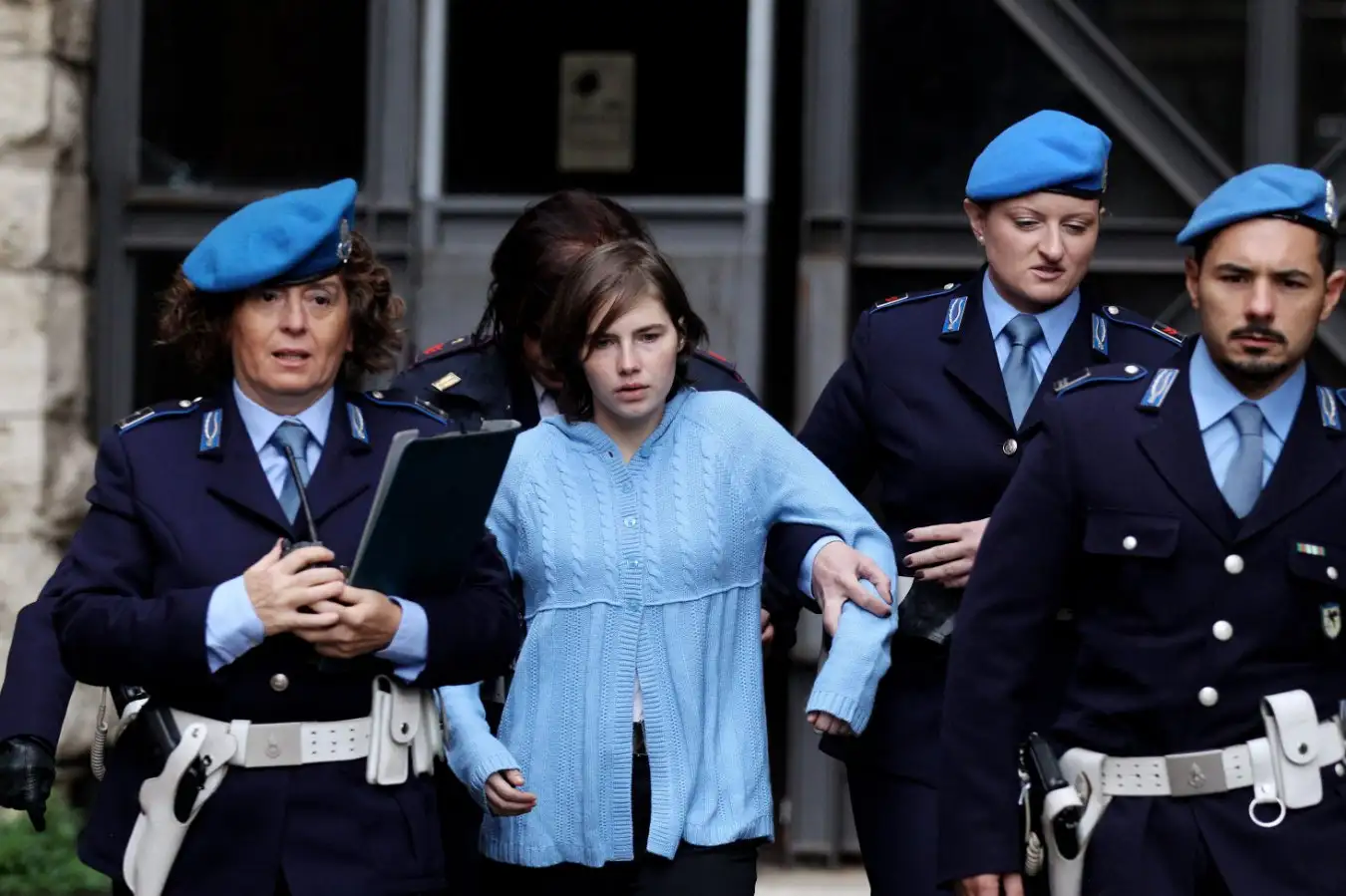

DNA evidence led to Amanda Knox’s conviction and eventual release.
Oli Scarff/Getty Images
The Secret of Our DNA
Turi King
Doubleday, UK. Transworld Digital, USA
In 1993, a 62-year-old woman was found strangled in Idar-Oberstein, Germany, with DNA evidence suggesting two other individuals were involved in the crime, one of whom was female.
Fast forward to 2001, DNA linked a suspected female perpetrator to the murder of a 61-year-old man in Freiburg, Germany. Her DNA later surfaced in crimes across France and Austria.
In 2007, a woman known as the “Phantom of Heilbronn” became notorious after two police officers were shot in a vehicle, leading to a massive manhunt. Despite being implicated in 41 crimes via her DNA, the mysterious phantom’s identity remained elusive until 2009. It was discovered that the DNA belonged to a factory worker producing DNA testing swabs, highlighting a significant flaw in evidence handling and interpretation.
“There are instances where DNA is not the definitive evidence many perceive it to be,” remarks Turi King in The Secret of Our DNA: How Genetics Has Changed the World.
Dr. King, originally an archaeologist, transitioned to genetics after learning how DNA could reveal historical mysteries, including the identification of Nazi doctor Josef Mengele.
“You almost certainly carry the DNA of loved ones or colleagues with you,” states a striking pull quote from Dr. King.
“
You almost certainly carry the DNA of a loved one or work colleague with you.
“
Dr. King continues: “My fascination with DNA lies in the myriad stories it can unravel, from exonerating innocents to tracing family histories, and even unveiling hidden identities.”

Dr. King’s book narrates captivating tales, including the discovery of King Richard III’s remains under a parking lot in Leicester, England. Through DNA analysis, the skeleton’s identity was confirmed, bringing historical intrigue back to life.
“DNA is everywhere; we constantly shed it, sometimes in the most unexpected locations,” Dr. King states, emphasizing caution in assuming guilt based on DNA evidence alone, as illustrated by the Heilbronn case.
Consider Amanda Knox, convicted of her roommate Meredith Kercher’s murder in Italy in 2007 based on questionable DNA evidence linked to Rudy Guede. Knox and Raffaele Sollecito faced significant scrutiny over DNA found on evidence that could have been contaminated during the investigation.
After spending nearly four years in prison, Knox and Sollecito had their convictions overturned, echoing Dr. King’s assertion that while modern DNA analysis is extraordinarily precise, it is not infallible.
Dr. King’s narrative traverses the fine line between the power and limitations of DNA testing, shedding light on how misinterpretations can lead to profound consequences.
Another notable case involves U.S. Senator Elizabeth Warren, whose claim of Native American ancestry was verified through DNA, reminding us that genetics can sometimes yield unexpected revelations.

The remains identified through DNA analysis belong to King Richard III of England.
Ben Stansall/AFP via Getty Images
Dr. King reminds us that it’s entirely possible for a person to belong to a certain ancestry without having the corresponding DNA due to random inheritance patterns across generations.
Additionally, Dr. King led the analysis of Adolf Hitler’s genome in a 2025 documentary, emphasizing that genetic determinism is a misleading concept. “DNA does not dictate life’s choices,” he asserts, further clarifying that Hitler did not act in isolation.
If you’re contemplating whether to read this book, note that while much of it is deeply scientific, King’s vivid storytelling and the wealth of intriguing cases will keep you engaged.
Many lesser-known stories, like the Phantom of Heilbronn incident, offer an engaging perspective, making it a worthwhile read.
Three More Perspectives on Genetics

PictureLux/Hollywood Archive/Alamy
Gattaca
Directed by: Andrew Niccol
This 1997 dystopian film explores the societal implications of genetic determinism, maintaining relevance in today’s genetic landscape.

BBC Worldwide / Album
Orphan Black
Created by: Graham Manson and John Fawcett
Explore the concept of genetic identity through the lens of clones in the captivating series Orphan Black, featuring Tatiana Maslany.

Beyond Inheritance
Written by: Roxanne Khamsi
Challenge the perception of the genome as static. This book reveals the vast number of mutations occurring daily in our bodies, reminding us that we are all, in fact, mutants.
Topics:
Source: www.newscientist.com