


Close Menu
HitechubHitechub
    What's Hot
    Science

    Discover Early Paleocene Fish Fossils: Bridging the 10 Million-Year Gap Post-Dinosaur Extinction

    Science

    New Hyaenodont Species Discovered by Paleontologists in Pakistan

    Technology

    How Cell Phones and Screens Disrupt Your Child’s Sleep: Tips for Better Rest

    Important Pages:
    • About Us
    • Privacy Policy
    • Terms & Conditions
    Facebook X (Twitter) Instagram Pinterest
    Facebook X (Twitter) Instagram
    HitechubHitechub
    Tuesday, June 9
    • Technology
      1. AI
      2. Gadgets
      3. View All

      This is the most popular CEO in the world

      Sectors in which “Chat-GPT” is most often used

      AI Pioneer Expresses Concern About Potential for AI to Surpass Humanity

      Artificial intelligence has begun to “swallow” professions

      What’s new in Android 14

      Europeans have about 700 million old mobile phones in their drawers

      Here’s how you can tell if your phone is being tapped

      “Sneaker X” – computer case in the shape of a sneaker

      Russian Gamers Unite to Prevent Nuclear War: Join the Fight Online

      Challenges of Space Travel: Why Journeying to Space is So Difficult

      NASA Astronaut Casts Historic Vote from Space

      Discover the Future of Comfort: What If You Could Wear a Chair?

    • Science
      1. Space
      2. Wheels
      3. View All

      Galaxies in the universe are growing more slowly than they should

      “Espace” presented the new lander “Apex 1.0”

      The largest asteroid sample ever collected has arrived on Earth

      (VIDEO) Incredible flight of the Parker Solar Probe

      Toyota wants to make a new generation battery with a range of up to 1,200 km

      Meet Toyota’s lunar “baby” that could make exploring the Moon easier

      Microlino – Is this the perfect city car?

      Alfa Romeo 4C gets an electric successor

      Why Britain’s Mild Heatwave Feels Hotter Than America’s Most Severe Heatwave

      Rising Frequency and Intensity of Severe Turbulence: What’s Behind the Unpredictable Sky Conditions?

      Achure’s Expert Toolmakers: Selecting Stones with Unmatched Precision

      New Bird Species Discovered by Ornithologist on Remote Indonesian Island

    HitechubHitechub
    Home » Astronomers Discover Clearest Evidence of an Exoplanet’s Magnetic Field Yet
    Science

    Astronomers Discover Clearest Evidence of an Exoplanet’s Magnetic Field Yet

    Share Facebook Twitter Pinterest WhatsApp
    Share
    Facebook Twitter LinkedIn Pinterest WhatsApp

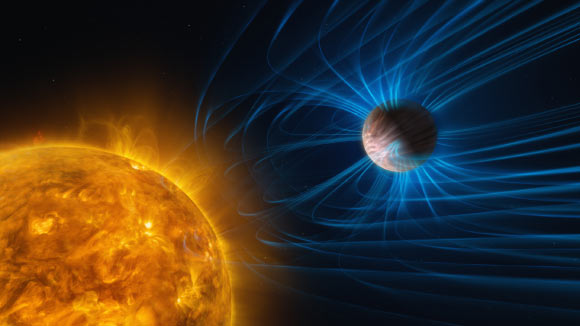
    Astronomers have unveiled groundbreaking evidence that magnetic fields influence the weather on exoplanets, particularly by examining the violent winds in the atmospheres of seven superhot Jupiters.


    Illustration of the magnetic activity of a superhot Jupiter. Credit: ESO / M. Kornmesser / L. Calçada.

    The Earth’s magnetic field plays a crucial role in the atmosphere, influencing conditions that support life. Similarly, magnetic fields are present on other planets in our solar system, including Jupiter and Saturn.

    However, for the past 15 years, researchers have struggled to directly measure the strength of an exoplanet’s magnetic field.

    “This landmark discovery opens new avenues in exoplanet research,” stated Dr. Julia Seidel, an astronomer at the Lagrangian Laboratory at the Côte d’Azur Observatory.

    “It marks the first occasion we can compare magnetic environments of different worlds, a vital step toward understanding which planets can sustain water and potentially harbor life.”

    The researchers analyzed wind speeds from seven tidally locked superhot Jupiters orbiting various stars.

    Wind speeds ranged from around 7,200 km/h to over 25,000 km/h, in stark contrast to Jupiter’s fastest winds, which reach approximately 1,500 km/h.

    Utilizing data from the ESPRESSO instrument on the ESO’s Very Large Telescope and a similar device on the Gemini North telescope, they uncovered an intriguing pattern: hotter planets exhibited slower wind speeds.

    “This is counterintuitive; generally, higher temperatures should accelerate winds,” explained Professor Vivienne Parmentier from the Lagrangian Laboratory.

    “Something must be inhibiting the wind speeds of these hotter bodies.”

    Scientists suggest that the most plausible explanation is the presence of a planet-wide magnetic field that acts as a brake, limiting the motion of charged particles within the atmosphere.

    From their findings, the authors were able to estimate the magnetic field strength of each planet studied.

    Their intensity was found to be similar to those in our solar system, approximately four times stronger than Saturn’s field and about half that of Jupiter’s.

    Such potent magnetic fields can impact more than just winds on distant exoplanets.

    “Here on Earth, we enjoy the stunning displays of the Northern and Southern Lights, where solar particles collide with our magnetic fields,” noted ESO astronomer Dr. Viviana Prinos.

    “Auroras driven by magnetic forces on these exoplanets could be even more spectacular.”

    For more details, view the full study published in Nature Astronomy.

    _____

    JV Seidel et al. The magnetic field strength of a hot giant exoplanet matches that of our solar system. Nat Astron published online June 2, 2026. doi: 10.1038/s41550-026-02870-1

    Source: www.sci.news

    Share. Facebook Twitter Pinterest LinkedIn WhatsApp
    Previous ArticleAncient Oceans Lost Oxygen Millions of Years Before End-Triassic Mass Extinction
    Next Article Revolutionary Mathematics AI Solves Decades-Old Research Problems in Just Weeks

    Related Posts

    Science

    Why Britain’s Mild Heatwave Feels Hotter Than America’s Most Severe Heatwave

    Science

    Rising Frequency and Intensity of Severe Turbulence: What’s Behind the Unpredictable Sky Conditions?

    Science

    Achure’s Expert Toolmakers: Selecting Stones with Unmatched Precision

    Science

    New Bird Species Discovered by Ornithologist on Remote Indonesian Island

    Science

    Why You Can Relax: AI’s Recursive Self-Improvement Explained

    Science

    Revealed: New Insights into How the Pyramids Were Constructed

    Science

    Half of Global Reservoirs at Risk of Soil Sedimentation by 2060: Impacts and Solutions

    Science

    Astronomers Discover the Missing Black Hole Wind in the Milky Way Galaxy

    Add A Comment
    Leave A Reply Cancel Reply

    Stay In Touch
    • Facebook
    • Twitter
    • Instagram
    • Pinterest
    Top Picks
    Space

    Space Exploration: Unveiling the Wonders of the Universe

    Space exploration and astronomy have long captured the imagination of humanity.

    Exploring the Environmental Impact of Lithium Mining on Local Water Sources – Sciworthy

    Webb Discovers Most Distant Inactive Black Hole Ever Detected

    The most powerful X-ray laser in the world has been activated

    The story of traffic lights

    Most Popular
    Technology

    Should You Upgrade Your Laptop?

    Science

    Neil deGrasse Tyson Discusses New Book: Exploring Aliens on Earth and the Fascinating Science of Wormholes

    Categories
    • AI (13)
    • Gadgets (10)
    • Science (139)
    • Space (9)
    • Technology (37)
    • Wheels (9)
    Our Picks
    Science

    Atlantic’s Mysterious Cold Mass: Implications for AMOC Weakening

    Science

    Exploring Distant Galaxies: Uncovering New Planets – Sciworthy

    © 2026 Hitechub.
    • Home
    • About Us
    • Privacy Policy
    • Terms & Conditions

    Type above and press Enter to search. Press Esc to cancel.

    We are using cookies to give you the best experience on our website.

    You can find out more about which cookies we are using or switch them off in .

    Ad Blocker Enabled!
    Ad Blocker Enabled!
    Our website is made possible by displaying online advertisements to our visitors. Please support us by disabling your Ad Blocker.
    Go to mobile version
    Hitechub
    Powered by  GDPR Cookie Compliance
    Privacy Overview

    This website uses cookies so that we can provide you with the best user experience possible. Cookie information is stored in your browser and performs functions such as recognising you when you return to our website and helping our team to understand which sections of the website you find most interesting and useful.

    Strictly Necessary Cookies

    Strictly Necessary Cookie should be enabled at all times so that we can save your preferences for cookie settings.