


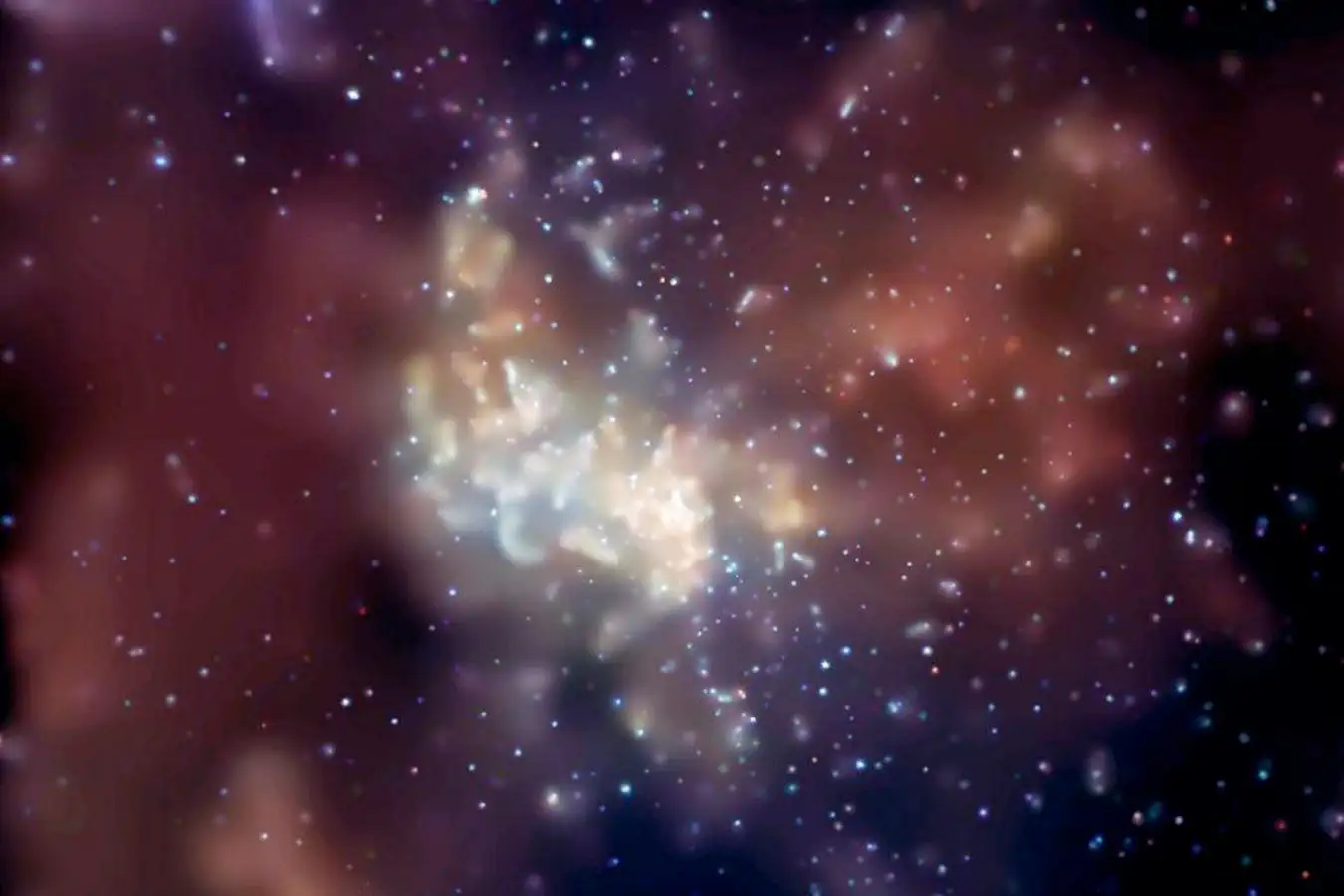
Bright Flares Near Sagittarius A*
Photo credit: NASA/CXC/MIT/FKBaganoff/Getty Images
The center of our galaxy is a fascinating and chaotic region, and researchers may have finally unraveled the mystery behind the unusual star populations orbiting it. The supermassive black hole known as Sagittarius A* is enveloped by three distinct star populations, each varying in characteristics yet similar in age. Recent studies have led to the development of a comprehensive model that aims to explain these peculiarities.
The star group closest to Sagittarius A* is the S stars. This cluster consists of spherical stars, many of which follow elongated orbits, drawing perilously close to the black hole. Furthermore, researchers have noted peculiar gaps in their distribution, termed avoidance zones. Surrounding these are the clockwise disk stars, which form a regular mass in a disk orbiting outside the S stars. Lastly, there are extra-disk stars, displaying more scattered orbits, with some seemingly moving in directions opposite to their neighboring stars.
While numerous theories have been suggested to explain these distinct populations, none have successfully accounted for all observed behaviors. Jen Xiaochen She and her team from the Beijing Planetarium in China propose a new approach to this cosmic enigma.
Their model introduces an intermediate-mass object, likely a black hole hundreds to a thousand times the mass of the Sun. In this model, the stars originated from a common gas and dust disk, orbiting in unison.
The presence of the intermediate-mass object near the galactic center, orbiting at a steep angle, triggers complex interactions among the disk’s stars. This affects outer stars most significantly, twisting and elongating their trajectories, leading some to appear to orbit in reverse.
For the clockwise disk star, gravitational resonance between the intermediate-mass object and Sagittarius A* subtly alters its orbit without major disturbances. Meanwhile, the S stars remain largely undisturbed by this object and are mainly influenced by interactions among themselves, creating natural avoidance zones by pulling binary stars apart.
“Through three distinct gravitational interactions, this cosmic companion separated star families,” Zheng explained. This model presents a straightforward explanation for the three populations surrounding our galaxy’s center, avoiding the complexity of postulating numerous independent formation events without clear temporal or spatial connections.
However, many details remain unresolved, particularly those pertaining to the cosmic companion. “Identifying this perturber is crucial, but locating intermediate-mass black holes poses significant challenges,” notes Albert Zijlstra from the University of Manchester. “So far, attempts to discover such objects in this mass range have repeatedly failed due to insufficient evidence.”
A promising candidate exists; the star cluster known as IRS-13E orbits near the galactic center and may harbor a black hole at its core. However, the true nature of IRS-13E remains uncertain—it may merely be an ephemeral stellar grouping. Continued research, including more precise measurements over extended periods, is essential to unlock the secrets of our galaxy’s center.
Topics:
Source: www.newscientist.com