


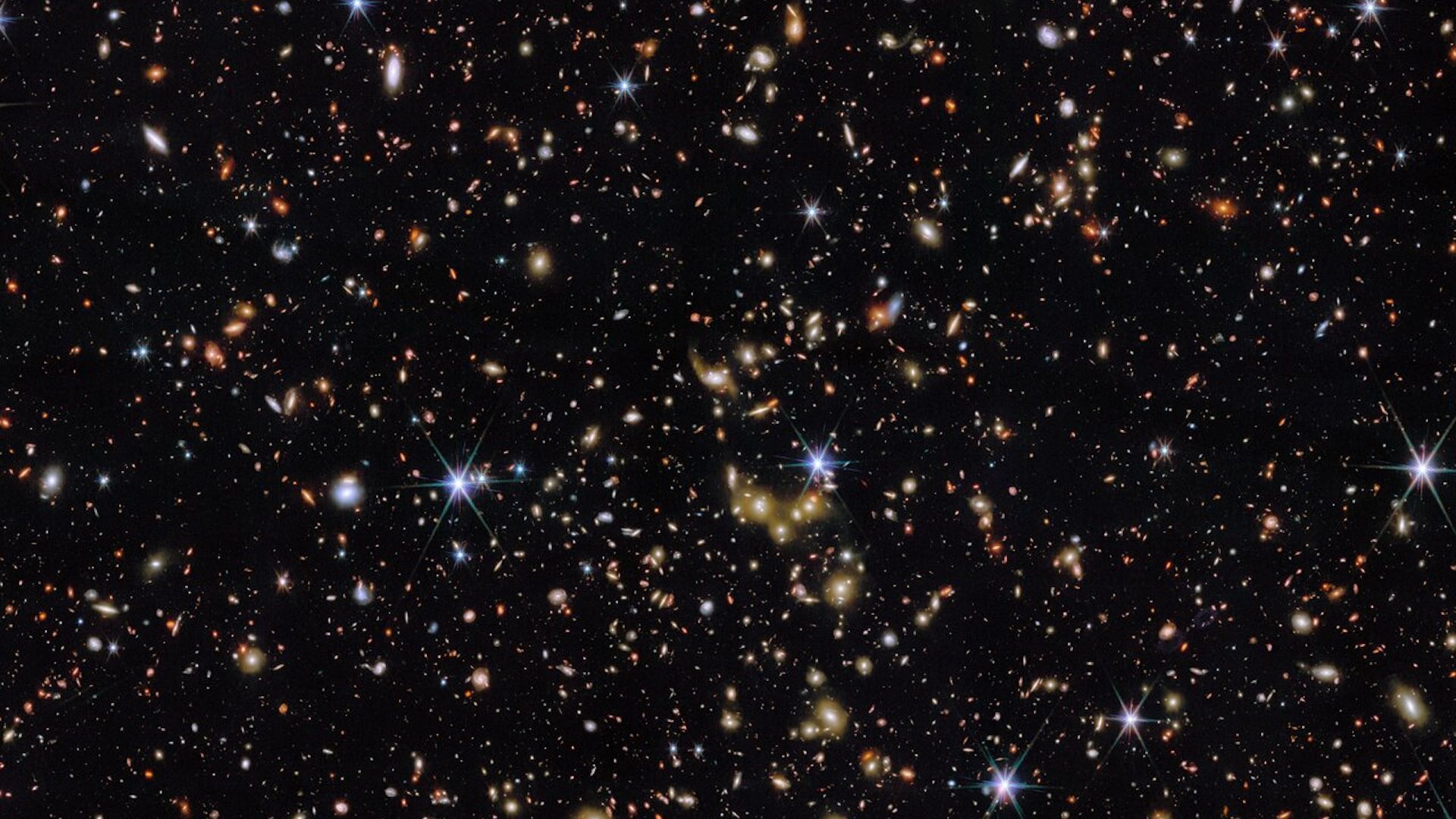
A mysterious force cleared the hydrogen fog that once filled the universe, allowing ultraviolet light to travel freely. New research suggests that astronomers may have misunderstood the process: rather than supernovae driving cosmic reionization, the intense radiation from newly formed stars may have been the primary source, while supernova-driven winds could actually have reduced the escape of ionizing light.
About 400,000 years after the Big Bang, the young universe cooled enough for atoms—mainly hydrogen—to form. Because these neutral, uncharged hydrogen atoms absorbed ultraviolet (UV) light, they created a cosmic fog that made the universe opaque.
After the first stars formed and gathered into galaxies, their radiation ionized the neutral hydrogen, splitting it into electrically charged protons and electrons. Light could then pass through interstellar space and eventually reach observatories. This transformation is known as the epoch of reionization, or, as the researchers describe it, “the last great phase transition in the universe.”
“We don’t know exactly what kind of object caused reionization or how it evolved,” Cody Carr, an astronomer at the University of Michigan who studies the evolution of galaxies, said in a statement. Carr is the first author of a new study of this period. “We know it happened, but we don’t have complete answers to those questions.”
Astrophysicists previously attributed the clearing of the fog to supernovae, the violent explosions marking the deaths of stars. Stars with about 8 to 50 times the mass of the Sun can end their lives in these explosions.
But a new study published Oct. 15 in the journal Nature Astronomy presents evidence that supernovae may have had the opposite effect. The explosions appear to have captured so-called Lyman continuum (LyC) photons—ionizing ultraviolet light—rather than helping those photons escape and disperse the cosmic fog.
“The most interesting part of our paper is the observation that the strongest LyC emitters lack fast galactic winds,” Carr told Live Science via email. “This calls into question the concept that galaxies require high-velocity winds from supernovae to enable LyC’s escape.”
Which way does the wind blow?
The researchers used the Hubble Space Telescope to observe six nearby, star-forming galaxies that may resemble galaxies in the ancient universe. The galaxies are about 3.5 billion light-years away and are driven by winds produced by intense bursts of star formation.
These compact starburst galaxies are generally less than 6,500 light-years across and form stars at a rate equivalent to about 10 solar masses per year. Their star-formation rate is up to 20 times greater than that of the Milky Way.
The spectra, or light-based fingerprints, of the galaxies revealed the origin, chemical composition, speed and direction of stellar winds generated by radiation from newly formed stars.
The researchers also traced how these processes changed as massive young stars evolved and later died as high-energy supernovae. Billions of years later, the resulting galactic winds overwhelmed the earlier stellar winds.
The observations revealed a counterintuitive, two-step process.
During the first phase, covering the initial 3 million years of star formation, winds from newly formed massive stars tore through the galaxies’ neutral gas and dust at nearly 2,000 miles per second (3,000 kilometers per second). This opened pathways through which LyC light could escape and ionize neutral gas and dust in intergalactic space.
A second phase appeared about 3 million years after star formation began and seemed to reverse the process. O-type stars—the hottest, bluest and most massive stars—live briefly and die young. Their ejected material then mixed with the galaxies’ gas and dust, stirring it up and adding mass. This created a trap for LyC light.
The oldest galaxies in the study, which had the fastest galactic winds produced by supernovae, had the least ionizing radiation escaping from their surroundings.
“In general, our results are inconsistent with most cosmological simulations showing that the escape rate of LyC peaks after the supernova-induced winds,” Carr explained in an email. In other words, supernovae may not have driven the epoch of reionization; they may instead have weakened it. The intense light from newborn stars currently appears to be the most viable source of reionization.
Future studies may examine additional galaxy samples and obtain higher-resolution observations at other wavelengths.
Study
Carr, C., Cen, R., McCandliss, S., Ford, J., Saldana-Lopez, A., Scarlata, C., Huberty, M.S., Jaskot, A., Flury, S., Oey, M.S., Amorín, R.O., Borthakur, S., Haye, M., Heckman, T., Ji, Z., Komarova, L., Reste, A.L., Leclerc, F., Márquez Chaves, R., et al. (2026). “The Lyman continuum escapes during the generation of galactic winds caused by compact starbursts.” Nature Astronomy.
Topics: Hubble Space Telescope
Source: www.livescience.com