


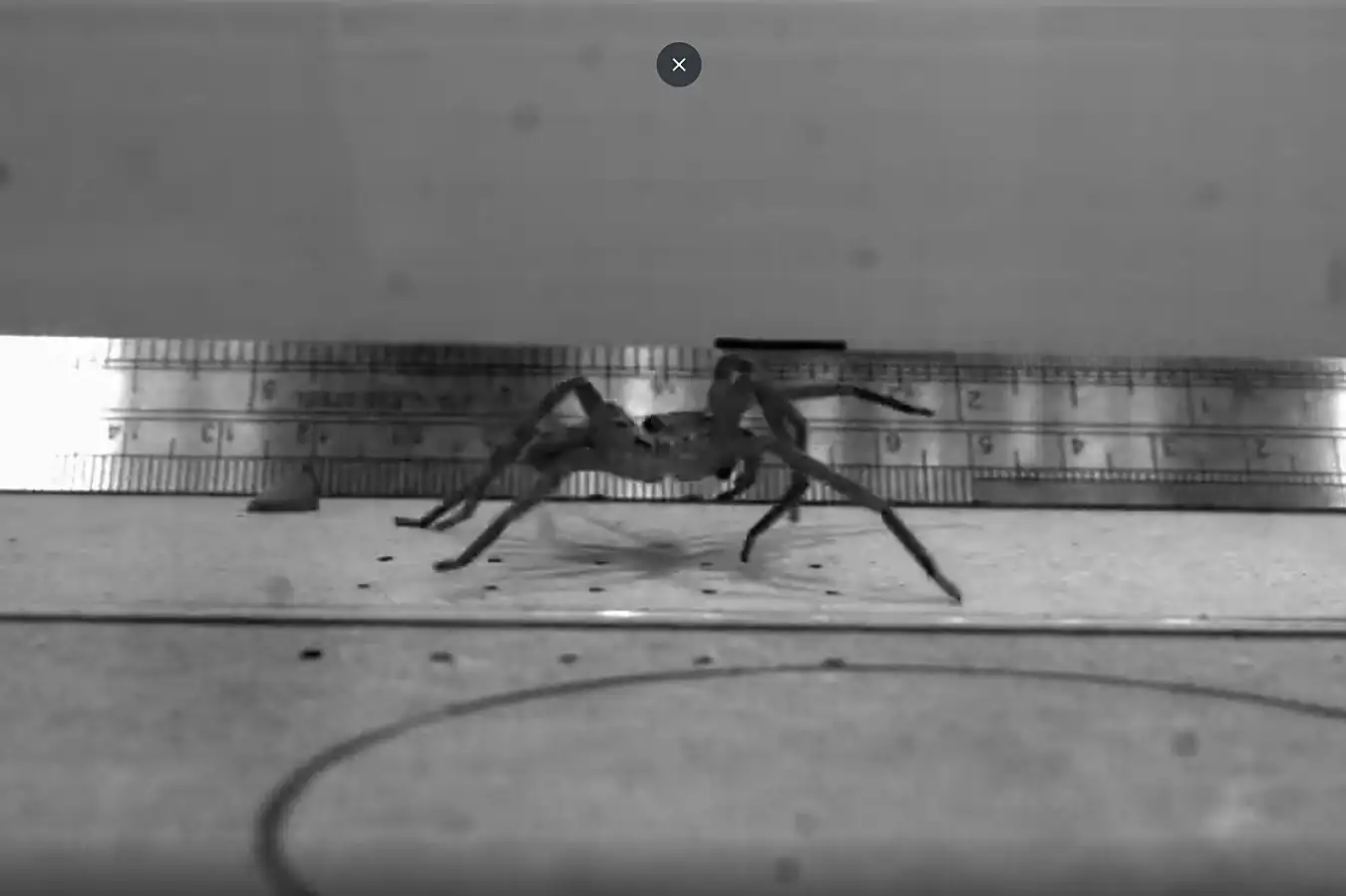
Jungle Huntsman Spider during Speed Test
Christopher Clemente/University of the Sunshine Coast
The Jungle Huntsman Spider, found in Queensland, Australia, has been crowned the fastest spider globally, reaching speeds of nearly 3.6 meters per second, according to an extensive study on arachnid locomotion.
The current Guinness World Record recognizes Flick Flak spiders in Morocco (Cebrenus rechenbergi), which can achieve speeds of 1.7 meters per second using unique rolling and tumbling movements. However, some researchers argue that this classification may be misleading.
Dr. Jonas Wolff from the University of Greifswald notes, “Flick Flak locomotion is specific and primarily effective on downhill terrain.”
To assess spider speeds comprehensively, Shreyas Kuchibhotla from Imperial College London and his team collected 162 live spider species and various specimens from pet stores during research in the UK, North America, Southern Europe, and Australia.
Each spider was carefully weighed, and their speeds were tested on A4 or A3 graph paper. Most species could be coaxed to run by gently stroking them with a paintbrush, though some were less amenable. “If only spiders understood English, this research could have wrapped up in a month,” Kuchibhotla remarked. “Tarantulas are not designed for running; they prefer to stay grounded, so we had to motivate them with compressed air.”
Kuchibhotla’s team also gathered speed records for 96 additional species documented by other researchers. The Jungle Huntsman Spider (Heteropoda possumidae) was recorded at a remarkable speed of 3.59 meters per second by Christopher Clemente and his colleagues at the University of the Sunshine Coast.

Jungle Huntsman: The World’s Fastest Spider
Christopher Clemente, University of the Sunshine Coast
The Jungle Huntsman Spider’s remarkable speed can be attributed to its large size relative to other spiders, without the heavy abdomens that hinder movement. “Generally, larger spiders tend to be faster, yet some species outperform expectations based on their size,” said Clemente. One surprising find was the orange goblin spider (Unops pulcher), which, despite weighing only 0.1 milligrams, can sprint at over 20 centimeters per second, with Kuchibhotla commenting, “Nothing prepared me for its almost teleportation-like movements across the testing arena.”
David Labonte from the Imperial team explains that speed is fundamentally guided by physics, but lifestyle factors, including hunting tactics, significantly influence the evolution of speed-related anatomical and physiological traits. “For instance, a cheetah can outpace most similarly-sized dogs due to its fast-paced lifestyle, though it remains confined to physics,” Labonte adds.
After examining body size and lineage, researchers found that rapid running tends to correlate with longer legs but not with thinner legs or the spider’s typical orientation, whether upright or hanging.
According to Dr. Leanda Mason from Edith Cowan University in Perth, Australia, longer legs serve as the spider’s “speed gears.” While hunters capture record speeds, the deeper revelation is that spider speed is influenced more by leg structure and evolutionary history than just sheer size or the act of spinning webs.
Topics:
Source: www.newscientist.com