


Astronomers using NASA’s James Webb Space Telescope (JWST) have made an exciting discovery: a giant exoplanet named Beta Pictoris d, located outside our solar system, in one of the Milky Way’s most studied planetary systems.
The young star Beta Pictoris is known to host two other giant planets, namely Beta Pictoris b, which was among the first exoplanets to be directly imaged, and Beta Pictoris c. With the identification of Beta Pictoris d, this system has become only the second known to feature at least three imaged planets. Unique to this discovery, Beta Pictoris d was identified by detecting distinctive chemical signatures in its atmosphere rather than through bright light spots, showcasing a revolutionary technology that may transform how we explore exoplanets.
“This discovery adds a new dimension to an already captivating planetary system,” stated Aidan Gibbs, lead author of the study. New research published in the Astrophysical Journal Letters underscores that Beta Pictoris has served as an essential laboratory for understanding the formation and evolution of planetary systems. Now, with this new planet, we enrich that narrative.”
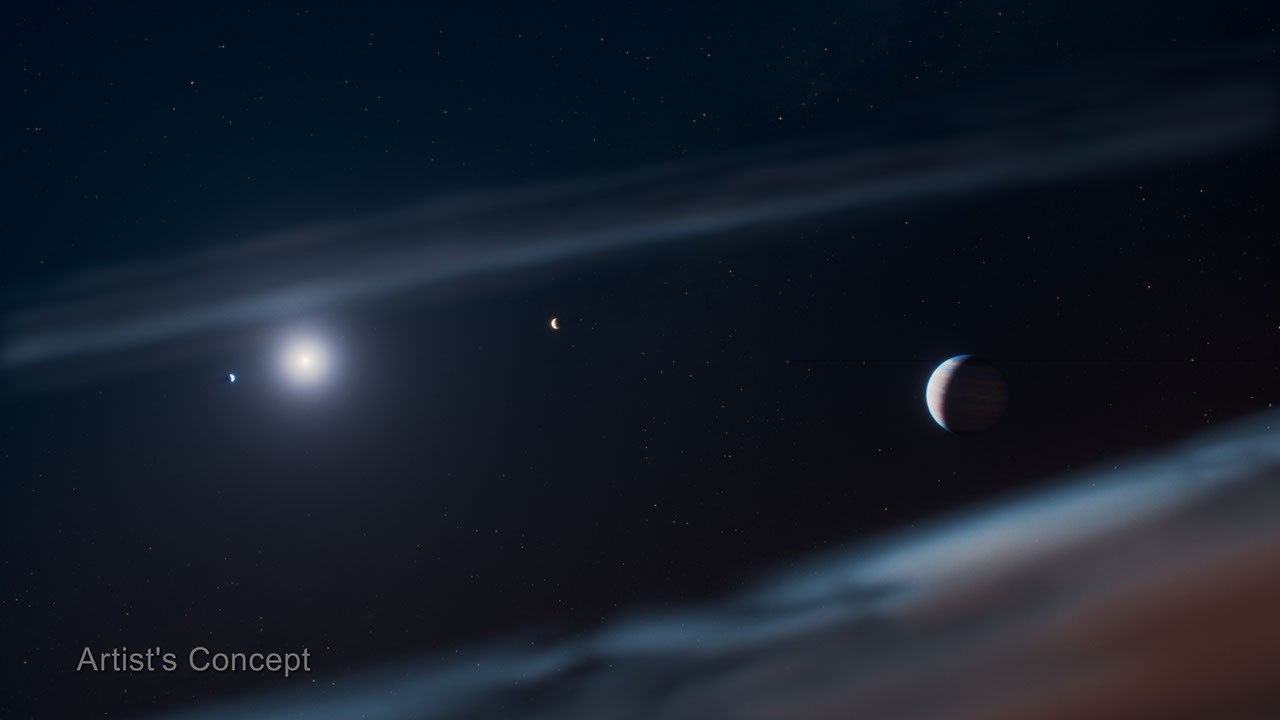
This artist’s concept illustrates the Beta Pictoris system featuring the newly identified giant exoplanet Beta Pictoris d on the right, showcasing its unique position within its orbit.
Illustrations: NASA, ESA, CSA, STScI, Ralph Crawford (STScI)
Positioned 63 light-years from Earth and approximately 23 million years old, Beta Pictoris provides a rare opportunity to study the interactions between emerging planets and the disks of dust and debris from their formation.
The research team estimates that Beta Pictoris d is at least twice the mass of Jupiter, making it the smallest of the three known giant exoplanets in this system. Current models suggest its orbit lies about 30 astronomical units from its star, similar to Neptune’s position in our solar system and within the bounds of the inner debris disk.
Interestingly, the astronomers didn’t initially set out to discover other planets with the JWST. Instead, while studying Beta Pictoris’s atmosphere, they serendipitously identified this new planet using the telescope’s NIRSpec (Near-Infrared Spectrograph). This technology captures both images and spectral data, allowing for an in-depth analysis of the planet’s composition and motion.
“We weren’t searching for new planets,” explained Gibbs. “Our aim was to analyze a known signal, and unexpectedly, a noteworthy signal appeared in our data.”
This signal—a pattern of peaks and valleys in the spectroscopic data—revealed a complex barcode of carbon monoxide absorption lines, a feature indicative of a giant planet’s atmosphere.
Through this advanced method, researchers extracted not only the chemical makeup but also the planet’s velocity and its relationship to the debris disk, confirming it was indeed an orbiting body rather than a background star or brown dwarf.
“Initially, we noted an unexpected bright spot, but experience taught us to be cautious of such clumps in images,” stated Jean-Baptiste Ruffio, a research scientist. “By analyzing the spectra alongside the images, we quickly affirmed our findings.”
Further observations using Webb’s MIRI (Mid-Infrared Instrument) Director Discretionary Time Request revealed water vapor and methane, enriching our understanding of the planet’s atmosphere.
Unlike traditional imaging techniques, the spectroscopic method enabled researchers to confirm the planet’s identity and begin studying its atmospheric composition right from the first observations.
“The spectrum reveals an astounding amount of information,” indicated Rufio. “It offers insights into temperature, chemical reactions, and even motion.”
A complementary imaging study conducted by Ben Sutliff of the University of Edinburgh and Marcus Bonse of the European Southern Observatory independently confirmed the existence of Beta Pictoris d.
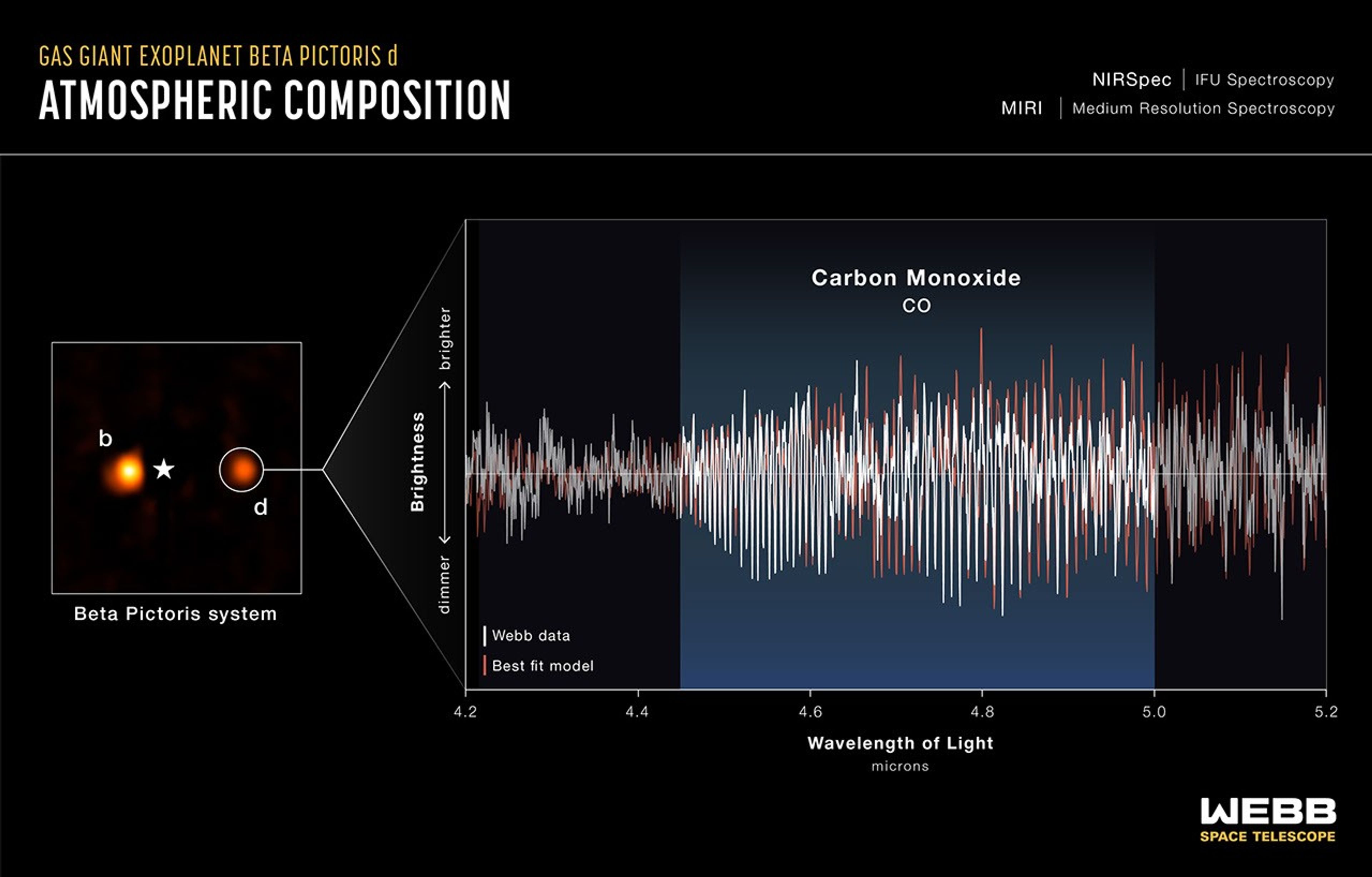
This visualization illustrates the atmospheric composition of Beta Pictoris d, including the presence of carbon monoxide.
Images: NASA, ESA, CSA, STScI; Science: Aidan Gibbs, Jean-Baptiste Ruffio. Image processing: Alyssa Pagan (STScI)
Beta Pictoris d had evaded detection for years, hidden within the dazzling debris disk surrounding its star. This disk scatters light from the star, complicating traditional imaging techniques by blending the planet’s features with surrounding material. The JWST’s spectroscopy effectively isolated the unique molecular signatures of the planet’s atmosphere.
Scientists speculate that the presence of Beta Pictoris d may elucidate the distinct inner edge of the debris disk and other unusual formations that have puzzled astronomers. Predictions about planets like Beta Pictoris d had been made to account for the disk’s atypical structure.
This groundbreaking discovery not only broadens our understanding of the Beta Pictoris system but also introduces a potent new technique for exoplanet exploration.
Notably, Beta Pictoris d is the first directly imaged planet discovered primarily through medium-resolution spectroscopy, demonstrating that atmospheres can provide crucial data on celestial objects in complex environments, moving beyond traditional imaging methods.
Researchers plan to continue their analysis of the JWST data to gain a more nuanced understanding of the planet’s temperature, atmospheric make-up, and orbital dynamics, enhancing our insights into one of astronomy’s most recognized planetary systems.
The James Webb Space Telescope is the foremost space science observatory globally, designed to unravel the mysteries of our solar system, peer into distant worlds around other stars, and investigate the very structure and origins of the universe. It operates as an international partnership led by NASA, with contributions from ESA (European Space Agency) and CSA (Canadian Space Agency).
For further information about JWST, please visit:
The section below provides links to download images and videos related to this article in various resolutions, along with additional resources, media contacts, and links to research articles and Spanish translations, where applicable.
Source: science.nasa.gov