


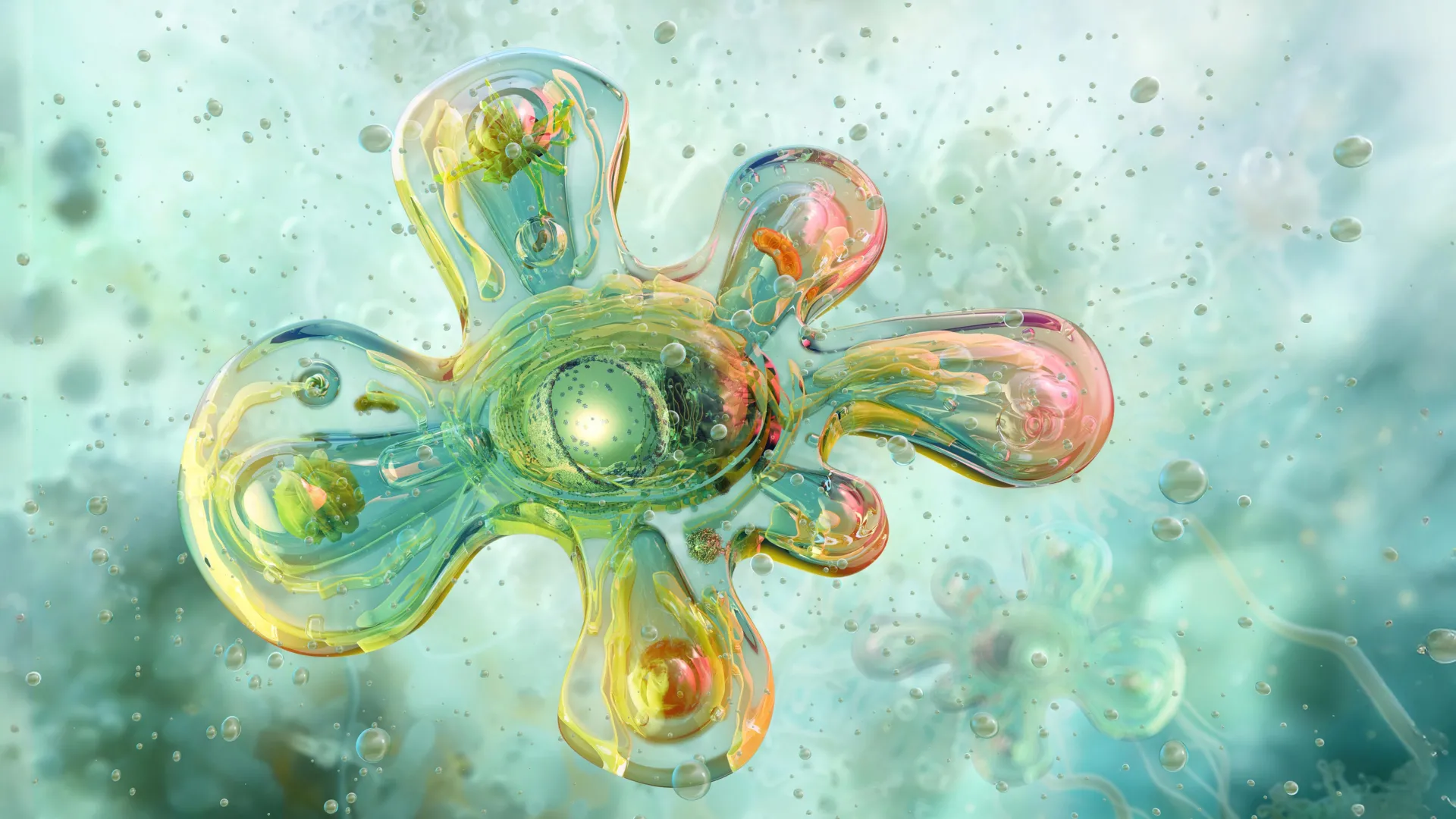
The search for life on Mars and icy moons such as Europa and Enceladus often captures public attention. However, one of astrobiology’s most important questions is much closer to home: When did the first eukaryotes appear on Earth, and how did they pave the way for complex life?
Microbes dominated Earth for roughly 90 percent of the planet’s history. Understanding how life evolved from a microbial world into one filled with plants, animals, fungi, and other complex organisms could also help scientists determine whether advanced life might develop elsewhere in the universe.
How life evolved from microorganisms to complex organisms
Paleontologist Ross Anderson of the University of Oxford in the United Kingdom says life first appeared on Earth more than 3.5 billion years ago. Cyanobacteria and oxygen-producing photosynthesis existed at least 2.3 billion years ago, while the earliest eukaryotes appeared at least 1.7 billion years ago.
Algae emerged at least 1 billion years ago and may have appeared much earlier. The first animals evolved at least 570 million years ago, although some evidence suggests they may have existed slightly earlier.
According to Anderson, scientists must look back approximately 1.6 billion years to reach the common ancestor shared by the plant and animal kingdoms.
Crown eukaryotes are among the earliest eukaryotic lineages scientists study. These organisms played a crucial role in the evolution of complex life on Earth, and Anderson considers eukaryotes to be the earliest examples of complex life.
What are eukaryotes and why are they important?
Eukaryotic cells contain a nucleus that encloses their DNA. They also contain organelles, specialized structures that perform essential cellular functions. Mitochondria, for example, generate much of the energy required to support larger and more complex organisms.
Over time, eukaryotes gave rise to complex multicellular organisms and the large, visible forms of life found on Earth today. All animals, plants, and fungi are eukaryotes.
However, identifying the earliest eukaryotic ancestors is extremely difficult.
Organisms that lived more than 500 million years ago generally lacked shells, skeletons, and other hard tissues. Because these protective structures had not yet evolved, paleontologists must search for rare geological environments capable of preserving fragile cells and soft tissues.
This scarcity of evidence leaves scientists with limited information about how life changed during the earliest 90 percent of Earth’s history.
Investigating the evolution of multicellular life
Anderson’s research examines one of the most significant transitions in biological history: the shift from a planet dominated by bacteria to one inhabited by complex multicellular organisms.
Because fossils of early multicellular life are rare, he studies the chemistry of ancient rocks to identify the environmental conditions most likely to preserve these organisms.
Time is another major challenge. Eukaryotic microfossils have survived billions of years of geological alteration, erosion, burial, and chemical degradation. These processes can destroy or obscure even the smallest traces of ancient life.
Scientists know that unicellular organisms evolved into multicellular forms multiple times in different regions of the world. Anderson is particularly interested in discovering how these repeated evolutionary transitions eventually contributed to the remarkable diversity of animals.
Many of the foundations of modern animal diversity emerged during the Ediacaran-Cambrian transition, approximately 540 million years ago. This period marked a major evolutionary change from predominantly soft-bodied organisms to animals with greater mobility, protective carapaces, and skeletons. It also led into the rapid diversification known as the Cambrian explosion.
Where scientists search for ancient eukaryotic microfossils
Finding fossils from Earth’s distant past requires exploring locations where delicate biological material had an unusually high chance of being preserved.
Anderson and his colleagues are studying an area covering approximately 100 square kilometers near Svalbard, Norway. Located near 80 degrees north latitude, this remote Arctic region was once covered by a shallow sea—an environment that may have supported and preserved early eukaryotic life.
Australia has also produced important evidence. Researchers recently discovered some of the oldest known eukaryotic microfossils there, dating back approximately 1.75 billion years.
Ancient coastal environments are especially promising targets. Eukaryotes living along these shores would have had access to abundant nutrients and organic matter, conditions that may have encouraged greater biological diversity and the evolution of multicellularity.
Researchers often focus on pristine areas that have received little scientific attention. Anderson specializes in locations containing extensive clay deposits, which may be particularly effective at preserving ancient eukaryotic remains.
Many of the most promising sites are found in deserts and Arctic landscapes. With little vegetation or ground cover, ancient rocks remain exposed and more accessible for geological and fossil research.
Why are ancient eukaryotic fossils so difficult to find?
Even in favorable locations, discovering eukaryotic microfossils is a significant challenge. These organisms were microscopic, lacked protective hard tissues, and endured billions of years of geological damage.
One of the biggest difficulties, Anderson explains, is that rocks from this period have not been sampled extensively. As a result, the fossil record for early eukaryotes remains incomplete.
Nevertheless, researchers are making progress. Scientists are improving their ability to identify the rock types and ancient environments most likely to contain early fossils. Each discovery provides new evidence for reconstructing the history of Earth’s earliest life.
What Earth’s oldest life can reveal about extraterrestrial biology
The study of ancient eukaryotes has implications that extend far beyond Earth’s biological history.
Anderson’s research into clay deposits was initially inspired in part by the search for life on other planets. Learning which environments on Earth preserve evidence of ancient organisms could help scientists recognize potential biosignatures elsewhere in the solar system.
Understanding how life originated on Earth and became increasingly complex is therefore central to astrobiology. To estimate how likely life is to emerge and evolve on other worlds, scientists first need a clearer understanding of how that process unfolded on our own planet.
Source: www.sciencedaily.com