


NASA Sea Level Science Inspires More Than 1,000 Visitors at World Oceans Day Event
More than 1,000 visitors explored NASA ocean science and sea level rise research during World Oceans Day on June 6, 2026, at the University of Georgia Aquarium on Skidaway Island. The free community event was supported by NASA’s Science Activation Program through the NASA Sea Level Education, Awareness, and Literacy (SEAL) Project.
SEAL is a national initiative that connects NASA sea level rise data with educators, students, and coastal communities—particularly historically underserved communities already experiencing the impacts of rising seas. The project helps participants better understand coastal change and discover practical strategies for building climate resilience.
Connecting Communities With NASA Sea Level Rise Data
The NASA SEAL Project is a partnership between NASA and four NOAA Sea Grant programs. Together, the partners develop lesson plans, interactive activities, and place-based learning experiences that make sea level science accessible and relevant across the United States.
By using NASA observations, models, and predictions, SEAL helps educators teach students about the causes, variability, and impacts of sea level rise. The project also encourages communities to explore how science, planning, and adaptation strategies can reduce risks associated with a changing climate.
Hands-On Sea Level Rise Activities at the UGA Aquarium
During the World Oceans Day celebration, Marine Extension and Georgia Sea Grant SEAL partners teamed up with Georgia Tech’s Coastal Equity and Resilience Hub to lead hands-on activities focused on sea level rise and coastal resilience.
Visitors participated in the “Tumbling Tower” game, in which removing blocks represented the growing challenges and impacts that rising sea levels can create for coastal communities. Guests also used colorful glass beads to create “Sea Level Friendship Bracelets,” with each bracelet representing observed sea level rise along the local coastline.
Augmented Reality Sandbox Demonstrates Coastal Adaptation
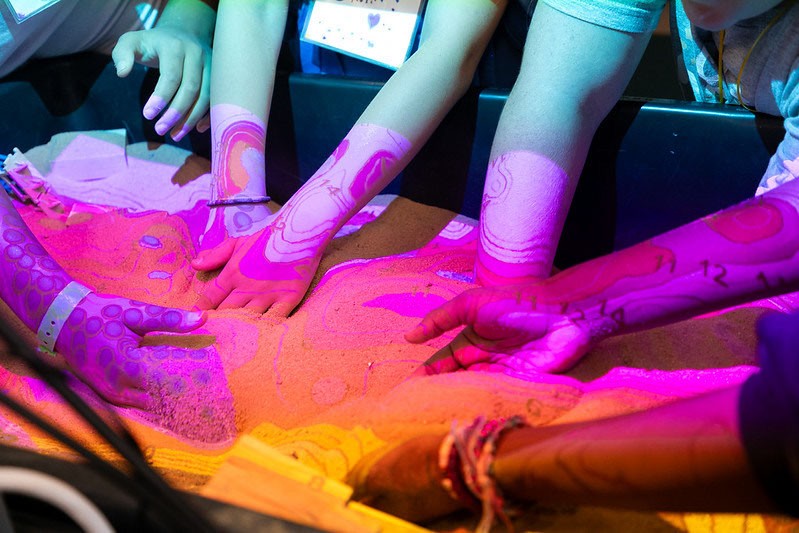
The event also featured the debut of a new augmented reality sandbox developed through the SEAL Project. Participants shaped sand into coastal landscapes and watched NASA sea level rise predictions transform their creations in real time.
The interactive experience allowed visitors to test coastal adaptation strategies, including building sand dunes and relocating homes. By experimenting with different approaches, participants could see how planning and adaptation may help communities prepare for future sea level changes.
NASA SEAL Lesson Plans for Educators
Educators from formal classrooms, informal learning programs, and homeschool environments who attended the event received four SEAL lesson plans. The resources are designed for both classroom and community-based learning and use NASA data alongside interactive STEM activities.
The lessons help students investigate sea level rise processes, modeling, variability, and impacts. SEAL plans to make all lesson plans developed through the project available online. Until then, educators can email Shannon Matzke to request a digital copy.
“World Oceans Day is an annual tradition at UGA Aquarium,” said Shannon Matzke, marine educator and public program coordinator for UGA Marine Extension and Georgia Sea Grant. “With support from NASA’s Science Activation Program, this year’s event was free, which allowed us to reach more people and a more diverse audience than usual. Incorporating SEAL activities made the day even more impactful for our visitors, many of whom live in coastal areas already experiencing the effects of rising sea levels.”
The SEAL Project is supported by NASA Cooperative Agreement Award Number NNH21ZDA001N-SCIACT and is part of the NASA Science Activation Program portfolio. Through partnerships with educators and community organizations, NASA Science Activation connects learners with authentic NASA science, technology, engineering, and mathematics experiences.
Source: science.nasa.gov