


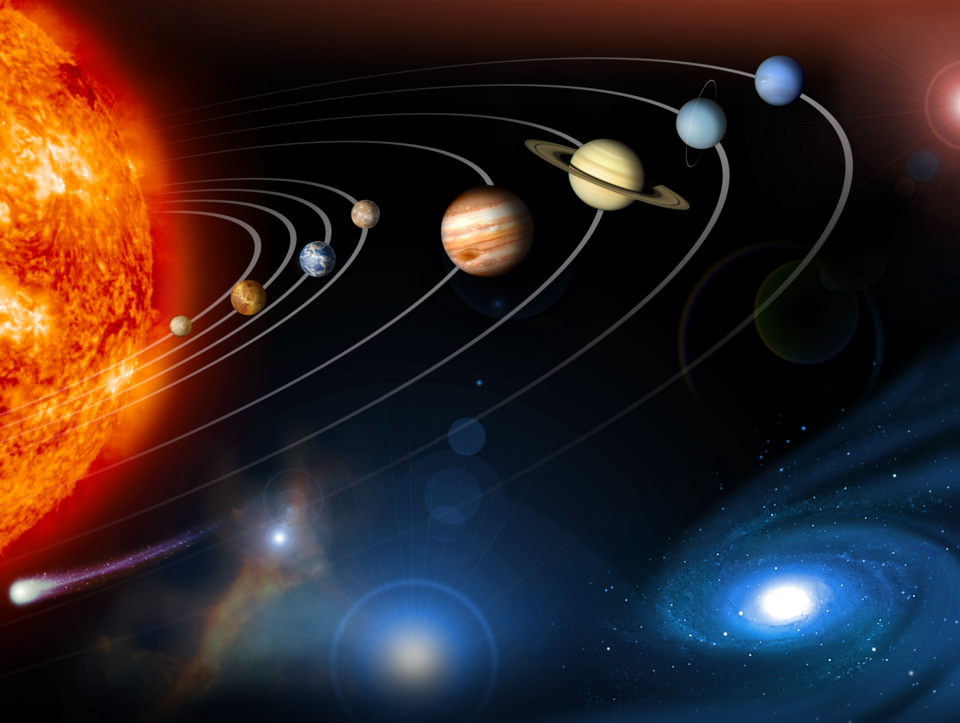
Approximately 4.6 billion years ago, a massive cloud of gas and dust in the universe experienced a collapse. During this event, gravity pulled most of the matter towards several small points, with one becoming our Sun, and the others forming what scientists refer to as open star clusters.
At this initial stage of the Sun’s life, it was encircled by a swirling disk of residual material known as a
protoplanetary disk. This disk eventually condensed, leading to the formation of the planets in our solar system. Typically, these systems feature a star at the center with planets orbiting along the star’s equatorial plane.
However, recent discoveries indicate that our solar system doesn’t conform to this standard model. The planets orbit the Sun in a single plane, offset by approximately 6 degrees from the Sun’s equator. This alignment reinforces the validity of the protoplanetary disk model, as the probability of a rogue planet being captured by the Sun is extraordinarily low.
rogue planet
. This peculiar arrangement raises the question: What led to such unusual planetary orbits in our solar system?
This illustration demonstrates that the planets in our solar system revolve around the Sun at an offset of approximately 6° from its equator. Simulation based on the four largest planets: Neptune, Saturn, Jupiter, and Uranus. Illustration by Andrew Bizal.
To investigate the cause of the solar system’s tilt, Daohai Li from Queen Mary University of London utilized the
NBODY6++
computer program to model various configurations of the open star cluster that birthed the Sun. His simulations involved adjusting the number of stars from 500 to 8,000, varying cluster radii from 0.25 to 1-4 parsecs, and manipulating binary companion ratios from 10% to 90%. Each star was assigned an initial mass, position, and velocity randomly, simulating their interactions over 400 million years.
Li identified stars with a mass similar to that of the Sun within the solar-massive group. He found instances where stars either formed independently or separated from the cluster, leaving their original companions. He proposed that these stars closely resembled the Sun and could feasibly host a simulated solar system.
Next, Li simulated the formation of planets and their orbits around these stars. To streamline the process, he focused on the four giant planets—Jupiter, Saturn, Uranus, and Neptune—that heavily influence the behavior of the solar system. He modeled these solar systems independently for 200 million years, ensuring their stability for statistical analysis.
Li discovered two potential scenarios explaining the solar system’s tilt. In the first scenario, the primordial solar system was densely populated with many distant neighbors. Such collisions could randomly tilt planetary orbits, leading to a chaotic orbit pattern that deviates from what we observe today.
The second scenario involves the Sun having a temporary companion star, which could significantly influence the alignment of the planets’ orbits when they briefly interacted. The likelihood of a star with a binary companion tilting planetary orbits by more than 6 degrees is about 10%, whereas a star forming alone has a probability of less than 0.1%.
Li concluded that our solar system’s tilt may stem from interactions with a temporary companion star in its origin cluster. However, he acknowledged that these models heavily depend on stellar proximity; a closer encounter would have a more substantial impact on the solar system. Despite the uncertainty, it’s plausible that a twin or long-lost neighbor of our Sun exists somewhere in the universe, possibly accounting for our solar system’s unique tilt.
Post views:
55
Source: sciworthy.com