


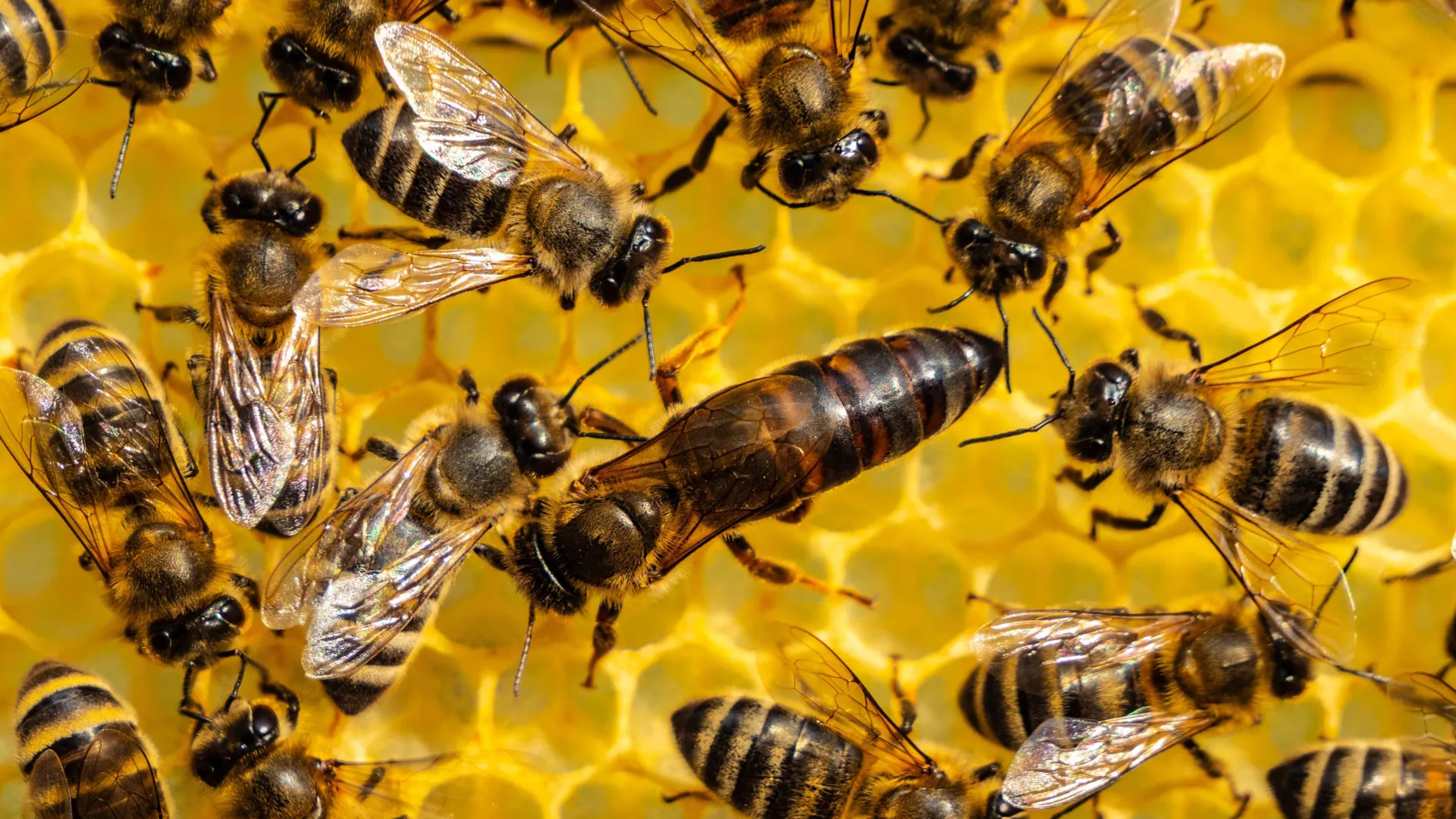
For more than 60 years, evolutionary biologists have debated whether the unusual genetic system found in ants, bees, and wasps helped drive the evolution of eusociality—one of nature’s most advanced forms of social organization. In eusocial colonies, reproduction is concentrated among queens and a small number of reproductive individuals, while workers cooperate to raise offspring and maintain the colony.
New research from Arizona State University suggests that genetics alone may not explain why complex insect societies evolved.
Published in Current Biology, the study found that eusociality appears more common among insects with haplodiploid genetic systems. However, nearly all of this pattern can be traced to one evolutionary group: aculeate Hymenoptera, which includes ants, bees, and stinging wasps. Across insects more broadly, haplodiploidy does not reliably predict whether eusociality will evolve.
The findings suggest that the repeated evolution of complex insect societies may depend more on biological traits shared by particular evolutionary lineages than on their systems of chromosomal inheritance.
“People have been discussing this hypothesis for about 60 years,” says Sachin Suresh, a doctoral student in Arizona State University’s College of Life Sciences and lead author of the study. “While there have been many theoretical predictions, formal comparative tests across insects have been surprisingly rare.”
Why is eusociality rare among insects?
Eusociality is considered one of the most advanced forms of social organization in nature. Eusocial species typically live in colonies with overlapping generations, cooperative brood care, and a division of reproductive labor. One or a few individuals reproduce, while other members function primarily as workers.
All ants are eusocial, as are many bees and some wasps. By contrast, eusociality is uncommon in other insect groups, including termites, thrips, aphids, and several beetle lineages.
Scientists have long studied haplodiploidy as a possible explanation for why eusociality evolved repeatedly in ants, bees, and wasps. Under this genetic system, females develop from fertilized eggs and have two sets of chromosomes, while males develop from unfertilized eggs and have one set of chromosomes.
Because of this arrangement, sisters can be more closely related to one another than they are to their own offspring. Evolutionary theory therefore proposed that, in some circumstances, females could increase their genetic success by helping their sisters produce offspring rather than reproducing independently.
This hypothesis had a major influence on evolutionary biology and became widely discussed in biology textbooks. Despite its importance, however, it has rarely been tested with large-scale datasets covering a broad range of insect species.
Testing a 60-year-old evolutionary hypothesis
To examine the hypothesis on a large scale, Suresh and co-author Timothy Linksvayer compiled data on social behavior and genetic systems from tens of thousands of insect species. The researchers then mapped these traits onto two of the largest species-level insect family trees available.
Using comparative phylogenetic methods, the team estimated how often eusociality evolved in insects with different genetic systems.
At first, the results appeared to support the traditional explanation: eusociality seemed to occur more frequently among haplodiploid insects.
Further analysis, however, revealed a different pattern. Nearly all of the statistical signal came from a single branch of the insect evolutionary tree.
“When we formally tested it, we found that there is no general link between genetic systems and eusociality,” Suresh said. “It has more to do with environmental factors and the life-history characteristics of insects.”
After accounting for the distinctive evolutionary history of aculeate Hymenoptera, the researchers found that haplodiploid insects outside this group evolved eusociality at rates similar to those of diploid insects.
Nearly 69,000 insect species reveal a different pattern
The findings also help resolve recent research that questioned how important haplodiploidy is to the evolution of complex insect societies.
After analyzing approximately 69,000 insect species from across the insect world, the Arizona State University team concluded that the apparent connection between haplodiploidy and eusociality is largely explained by evolutionary history within a particular lineage. It does not appear to be a universal biological rule.
This conclusion shifts attention toward other traits that may have enabled ants, bees, and wasps to repeatedly evolve highly cooperative colonies.
Features such as stingers, specialized nesting behaviors, ecological conditions, and other life-history traits may have created environments in which cooperation became especially beneficial. These characteristics could help explain why sophisticated insect societies evolved repeatedly within certain groups.
The study is one of the most comprehensive empirical tests of a longstanding idea in evolutionary biology. It also demonstrates how large comparative datasets can help scientists reassess theories that have shaped the field for decades.
Source: www.sciencedaily.com