


Being Near Someone You Love May Help Your Body Handle Stress More Efficiently
Sitting next to a loved one may do more than feel comforting. A new study suggests that social closeness can reduce the body’s physiological workload, affecting blood sugar regulation, skin temperature and stress responses.
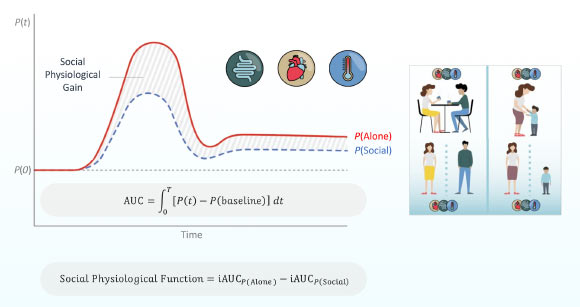
Social physiology refers to how efficiently physiological regulation functions in social situations compared with when alone. Image credit: Masalha et al., doi: 10.1126/sciadv.aeg4937.
How social connection affects the body
“We used to think of the body as an isolated system that controlled itself,” says Shir Atzir, a researcher at the Hebrew University of Jerusalem.
“Our findings show that human physiology is inherently social. Being close to loved ones reduces the physical energy your body spends on self-regulation.”
“This gives us direct metabolic benefits to being together and reveals a central evolutionary reason why humans form bonds in the first place: our bodies work better together.”
Eating with a partner was linked to lower blood sugar exposure
In one experiment, 108 adults ate a standardized carbohydrate meal first alone and then with a significant other. Researchers tracked their blood sugar levels for two hours after each meal.
When participants ate with a partner, their blood sugar levels rose less, returned to baseline faster and resulted in about 15% less overall glucose exposure than when they ate alone.
Partners also influenced temperature and stress responses
The scientists repeated the study design across two additional physiological systems.
In a cold-exposure test involving 116 participants, skin temperature decreased less and recovered faster when a partner was nearby.
In a mild electrical-shock stress test involving 115 adults, skin conductance—a marker of nervous-system arousal—was also less responsive and returned to normal more quickly when participants were in a social situation.
Similar effects appeared in mother-infant pairs
A related pilot study of 56 mother-infant pairs found a similar pattern. Infants showed lower stress responses to loud noises when their mother was in the room than when she was in a separate room.
Across all three adult experiments, combined statistical analyses found consistent effects. The cumulative physiological “costs” of the tested tasks were approximately 8% to 12% lower in social situations than when participants completed the same tasks alone.
What is “social physiology”?
Professor Atsir and his colleagues describe these findings as evidence of “social physiology”—the idea that being around other people may not only relieve stress and increase comfort, but also make everyday bodily regulation more efficient.
The researchers say this effect may extend to systems that are not usually considered socially responsive, including glucose metabolism.
Notably, the blood sugar findings did not appear to be explained by reduced stress. Markers of physiological arousal did not differ between the alone and social conditions during the feeding experiment. The effect also remained after the researchers statistically accounted for stress levels and physical contact between partners.
Could the brain be anticipating support?
The authors suggest that the benefit may involve the brain’s predictive regulation of the body, a process known as allostasis. Through allostasis, previous social experiences may help the brain anticipate and manage physical demands before they fully unfold.
“Regulating blood sugar levels is not just about what you eat, it’s also about who you eat with,” Professor Atsir says.
“Our relationships play an active biological role in our physical health.”
The findings appear in the journal Science Advances.
_____
Monia Masala et al. 2026. Social Physiology: Human homeostasis is more efficient in social proximity. Science Advances 12(39); doi: 10.1126/sciadv.aeg4937
Source: www.sci.news