


Paleontologists in northeastern Thailand have discovered a new species of mamenchisaurid sauropod dinosaur, revealing evidence that these gigantic creatures, once believed to be exclusive to East Asia, also inhabited mainland Southeast Asia.
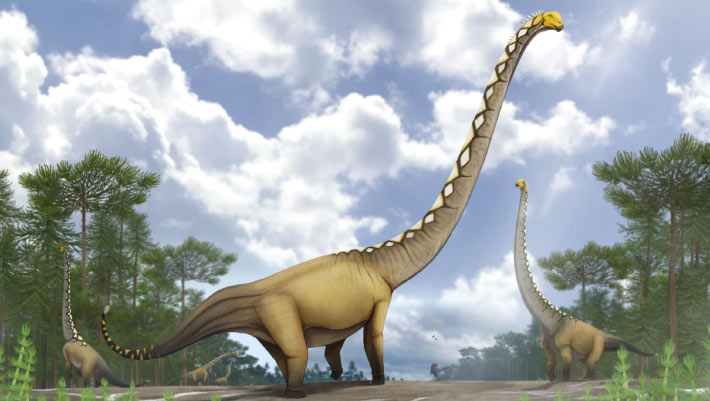
A reenactment of five Uragasaurus carasinensis individuals in the Late Jurassic forests of Thailand, accompanied by rhymphorhynchoid pterosaurs and metricanthosaurid theropods. Image credit: Pakorn Chotchaiyaporn.
The newly identified species, Uragasaurus carasinensis, thrived in what is now Thailand during the Late Jurassic, approximately 150 to 145 million years ago.
This dinosaur belonged to the Mamenchisauridae family, known for their remarkably long necks.
While mamenchisaurids were prevalent in China during the Middle to Late Jurassic, their occurrence outside of China has been scarce.
According to Dr. Apirut Nirupanapan from Thailand’s Mahasarakham University and his colleagues, “Mamenchisauridae represent a significant non-neosauropod clade from the Middle to Late Jurassic of East Asia.”
“These members are characterized by elongated cervical vertebrae with sophisticated pneumatic structures, distinguishing them from other eusauropods.”
“Though similar traits evolved in various Cretaceous neosauropods, they complicate interpretations of mamenchisaurid relationships, adding to the uncertainty around their phylogenetic positioning among sauropods.”
The fossil record for mamenchisaurids is richest in China, particularly the Sichuan Basin, which has yielded diverse well-known taxa from the Middle to Late Jurassic Shaximi Formation.
Uragasaurus carasinensis is represented by a single, well-preserved anterior dorsal vertebra located just behind the dinosaur’s neck.
This specimen was excavated from the Phu Noi Fossil Site within the Phu Kradung Formation, a rock formation renowned for its rich assemblage of Jurassic vertebrate fossils in Southeast Asia.
Cataloged as PRC 460, this fossil was found alongside other sauropod bone fragments, though these fragments were not definitively associated with the same individual.
For phylogenetic analysis, Uragasaurus carasinensis is positioned near the base of the mamenchisaurid family tree, indicating it may be one of the earlier divergent members of this group.
This discovery enriches the limited list of mamenchisaurids found outside China and suggests a broader geographic range and more complex evolutionary history for the family than previously recognized.
The identification of Uragasaurus carasinensis marks the first formally named mamenchisaurid from Thailand. “It also extends the distribution of Mamenchisauridae to mainland Southeast Asia, further indicating that this clade was widespread across East Asia during the Late Jurassic,” paleontologists remarked.
They added, “The existence of closely related taxa in China implies potential faunal connections across the East Asian continent during this era.”
Comparative studies with more distantly located taxa underscore the intricate paleobiogeographic patterns of Jurassic sauropods, yet the limited fossil record constrains detailed reconstructions of dispersal routes at this time.
The phylogenetic arrangement places Uragasaurus carasinensis close to the Mamenchisauridae base, highlighting the morphological diversity among early divergent members of the clade.
Continuing discoveries from the Hu Kradung Formation and other Jurassic deposits in Southeast Asia may provide crucial insights into the early evolutionary adaptations and biogeographical dispersal of mamenchisaurid sauropods.
The discovery of Uragasaurus carasinensis has been documented in a scientific paper published in Scientific Reports.
_____
A. Nirupanapan et al. 2026. A new mamenchisaurid sauropod discovered from the lower Phu Kradung Formation in the Upper Jurassic period of northeastern Thailand. Scientific Reports 16, 21205; doi: 10.1038/s41598-026-49822-3
Source: www.sci.news