


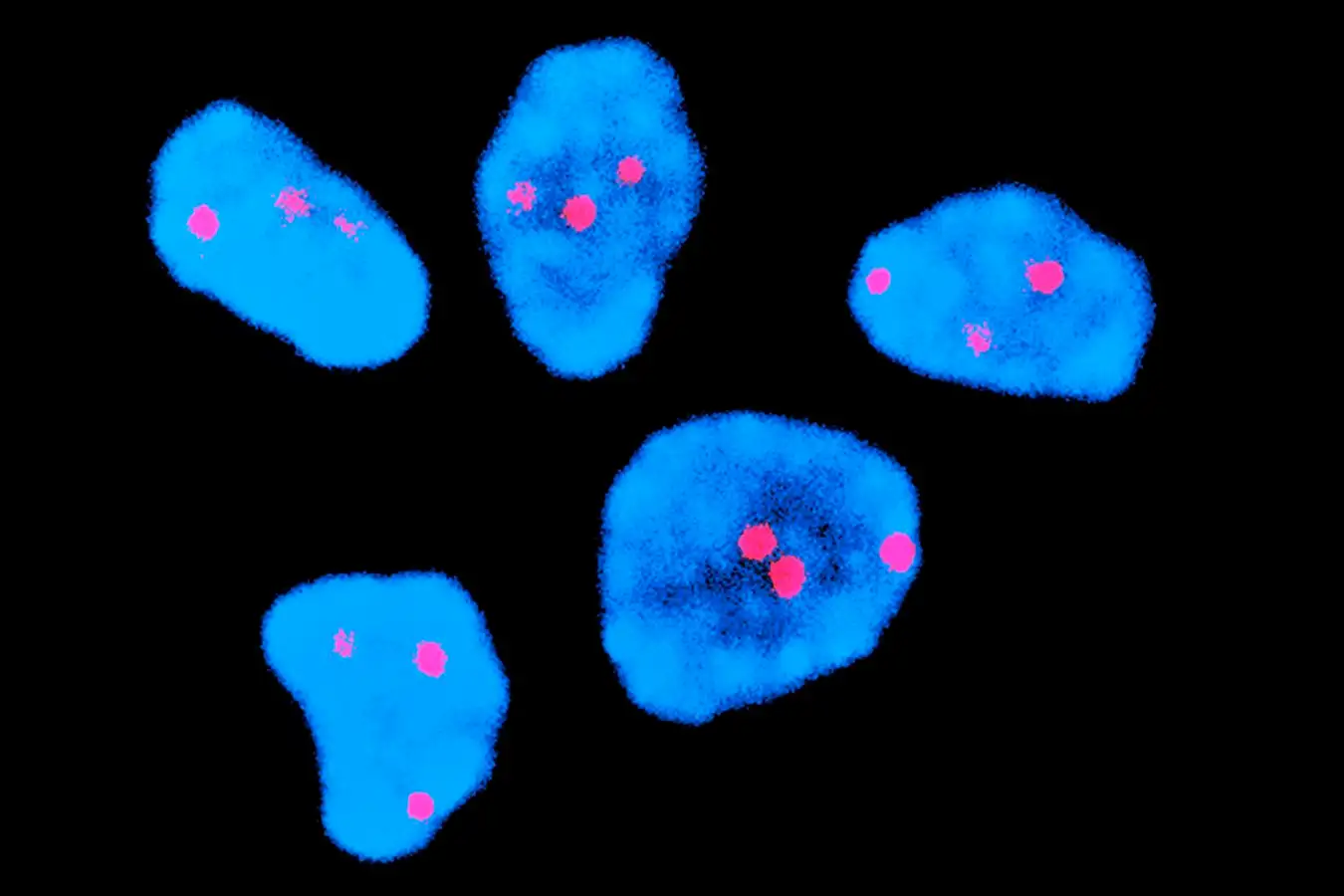

Cells Indicating Excessive Chromosome Presence
Department of Clinical Cytogenetics, Addenbrookes Hospital/Scientific Photo Library
Human eggs with abnormal chromosome numbers can lead to miscarriages, unsuccessful IVF attempts, and genetic disorders like Down syndrome. Recent advances reveal that a single injection into the egg can dramatically mitigate these issues, potentially enhancing IVF success rates for older women.
“This is groundbreaking,” states Marcos Iuri Ruth Kullman, Ph.D., in Reproductive Medicine from Porto Alegre, Brazil, who was not part of the study. “This therapy aims to illustrate the clinical viability of correcting a primary cause of IVF failure.”
Meiosis is the process where egg and sperm cells reduce their genetic material by half. This ensures that, upon fertilization, the resultant embryo has a complete and balanced genome. However, some sperm or egg cells may become aneuploid, possessing too many or too few chromosomes, leading to complications.
Aneuploidy affects about 10-25% of eggs starting as early as the 30s, increasing significantly with age. “By the late 30s, more than 65% of eggs are aneuploid,” notes Agata Zielinska from Ovo Labs during a talk at the European Society of Human Reproduction and Embryology conference in London, held on July 6th.
Clinicians may evaluate IVF embryos for aneuploidy to assist couples at higher risk of miscarriage or IVF failure. Nonetheless, most genetic conditions, including Down syndrome, can currently be detected only via blood tests or ultrasound during the early stages of pregnancy. Zielinska emphasized that previously, there was no method to mitigate the risk of aneuploidy.
Research indicates that older eggs exhibit significantly lower levels of a protein named Shugosin-1, crucial for chromosome pairing during meiosis. Shugoshin-1 helps to maintain the molecular cohesion of chromosome pairs.
Upon fertilization, these chromosome pairs separate, leading to the formation of a mature egg cell and disposal of the excess. However, in older eggs, the deterioration of cohesion allows premature separation, resulting in aneuploidy.
The research team investigated whether supplementing Shugoshin-1 could preserve these crucial chromosome pairs to prevent aneuploidy. They injected mRNA encoding for Shugoshin-1 into immature eggs sourced from over 30 women aged 22 to 43, comparing treated to untreated eggs.
Results showed that 53% of untreated eggs experienced premature chromosome separation, compared to only 29% of those treated. In women over 35, untreated eggs showed an average aneuploidy rate of 65%, while treated eggs had a reduced rate of 44%. The difference, although promising, wasn’t statistically significant due to sample size limitations.
Subsequent experiments indicated that this supplementation also prevented aneuploidy in mouse eggs, allowing for successful fertilization and healthy offspring.
There were no noted side effects in either mouse or human studies. Zielinska noted, “We achieved live births in mice, confirming that our approach does not disrupt embryonic development nor affect offspring health during pregnancy.”
Researchers are now focusing on testing Shugoshin-1’s effects in humans. This involves adapting standard IVF techniques to utilize immature eggs, a change deemed relatively straightforward by Zielinska.
They anticipate that their treatment, dubbed “EmbryoProtect,” will offer a cost-effective means to enhance IVF outcomes for older women. “We expect the cost to be significantly lower than a full IVF cycle,” Zielinska adds. “By improving success rates, we hope to reduce the number of IVF attempts needed, particularly for women over 35 who naturally face lower success rates.”
Topics:
Source: www.newscientist.com