


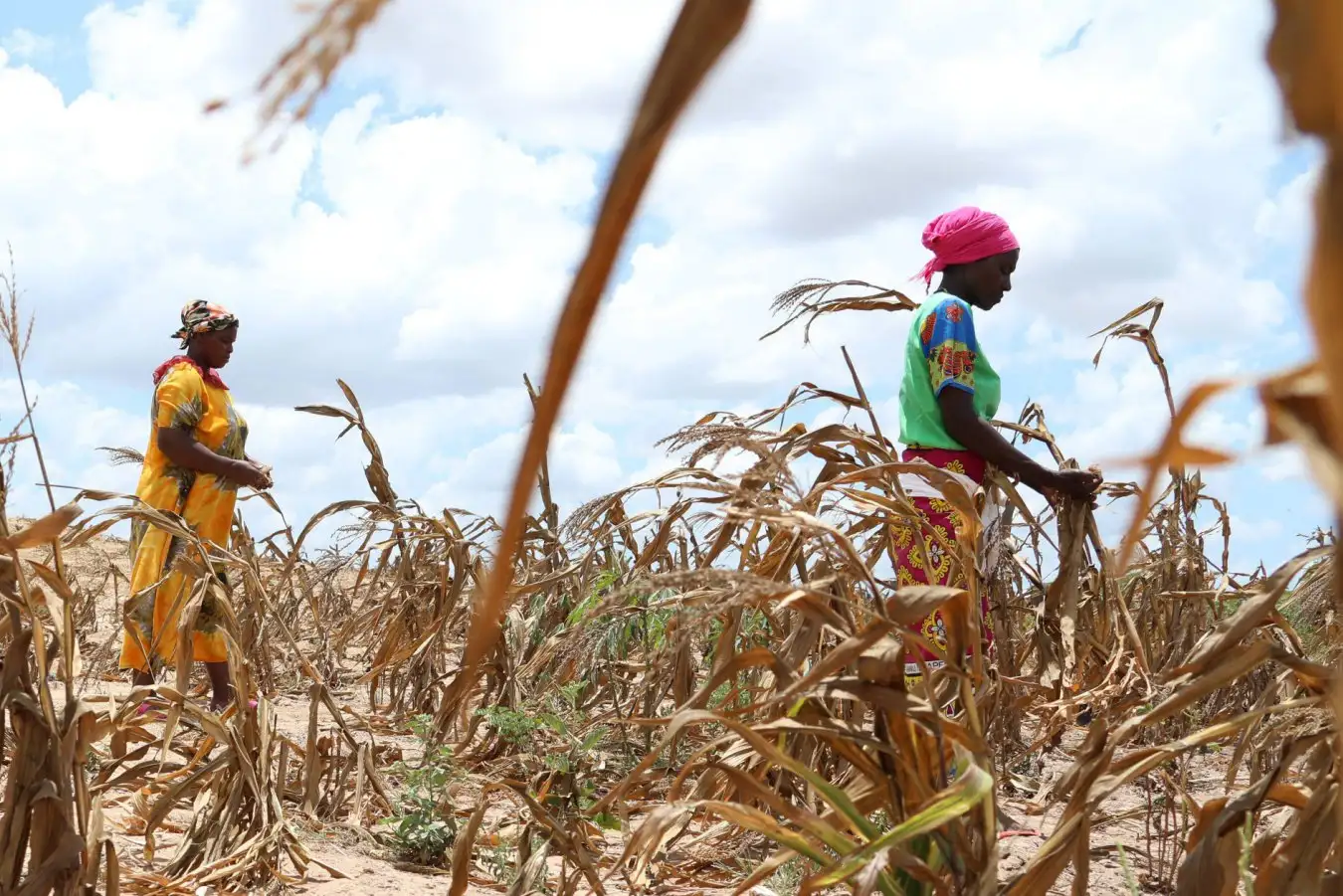

Economies heavily reliant on agriculture will face the biggest challenges.
Imago/Alamy
Research indicates that heat and drought driven by climate change are currently costing yields of corn, wheat, and soybeans approximately $20 billion annually. This figure could escalate to over $160 billion by the year 2100 if substantial emission reductions are not implemented.
The economic ramifications will be most severe in major agricultural producers like the United States, but low-income nations will feel the impact more acutely. As noted by Fan Yilin, from the International Institute for Applied Systems Analysis (IIASA) in Austria, “If you assess the least developed countries in Africa, the consequences are even more pronounced.” This situation could precipitate social unrest and increased migration.
These forecasts carry significant uncertainties since farmer responses and adaptations to a changing climate—such as transitioning to alternative crops or implementing irrigation—will greatly influence outcomes. The study aims to elevate awareness and promote adaptation strategies to lessen the likelihood of adverse predictions. Kai Kornhuber, also from IIASA, states, “Our goal is to drive action; we hope to eventually find that our projections are overestimations.”
The research team gathered data on country-specific yields of maize, wheat, and soybeans through the United Nations Food and Agriculture Organization (FAO). They calculated drought intensity using a standardized method based on historical climate data to estimate soil moisture from rainfall and evaporation.
After comparing extreme heat and drought conditions to yields from 1974 to 2004, statistical correlations were established to determine crop losses from 2007 to 2019. The findings reveal a 3.5% yield reduction due to extreme heat and drought compared to the baseline period. As Kornhuber points out, “Though 3% may seem minor, it creates a major impact on the global food market, potentially triggering severe regional crises.”
Using FAO data, researchers calculated economic losses based on farmer selling prices at the time. They applied the same methodology to predict future losses across multiple emissions scenarios, assuming some adaptation efforts are in play.
Under the high-emission scenario, SSP3-7.0, global yields could decline by roughly 35% by 2100, resulting in annual losses exceeding $161 billion. “Production losses from heat and drought are about 855 million tonnes annually,” notes Fung, who presented these findings at the European Geosciences Union conference in Vienna in May. “This figure is roughly equivalent to the annual consumption of around 2 billion people.”
This analysis may underestimate climate change’s total impact, as it considers only three crops and ignores potential damage from floods, storms, and excessive rainfall. Price spikes from shortages, similar to those seen with crops like coffee and cocoa, could also occur.
According to Jonas Jagermeyer, researchers at Columbia University suggest that the study’s reliance on statistical correlations might overestimate impacts by 2100: “Statistical yield models best explain current conditions but may lose accuracy in drastically altered environments, such as high-emission scenarios.” However, these models effectively project the effects of rising CO2 levels and temperatures on plant life.
Karine Chenu, a professor at the University of Queensland, shares similar views, stating, “While not perfect, the model is useful for these kinds of extrapolations.” However, her team recently released a preliminary study revealing significant errors in two commonly used wheat models, especially in predicting the combined effects of heat waves and droughts.
In defense of their statistical methods, Kornhuber argues, “While models are beneficial tools, some validation studies indicate they may be less sensitive to extreme conditions. Our research specifically focuses on extreme phenomena, prompting us to rely on direct statistical relationships.”
Topics:
Source: www.newscientist.com