


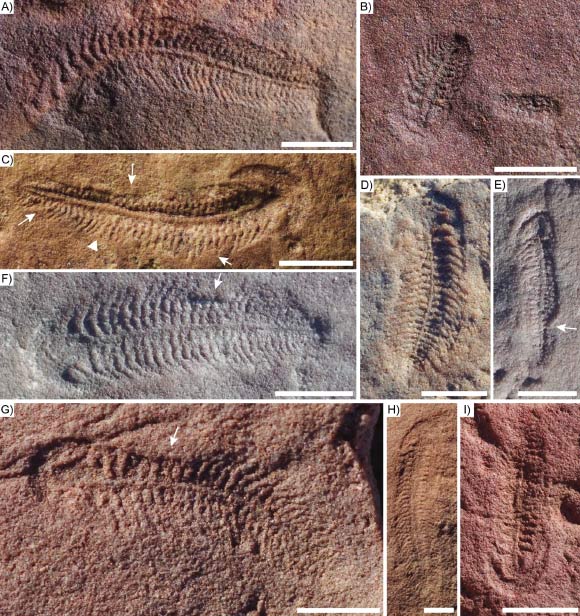
Spriggina flounder is a significant marine species from the Ediacaran period, approximately 550 million years ago. It stands out as one of the earliest known bilaterally symmetrical animals on our planet. Recent analyses of over 100 newly discovered fossils in South Australia suggest that the emergence of left-right behavioral preferences occurred much earlier in evolution than previously believed.
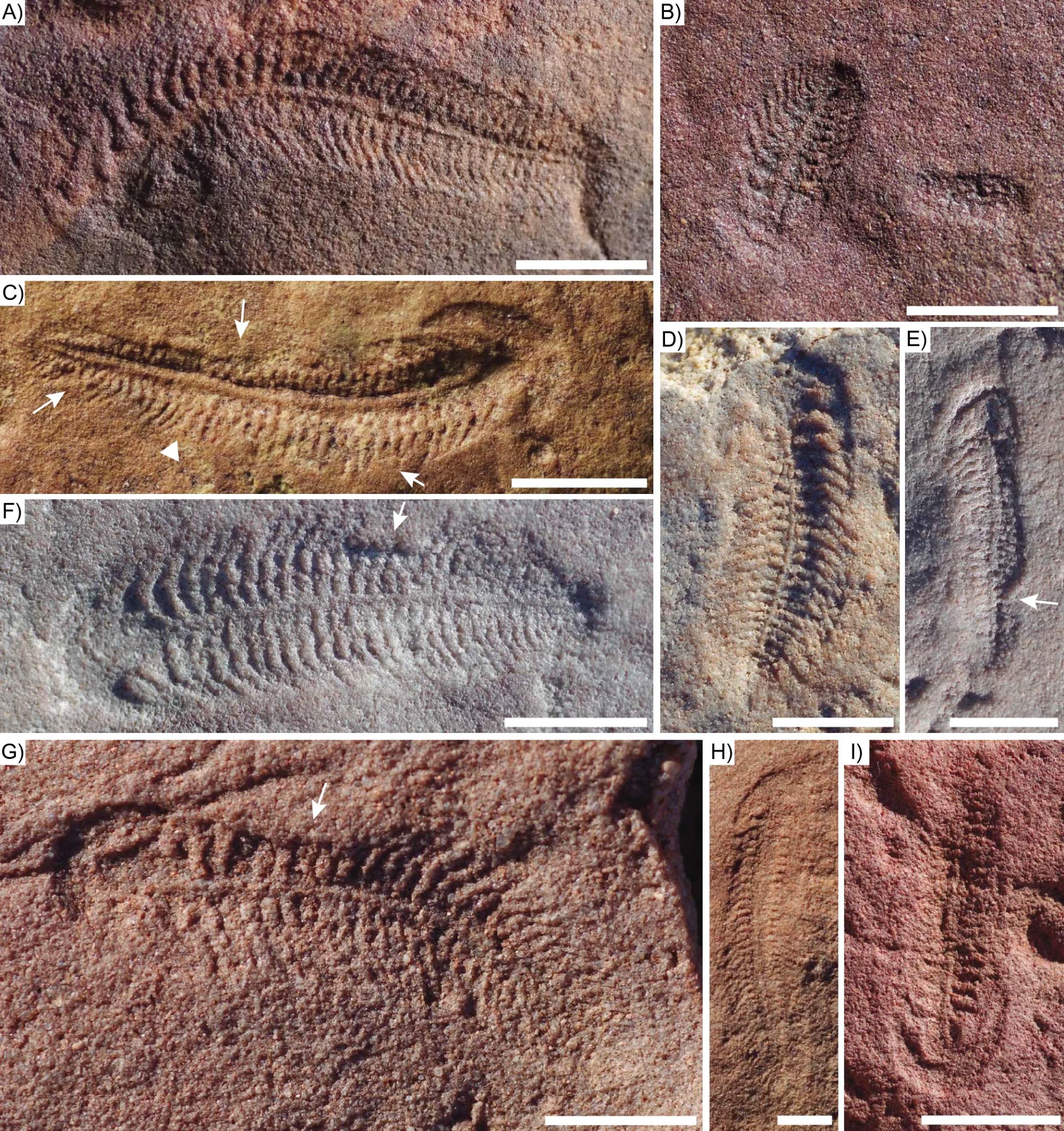
Fossil of Spriggina flounder from South Australia. White arrows highlight lifted regions, and white triangles indicate divergent bending angles of adjacent modules. Scale bar – 10 cm. Image credit: Evans et al., doi: 10.1038/s41598-026-53857-x.
The Ediacaran period (635 to 538 million years ago) represents a pivotal chapter in Earth’s biological history.
During this era, microscopic life forms evolved into multicellular organisms, becoming large enough for the naked eye to detect and developing increasingly complex behaviors, including locomotion.
The Flinders Ranges and nearby regions of South Australia contain some of the most remarkable fossil records from this time.
Excavations in Nilpena-Ediacaran National Park have uncovered Ediacaran communities that were preserved during storms, offering a glimpse of the ancient ocean floor 550 million years ago.
Among the remarkable fossils found is the Spriggina flounder, first described in 1958 based on three specimens.
Spriggina flounder is one of the earliest known examples of bilateral symmetry, showcasing a body plan that features distinct front-to-back and left-to-right orientations.
This fundamental body structure is a shared trait among humans and most contemporary animal species.
“When discussing right-handed or left-handedness, many people likely think about how to grip a pencil or kick a ball,” explains Dr. Scott Evans, a paleontologist at the American Museum of Natural History and Florida State University.
“However, our research indicates that animals without limbs that lived over 500 million years ago may have exhibited their own version of handedness.”
To determine whether Spriggina flounder exhibited lateral preference, researchers analyzed shape variations in more than 100 remarkably preserved fossils from the Nilpena Fossil Bed and collections housed at the South Australian Museum in Adelaide.
They made an intriguing discovery: there were approximately twice as many specimens bent leftward compared to rightward.
These fossils provide a mirror image of the original organism, meaning that the leftward bend in the rock corresponds to an animal that lived its life bending to the right.
This consistent pattern implies that Spriggina flounder predominantly faced right, marking it as the oldest animal known to display “handedness” in its population.
“This finding serves as a reminder that some traits we take for granted have ancient origins,” states Dr. Mary Droser, a paleontologist at the University of California, Riverside.
The discovery also sheds light on how Spriggina flounder may have interacted with its environment.
“We know that living species exhibiting similar handedness, from insects to octopuses to birds and mammals, possess complex sensory capabilities,” Evans notes.
This indicates that the nervous system of Spriggina flounder was relatively sophisticated and akin to modern animals.
Findings were reported on July 9, 2026, in a study published in the Journal Scientific Reports.
_____
SD Evans et al. 2026. Earliest evidence for behavioral handedness in Ediacaran motile bilateral animals. Spriggina flounder. Scientific Reports 16, 19924. doi: 10.1038/s41598-026-53857-x
Source: www.sci.news