


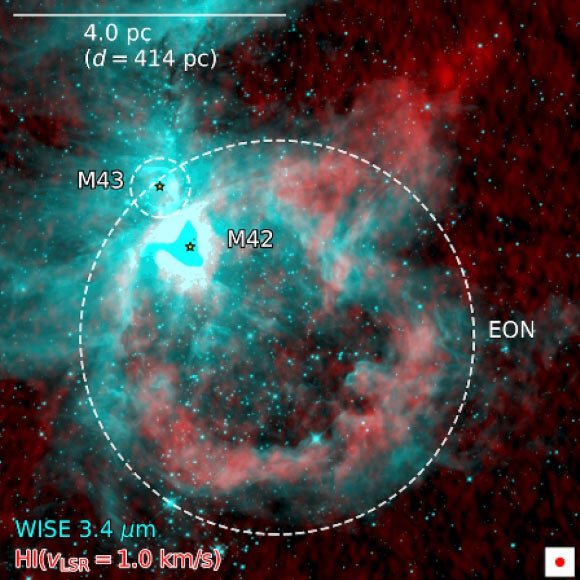
Astronomers utilizing the Karl G. Jansky Very Large Array (VLA) and the 500-meter Spherical Radio Telescope (FAST) have produced the most detailed radio map of neutral hydrogen surrounding the Orion Nebula. This groundbreaking research reveals expansive shells, enigmatic cavities, and elongated filaments, indicating that this renowned stellar nursery was shaped by numerous generations of giant stars rather than a singular expanding bubble.
The intricate structures of the Orion Nebula, captured through HI radiation from VLA and FAST (in red), Hα from the European Southern Observatory (in green), and 3.4 μm from WISE (in blue). Image credit: Juan D. Soler, University of Vienna / NRAO / VLA / NASA / WISE.
The Orion Nebula, located 1,350 light-years away in the constellation Orion, serves as a diffused nebula that captivates astronomers and stargazers alike.
Also known as NGC 1976, Messier 42, M42, LBN 974, and Sharpless 281, this nebula stretches approximately 24 light-years long.
Visible to the naked eye, it appears as a hazy spot adjacent to the Hunter’s Sword star Theta Orionis, below Orion’s belt.
At just 2 million years old, the Orion Nebula acts as an exceptional laboratory for studying young and developing stars, providing insights into the conditions present at the time of our Sun’s formation 4.6 billion years ago.
“Hydrogen, being the most abundant element in the universe,” noted Dr. Juan Diego Soler of the University of Vienna and his collaborators, “emits weak radio waves at a wavelength of 21 centimeters in its neutral atomic form. This allows astronomers to trace invisible gas between stars.”
To achieve unprecedented detail in detecting this emission, a collaboration of VLA and FAST telescope observations was employed.
“Earlier studies estimated that the shell enveloping Orion contained roughly 1,000 times the mass of the Sun,” the researchers explained. “However, our new hydrogen observations reveal its mass to be nearly ten times lower.”
This new radio map also uncovers what seems to be a second expanding cavity within the main shell, in addition to a narrow “protrusion” of atomic gas extending approximately four light-years outward from the bubble.
Such structures imply that the Orion Nebula was sculpted by various episodes of stellar feedback rather than a singular explosive event.
“The complexities unveiled by these observations challenge our existing comprehension of star formation,” stated Dr. Daniel Seifried, an astronomer at the University of Cologne.
“These surprising findings influence modern astrophysical simulations that investigate the evolution of gas and stars within the Milky Way.”
“These images challenge the theoretical models and numerical simulations we utilize to understand how massive stars influence their environments,” remarked Dr. Claire Murray from the Space Telescope Science Institute.
“Orion marks just the beginning,” emphasizes Dr. Soler.
“Our innovative method illustrates how forthcoming interferometers will lay bare the hidden structures and dynamics of the interstellar medium, even in regions previously thought to be well understood.”
This study’s results were published in the journal Astronomy and Astrophysics.
_____
JD Soler et al. 2026. Neutral Atomic Hydrogen Near the Sun (NeAtHood) Project. I. Ghost in the Shell: Neutral atomic hydrogen in the expanded Orion Nebula. A&A 711, A85; doi: 10.1051/0004-6361/202659272
Source: www.sci.news