


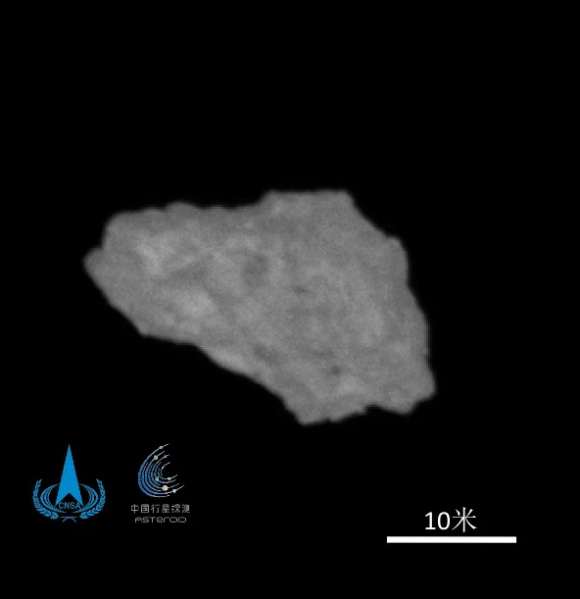
On July 2, 2026, the Tenbun-2 spacecraft approached within 20 km (12.4 miles) of the small near-Earth asteroid 2016 HO3, one of only seven known Earth quasi-satellites. A science campaign has been initiated in anticipation of the final sample return attempt.
Discovered on April 27, 2016, by the Pan-STARRS at Haleakala Observatory in Hawaii, 2016 HO3—also referred to as Kamo’olewa (meaning “vibrating celestial fragment” in Hawaiian)—has an orbital cycle of one year and is estimated to be about 30 meters (98 feet) in diameter.
“Among all known near-Earth asteroids, 2016 HO3 is a remarkably rare co-orbital object with Earth,” stated Dr. Rongqiao Zhang and colleagues from the Lunar Exploration and Space Engineering Center.
“As a quasi-Earth satellite, its orbital period closely matches that of Earth, enabling low-energy transfers and maintaining a stable distance of approximately 0.1-0.3 astronomical units (AU) from our planet, facilitating tracking, control, and communication.”
“Its unique orbital variations, enigmatic origins, and insufficiently characterized physical properties render this satellite a strong candidate for exploring fundamental questions about the origins of Earth’s quasi-satellites and the dynamism of their orbits.”
“Models of orbital dynamics indicate that the current quasi-satellite state initiated around 100 years ago and is projected to last for approximately 300 years,” added the researchers.
“It currently holds the position of the nearest quasi-satellite to Earth (minimum distance of 0.2 AU, overall dynamic stability not exceeding 0.3 AU) and is the most stable target of its kind.”
“Potential origins for this asteroid include localized formation, gravitational capture, or ejection from the lunar surface due to collisions with other celestial bodies.”
2016 HO3 is the primary target for the China National Space Administration’s (CNSA) Tianwen-2 small celestial body exploration mission.
“Launched from the Xichang Satellite Launch Center on May 29, 2025, using a Long March 3B/G2 rocket, China’s Tianwen-2 spacecraft is part of an ambitious planetary exploration program,” the researchers noted.
This exploration initiative, known as the Astronomical Project, encompasses a visionary series of four flagship missions: Tianwen-1 marks China’s inaugural journey to Mars, Tianwen-2 targets small celestial objects, Tianwen-3 focuses on sample return from Mars, and Tianwen-4 aims to explore the Jupiter system.
“What sets Tianwen-2 apart is its dual focus; not only will it gather samples from the near-Earth asteroid 2016 HO3, but it will also conduct an in-depth investigation of main-belt comet 311P.”
After an extensive 400-day journey covering around 1 billion kilometers (600 million miles), Tianwen-2 successfully approached within 20 kilometers of 2016 HO3 on July 2, 2026.
“Throughout the journey, Tianwen-2 executed a series of deep space maneuvers and mid-course corrections,” mission scientists confirmed.
“The spacecraft first detected the asteroid on June 6, conducted acquisition control from 30,000 km away on June 7, and achieved co-orbital alignment with the asteroid. By June 19, the asteroid was just 2,000 km distant.”
“We leveraged the optical navigation data collected to refine the asteroid’s ephemeris, improving its positional accuracy from several hundred kilometers based solely on ground observations to just a few kilometers.”
“Tianwen-2 is now set to commence a more comprehensive scientific investigation, focusing on characterizing the asteroid’s shape, surface composition, and internal structure, all crucial for the upcoming sample collection.”
Source: www.sci.news