


The oldest known animal fossils on Earth, dating back 574 million years to the Ediacaran period, reveal that cloning dominated the Ediacaran oceans. This prolonged asexual reproduction limited competition, hindering evolution until environmental stress led to the emergence of sexual reproduction, triggering an explosion of biodiversity.
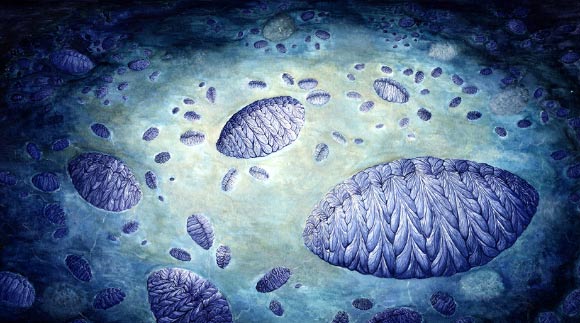
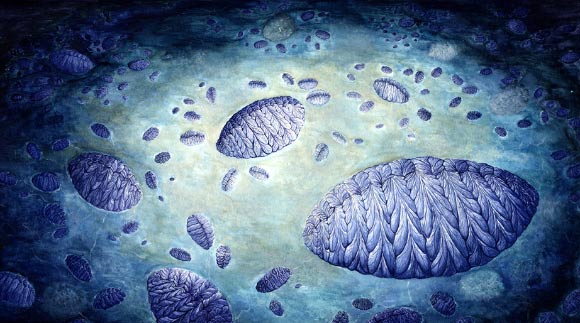
Artist’s reconstruction of a Fructofusus assemblage: a large specimen is surrounded by smaller clusters, forming independent double-cluster patterns. Image credit: CG Kensington.
After billions of years of microbial life, the first animals emerged during the Ediacaran period, spanning 635 to 539 million years ago, marking a significant leap in complexity.
Some of these early creatures, such as fructophusus, could reach impressive heights of 2 meters (6.6 feet), though most were considerably smaller.
These organisms exhibited fern-like characteristics and lacked mouths, organs, or means of locomotion, relying instead on absorbing nutrients from their surrounding waters.
Notably, these early life forms vanished from the fossil record at the start of the Cambrian period, 540 million years ago, complicating efforts to link them to modern species.
Research indicates that these primitive animals reproduced asexually, using techniques similar to modern strawberry plants, proliferating in the nutrient-rich Ediacaran seas.
According to Dr. Emily Mitchell from the University of Cambridge, “Life during the Ediacaran was relatively comfortable, which reduced the necessity for sexual reproduction.”
She noted that low competition meant there wasn’t much pressure to evolve new survival tactics.
Dr. Mitchell and Professor Andrea Manica from the University of Cambridge utilized laser scanning, spatial analysis, and artificial intelligence to analyze Ediacaran fossils found in Newfoundland’s Mistaken Point.
Their findings revealed that asexual reproduction via stolons limited competition among species. They developed a computer model to simulate early animal community dynamics under varying reproductive methods.
This groundbreaking approach, known as Approximate Bayesian computation, allowed researchers to backtrack from actual data to determine organism dispersal and resource competition intensity.
Through this method, they established that limited dispersal linked to asexual reproduction contributed to the reduced species diversity in early animal communities. Subsequent transitions to sexual reproduction and broader dispersal correlated with a significant increase in evolutionary diversity.
For billions of years, competition and environmental stress were primary drivers of evolution. However, in the tranquil Ediacaran deep seas, asexual reproduction thrived amidst limited competition.
As Professor Manica explained, “Being interconnected by runners allows you to share nutrients and minimizes competition.”
However, as Ediacaran organisms expanded from deep to shallow waters, they faced greater challenges. Factors like tides, storms, and fluctuations in temperature and nutrient levels created a more unstable environment that intensified resource competition.
Dr. Mitchell noted, “When organisms experience frequent environmental stresses, the evolutionary landscape shifts dramatically.”
“Such stress often drives the shift to sexual reproduction, resulting in increased dispersal distances as animals yearn to settle in new habitats due to heightened competition.”
As these early organisms adapted to novel reproductive strategies and habitats, there was a corresponding rise in diversity, paving the way for a ‘second wave’ of animal evolution during the Ediacaran, further accelerated in the Cambrian as mobility increased.
This research was published in this week’s issue of Nature Ecology and Evolution.
_____
E. G. Mitchell and A. Manica. The influence of reproductive mode on resource competition and diversity patterns in early Ediacaran animal communities. Nat Ecole Evol published online June 9, 2026. doi: 10.1038/s41559-026-03094-2
Source: www.sci.news