


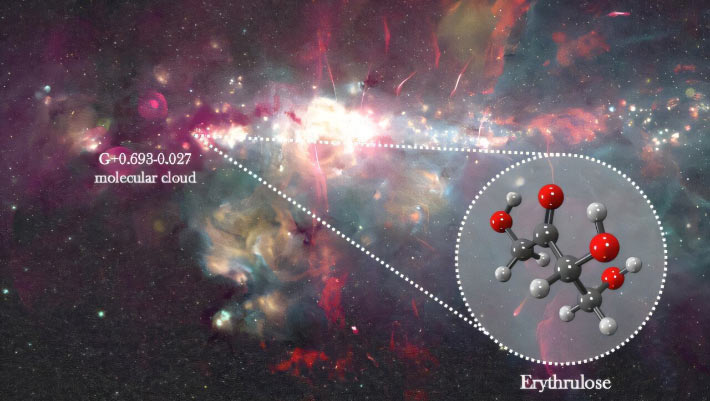
Using the Ieves 40-meter radio telescope and the IRAM 30-meter radio telescope, astronomers have successfully identified erythroulose, a tetracarbon sugar prevalent in raspberries and cosmetic sunscreens, within the molecular cloud G+0.693-0.027.
This composite image depicts the central region of the Milky Way, showcasing the location of molecular cloud G+0.693-0.027. Image credit: Ashley Barnes / Izaskun Jiménez-Serra / Juan García de la Concepción.
Sugars are crucial to life, forming the backbone of DNA and RNA while serving as metabolic fuel. However, scientists have faced challenges in explaining how these sugars formed in significant quantities on early Earth.
Laboratories replicating prebiotic conditions typically yield only trace amounts of sugar.
The detection of ribose and glucose in meteorite samples and the asteroid Bennu has spurred theories that some of Earth’s sugars may have extraterrestrial origins.
Until now, no sugar had been directly identified within the interstellar medium.
“Sugars are vital biomolecules that serve as metabolic fuels and structural components of nucleic acids,” commented Izaskun Jiménez-Serra, PhD, from CSIC-INTA and colleagues.
“A key question in the origin of life research is understanding how monosaccharides formed on early Earth, as experiments have produced insufficient concentrations.”
Astronomers employed the Ieves 40-meter radio telescope along with the IRAM 30-meter radio telescope to explore the molecular cloud G+0.693−0.027, a chemically rich area located roughly 8,200 parsecs (26,745 light-years) from Earth.
They detected 12 sets of radio emission lines that correspond to the expected spectral signature of erythroulose, a tetracarbon sugar with the formula C4H8O4.
“Erythroulose, consisting of 14 atoms, is the largest acyclic species ever identified in the interstellar medium and the first molecule containing four oxygen atoms detected in this region,” the researchers noted.
“This marks the first sugar and the second chiral molecule found in the interstellar medium.”
“Its detection not only provides direct evidence that complex chiral molecules can form under interstellar conditions, but also elevates our understanding of interstellar chemical complexity and suggests that other prebiotic and potentially chiral molecules could also form and persist under the extreme conditions of space.”
The findings indicated erythroulose is at least eight times more abundant than tricarbon sugars like glyceraldehyde and dihydroxyacetone, which were not detected in the same molecular clouds despite the survey’s sensitivity.
This discovery implies that erythroulose could form from simpler molecules on cosmic dust particles, eventually contributing to more intricate chemical systems.
“This unexpected discovery challenges the prevailing belief in astrochemistry that interstellar molecules grow primarily through the sequential addition of carbon atoms,” remarked Jiménez-Serra.
Dr. Carlos Briones, also from CSIC-INTA, added, “The detection of erythroulose is particularly significant as it paves the way for discovering other sugars in space, such as ribose, which is integral to RNA, and other molecules fundamental to the origin of life.”
This groundbreaking finding is detailed in the following article: paper published in today’s Nature Astronomy.
_____
I. Jimenez-Serra et al.. Tetracarbon sugar detected in interstellar space. Nat Astron published online on July 13, 2026. doi: 10.1038/s41550-026-02905-7
This version is enhanced for SEO, making it more engaging while preserving the necessary HTML structure.
Source: www.sci.news