


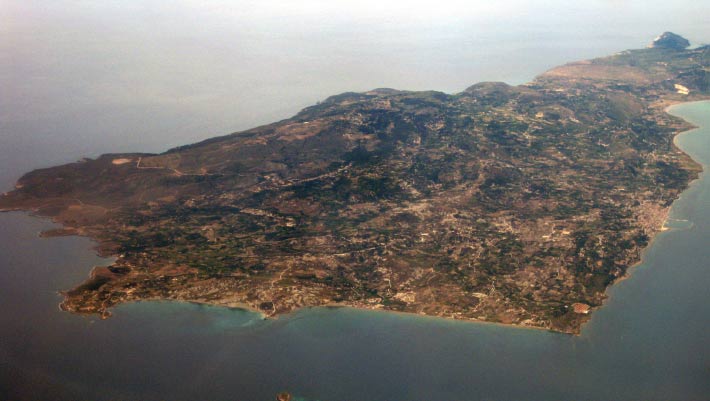
Readers familiar with Homer’s Odyssey often picture Odysseus’s hometown of Ithaca as its own distinct island. However, two scholars argue this long-held belief is incorrect, asserting that Ithaca was, in fact, a peninsula on the Greek island of Kefalonia.
Paliki Peninsula, Kefalonia, Ionian Islands, Greece. Image credit: Christos Vittoratos / CC BY-SA 3.0.
Professor James Diggle from the University of Cambridge and Professor John Underhill from the University of Aberdeen contend that Homer never explicitly referred to Ithaca as an island.
The duo emphasizes that the poet consistently employs Greek terms such as “land,” “homeland,” or “territory” when describing Ithaca, even in passages traditionally interpreted as suggesting it was surrounded by water.
“While Homer mentions Ithaca frequently, he does not use the term ‘island,'” asserts Professor Diggle.
“Homer and his characters prefer terms like ‘land’ (γαῖα/gaia), ‘homeland’ (πατρίς/patris, πατρὶςαἶα/γαῖα/patrisgaia), and ‘country’ (δῆμος’/dimos), despite the appropriateness of νῆσος for the poem’s meter.”
“Homer stated, Ithaca’s δῆμος. This term appears often in the narrative, especially when Odysseus finally returns home after his ten-year voyage.
During this time, a sailing ship approached the shores.
Ithaca is home to Forcis Bay.
Old man of the sea: there are two capes within it…
“While such translations may imply Ithaca is an island, Homer actually wrote: Ithaca’s δῆμος is home to Forchis Bay,” which suggests, “In the territory of Ithaca lies Forchis Bay”. This indicates Ithaca is part of the land the ship approaches.
According to the researchers, this larger island is Kefalonia, particularly its western peninsula, Paliki, believed to be the location where Odysseus governed the Cephalenians.
This theory was initially posited by businessman-turned-researcher Robert Bittlestone in his 2005 book Odysseus Unbound. He suggests that Paliki aligns with Homer’s descriptions of low-lying terrain facing west, adjacent to three named islands—a description not applicable to the contemporary, mountainous isle now known as Ithaki.
The challenge is that Paliki needed to be a genuine island, originally separated from the rest of Kefalonia by a channel that subsequently filled due to ancient earthquakes and landslides around 1200 BC.
Professor Underhill dedicated 20 years to investigating this concept through geological surveys and found no evidence of such a channel.
Two complementary lines of evidence have emerged: geological and philological.
Recent excavations at Paliki, particularly the Livadi Swamp site proposed as Odysseus’s port, further substantiate its significance as a notable Bronze Age location.
“We are confident that we have successfully integrated geoscience, Homeric texts, and Strabo to present a cohesive explanation that aligns with Robert Bittlestone’s vision in Odysseus Unbound, asserting that Paliki is the site of Homer’s Ithaca,” conclude the researchers.
Their findings were published in an online journal, Antigone. Read more here.
Source: www.sci.news