


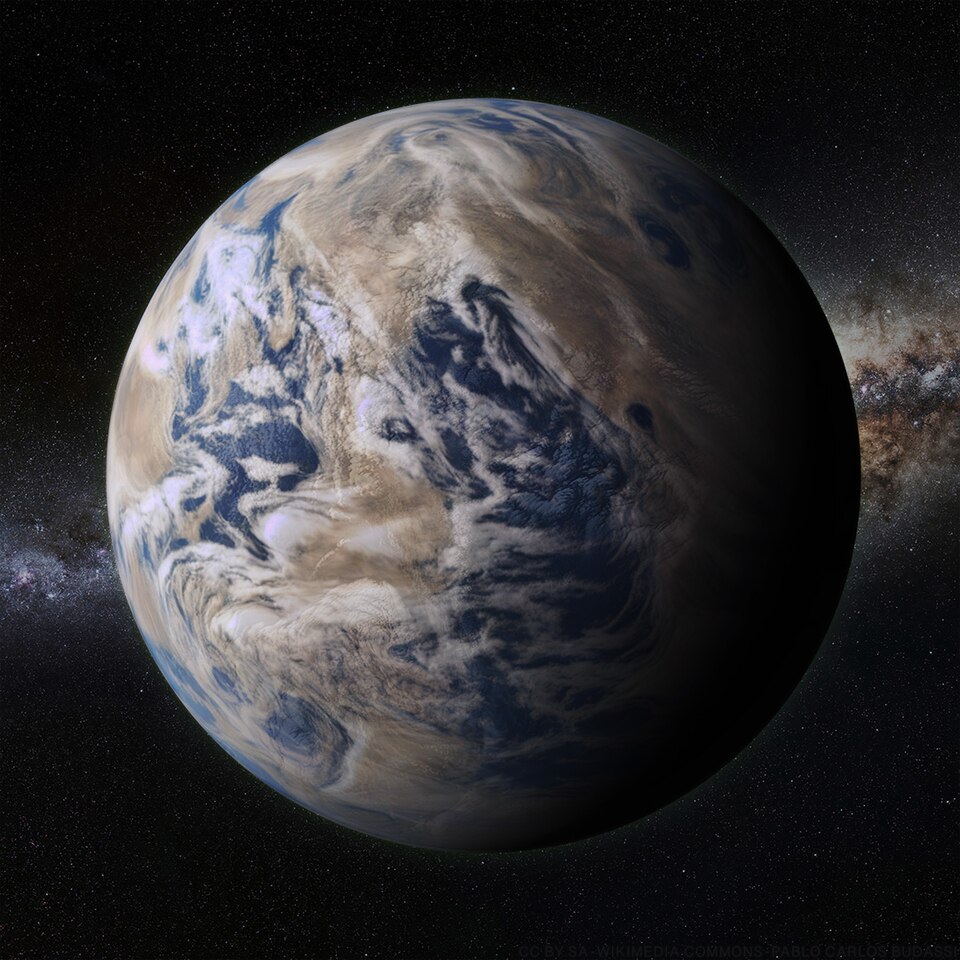
Earth boasts many unique features that set it apart from other planets, such as a protective magnetic field, a sizable moon, and active plate tectonics. It remains the only planet confirmed to support life, which aligns with the rare earth hypothesis. This hypothesis suggests that extraterrestrial life has yet to be discovered because other planets lack the necessary conditions for sustaining life.
Approximately 30% of Earth’s surface is land, while around 70% is covered by oceans. In a recent study, David Kipping, an assistant professor at Columbia University, examined the distribution of land and ocean across the planet, shedding light on the percentage of land available for life. This unique ratio is crucial for supporting not only simple microorganisms but also advanced species like humans.
To explore this hypothesis further, Kipping constructed four statistical models of planets with varying land areas to evaluate where intelligent life might evolve. His initial equation examined the probabilities of a planet existing within its habitable zone. The models focused on land configurations referred to as probability distributions, weighted towards scenarios where planets either consist of a single large landmass or a vast ocean, rather than a mixed configuration like Earth.
Kipping incorporated these land proportion probabilities into a statistical model to calculate the likelihood that a random planet with similar land coverage could host intelligent life. The four scenarios he analyzed included: 1) intelligent life is more likely to emerge on land-dominated planets, 2) on ocean-dominated planets, 3) on planets with a balance of land and ocean, and 4) the emergence of intelligent life is unaffected by land distribution.
To identify potential planets where intelligent life might exist, Kipping used his models to estimate the probability that a planet with Earth-like land distribution would support intelligent species. He then compared these probabilities to generate a ratio for each model. As Earth is the only known planet with intelligent life, models suggesting a higher chance of human presence on Earth are considered more reflective of reality.
Kipping regarded a ratio greater than 10 between two models as strong evidence favoring one model over another. This would indicate that one model is ten times more likely to predict the existence of Earth and its inhabitants. Kipping did not find this threshold exceeded in his comparisons. However, models suggesting that intelligent life tends to favor ocean-centric planets or balanced land-ocean models predicted the presence of humans 2.5 to 3 times more likely than land-centric models. Interestingly, models favoring a delicate balance between land and sea consistently ranked higher for predicting human existence, even if marginally.
Kipping also explored whether the discovery of additional planets with intelligent life could change which model is considered most accurate, especially if evidence emerged that life once existed on Mars. He identified two main challenges here: first, the uncertainty around how much of Mars was once under water—estimates range from 25% to 81% land. Second, proving ancient life on Mars does not inherently confirm the existence of intelligent life.
Despite this, Kipping recalibrated his model based on the assumption that ancient Mars had comparable land area to Earth. This revision produced a ratio akin to previous calculations focused solely on Earth. In simpler terms, no single model could definitively predict the presence of humans and life on Mars with a 10x factor.
Kipping inverted the 10x threshold to evaluate the required conditions that would exceed this ratio. His calculations revealed that astronomers need to identify 14 additional planets with intelligent life and known land areas to objectively determine whether intelligent life is more prevalent on desert planets, oceanic planets, or balanced ecosystems.
Kipping concluded that we cannot definitively say if the land ratio on Earth plays a unique role in the emergence of intelligent species. However, Earth’s existence suggests that intelligent life is unlikely to emerge on extreme desert planets, indicating that we may not find environments like Tatooine or Jackass in the Milky Way. While his analysis does not entirely dismiss the rare earth hypothesis, it does weaken the argument that the size of Earth’s oceans is the crucial factor for its rarity.
Post views: 457
Source: sciworthy.com