



The traditional timeline for vulnerability management has faded into obscurity. For years, defenders assumed it would take weeks, if not months, for an exploited vulnerability to transition into a successful attack.
Now, that gap has rapidly diminished.
The first contributing factor is the surge in vulnerabilities: New vulnerabilities are emerging at an unprecedented rate. In fact, the number of CVEs documented in the first half of 2026 surpasses all counts in full years prior to 2024, averaging about 1 every 7.4 minutes.
The second factor is speed. Recent advancements in AI have drastically reduced the time it takes to exploit vulnerabilities. Zero-day clocks, which measure the time from vulnerability disclosure to exploitation, indicate that the median time has now dropped to well under a day compared to weeks just a few years ago.
Unfortunately, security teams struggle to keep pace, and no organization can escape a backlog that grows almost instantaneously. Moreover, only a fraction of these CVEs evolve into real-world attacks.
This scenario increases the timeframe in which attackers can freely operate, while defenders remain powerless to intervene. Growing complexity complicates the landscape, distinguishing between genuine threats and the myriad vulnerabilities that rarely get targeted.
The Risks of Insufficient Testing
Conducting penetration tests continuously, rather than quarterly, helps narrow the focus, but it does impose limitations. Current automated penetration testing tools can only execute live exploits in designated safe zones with pre-existing workable exploits. Most companies typically cover only 10-15% of their actual attack surfaces.
Many vulnerabilities remain unverified. Conventional automated penetration testing can identify undisclosed flaws, but regulated and air-gapped systems are too sensitive for live attacks, especially when new vulnerabilities are disclosed that attackers may already be exploiting.
To prove exploitability, you don’t have to publicly exploit a vulnerability or risk a critical system. A security chain’s integrity relies on its weakest link, making it unnecessary to stress the entire chain to identify vulnerabilities. The Picus platform validates whether a vulnerability is exploitable without risking production systems.
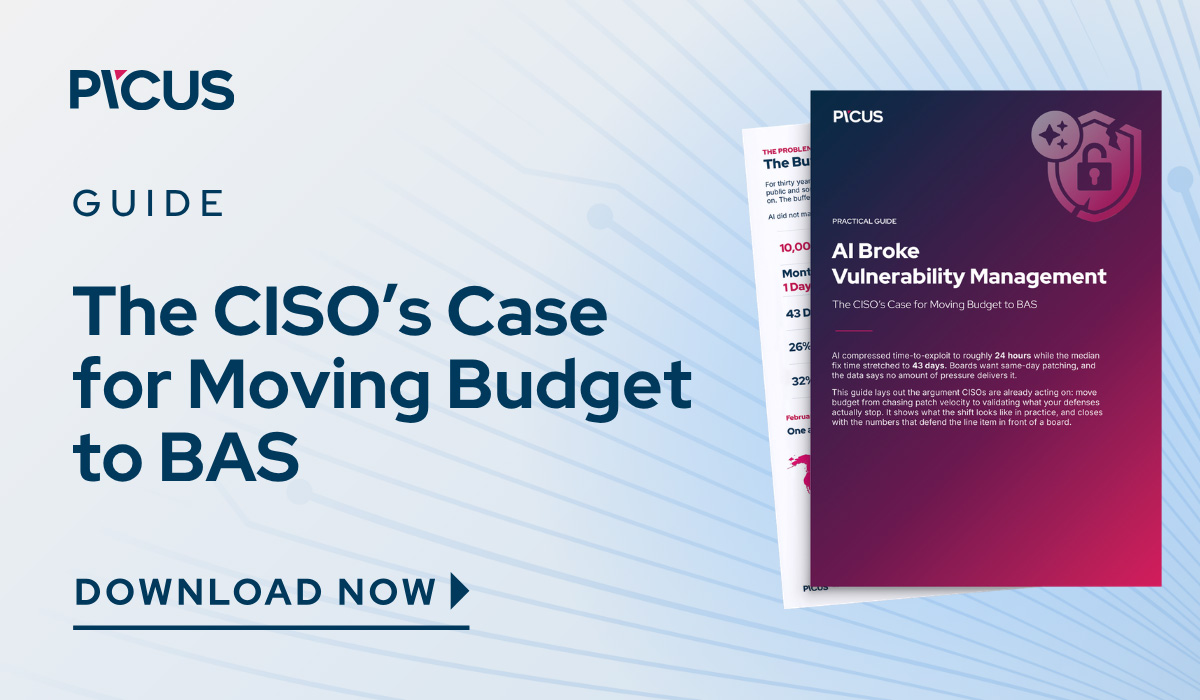
This gap in coverage is prompting CISOs to reallocate budgets from patch prioritization toward verification, supported by our comprehensive guide that presents compelling data for board discussions. Download your copy below.
Validate the Chain Rather Than Just the Exploit
This is where a balanced approach is essential. You can ascertain whether an exploit is functional against your environment without taking unnecessary risks.
Each exploit consists of several crucial steps: initial execution, defense evasion, privilege escalation, credential theft, and lateral movement. An attacker’s success at each phase is contingent upon the environment’s defenses.
By mapping vulnerabilities to their dependent steps and testing them against your actual defenses, you can discern if a required step lacks a viable path through the controls in place. If it doesn’t, the chain cannot be completed, indicating that exploits against that asset are unlikely to succeed, even if the vulnerability itself still exists. Conversely, if all necessary steps are validated, the exposure is genuinely exploitable, bolstered by concrete evidence rather than conjecture.
This logic is akin to rocket science. Engineers meticulously inspect engines, fuel systems, and safety features prior to any launch to ensure no critical component fails the test—because if it does, the vehicle cannot risk a launch attempt.
A new CVE is published every 7.4 minutes, and our AI transforms advisories into actionable exploits within a single day. No patching strategy can maintain this pace.
This guide elucidates why CISOs are reallocating budgets from patching speed to verifying the effectiveness of their defenses, complete with comprehensive supporting data.
Case Study: Nightmare-Eclipse
The latest vulnerability, illustrating this issue, unraveled as soon as a Windows zero-day was reported and subsequently picked up by the cybercriminal underworld. A real-world example is Nightmare-Eclipse. The exploit code surfaced on GitHub less than a week ago, but not every organization can afford to run real malware against its own domain controller as a testing method.
Examining the sequence of events surrounding this vulnerability highlights why proving the chain, rather than simply executing it, is a more strategic approach for prioritizing patches.
Nightmare-Eclipse (also known as chaotic eclipse or dead eclipse) is not a state-sponsored actor or a ransomware group, but rather appears to be a security researcher harboring grievances against Microsoft.
Commencing in early April 2026, attackers released a series of uncoordinated Windows zero-day vulnerabilities, many without CVEs or patches. These vulnerabilities were consolidated into a singular playbook for self-sufficient privilege escalation and evasion tactics.
- Blue Hammer: A local privilege escalation tactic that exploits a race condition in Windows Defender, enabling access to privileged files.
- Red Sun: An inverted approach focusing on writing privileged files, redirecting SYSTEM-level writes instead of merely reading from SAM hives.
- Remove Protection: Tools enabling the dismantling of Defender’s protections and reporting false statuses to the EDR console.
When executed together, these steps culminate in a system devoid of privilege boundaries and a security layer that conceals its vulnerabilities.
Developing a Trustworthy TTP Chain
Transforming penetration tests into secure assessments involves breaking down each attacker’s behavior into discrete actions that the Picus platform can replicate and analyze without actual exploitation.
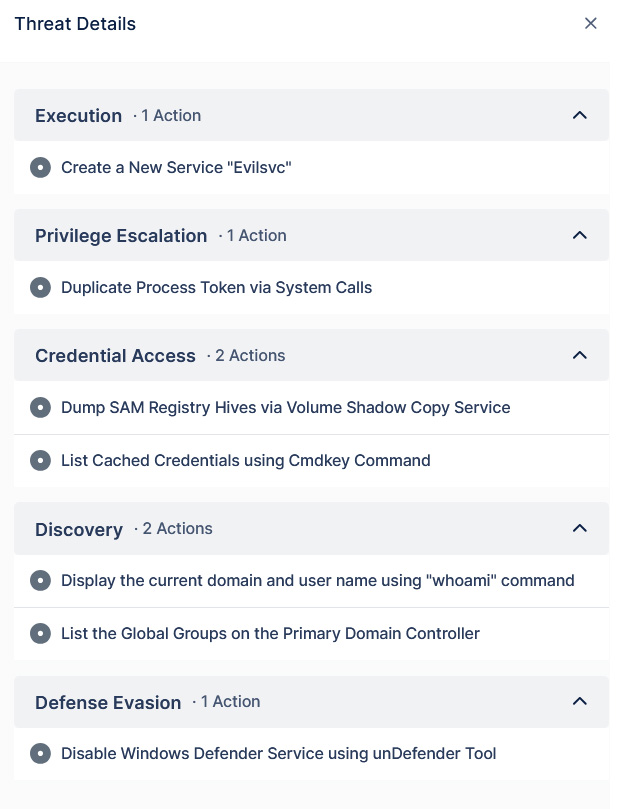
Each chain comprises several actions, but three components typically carry the most relevance.
- Create a New Service “Evilsvc” (Execution): This step concludes the BlueHammer escalation by registering a temporary Windows service.
- Dump a SAM Hive via Volume Shadow Copy (Credential Access): By leveraging shadow copies, an attacker can gain access to the credential data without engaging with a live registry.
- Disable Windows Defender Service (Defense Evasion): Safeguarding against Defender’s signatures while falsely illustrating a healthy status.
Implementing these steps against your real defenses allows you to determine if the full chain successfully executes and provides insights on where your defenses might be failing.
This methodology empowers you to prioritize the patches that genuinely mitigate risk while avoiding unnecessary exploitation, especially in sensitive systems. The TTP Chain guide details this entire process, from CVE identification to actionable decision-making, featuring a practical example. Get your copy below.

Comprehensive Coverage for Continuous Validation
Live exploits and TTP chains aren’t mutually exclusive; they complement one another effectively.
The most robust security programs employ both methods repeatedly as environments evolve. Controls that were effective last month may falter with future changes, making exploitability an ever-persistent query.
This is the gap Picus aims to close. When it comes to a potential exploit, whether in a safe environment or a newly identified vulnerability, autonomous penetration testing can exploit the real chain as the most compelling evidence available.
Breach and attack simulation will further validate all findings, ensuring last quarter’s “approved” status doesn’t mislead future assessments.
The result is a unified platform delivering immediate answers. What vulnerabilities are likely exploitable right now? We’ll identify cases that are still pending resolution: the next Nightmare-Eclipse release without a patch, an air-gapped system impervious to exploitation, and a newly arrived advisory.
Book a demo to witness how Picus can evaluate your environment against live exploits and TTP chains.
Sponsored and created by Picus Software.
Source: www.bleepingcomputer.com