


Editor’s note: Today’s feature is the July Puzzler.
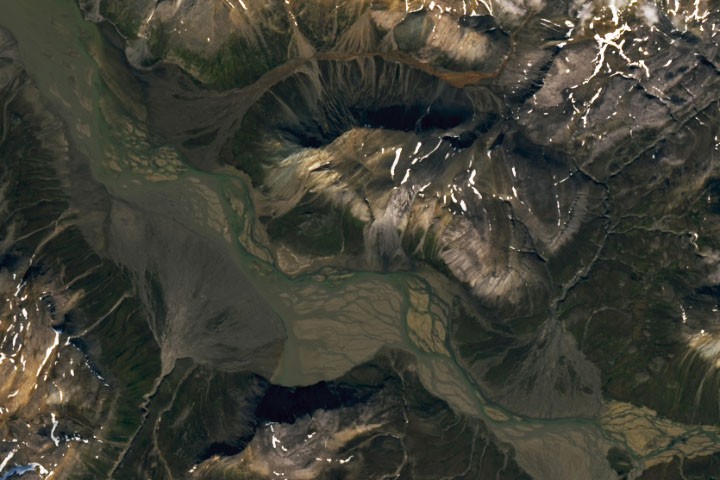
Welcome to the fascinating world of an alluvial faceoff. At the southern tip of Severny Island in Russia’s Arctic Circle, a river cascades down from rugged terrain, creating a dramatic valley. Upon reaching flat ground, the flow of water slows, dispersing sediment into unique cone-shaped formations known as alluvial fans. In this stunning Landsat 9 image, see several fans appearing in opposite directions along a braided river.
Severny Island, or Ostrov Severny, is a mountainous island located in the frigid high latitudes of the Northern Hemisphere. As part of the Novaya Zemlya archipelago, this remote island is primarily covered by glacial ice. Some glaciers, particularly in the north, end in the ocean, while others terminate on land, directing meltwater into glacier streams.
The rich sediment carried by streams and the island’s topography create optimal conditions for the formation of alluvial fans. Typically found at the bases of steep mountain ranges, these features emerge where narrow channels of rivers open into flatter areas. There, the flow slows and divides, distributing sediment to form fan-shaped deposits. In the expansive view below, observe how competing fans align along several gorges extending from northwest to southeast.
Seasonal snowmelt and glacier runoff ensure a continuous supply of materials for alluvial fan development along the Severny River. Hydrologist notes suggest that during warmer months, melting snow increases river flows, carrying more sediment from the mountains. Glaciers also contribute vast amounts of erosive materials as they descend, some of which are transported away by meltwater.
Smaller mountain glaciers, like those on southern Severny Island, are particularly vulnerable to melting due to rising atmospheric temperatures. Although Severny’s ice remains relatively unexamined due to its isolated location, satellite observations provide crucial insights into its conditions. Recent analyses using digital elevation models reveal significant changes in land-terminating glaciers across the Novaya Zemlya Islands, especially at lower altitudes during the 2000s and 2010s.
NASA Earth Observatory image by Lauren Dauphin, using Landsat data from the United States Geological Survey. Story by Lindsay Dorman.
- J. Mawecki (2022) Recent contrasting behavior of mountain glaciers across the European high Arctic revealed by ArcticDEM data. Cryosphere 16, 2067–2082.
- Melkonian, Alaska; Others. (2016) Recent changes in glacier velocity and glacier thinning in Novaya Zemlya. Remote Sensing of the Environment 174, 244-257.
- NASA Earth Observatory (July 30, 2009) Novaya Zemlya. Accessed July 13, 2026.
- National Geographic Society (October 19, 2023) Alluvial Fan. Accessed July 13, 2026.
- Carleton University Science Education Resource Center (June 9, 2026) Cold climate conditions as drivers of fan deposition in the Lost River Mountains, Idaho, USA. Accessed July 13, 2026.
Source: science.nasa.gov