


Author: Deborah Padgett, NASA Jet Propulsion Laboratory MSL Operations Product Ground Systems Task Lead
Earth Plan Date: Thursday, July 2, 2026
This week, Curiosity approached the geological boundary between a smooth, sandy area and a coarser rock unit in anticipation of Independence Day.
On Sol 4939, Curiosity reached its first destination after leaving behind the polygonal terrain. A Navcam search for dust devils took place on Sol 4940. The rover performed AEGIS ChemCam laser spectroscopic observations and Mastcam imaging of selected targets. Unfortunately, there were no suitable large rocks for brushing with the DRT at this location.
On Sol 4941, the MAHLI camera captured images of “Malpartida” and “Pico del Tunari,” two light-colored rock fragments. The APXS conducted X-ray spectroscopy to determine their composition. Additionally, the ChemCam employed active laser spectroscopy on light-colored rock fragments from “Kunturiri” while passively targeting dark-toned rocks, known as “Mekoita,” believed to be transported from another location. ChemCam utilized the telescopic RMI camera to examine sedimentary layers at the base of the Cordillera Buttes, and the Mastcam created several mosaics of a sand and rock debris ridge named “Sitayana.”
On Sol 4942, the Mastcam continued researching “Sitayana,” with ChemCam RMI taking more shots of the Cordillera Buttes. The Navcam filmed the Super Horizon Cloud movie as well as the Dust Devil movie. Finally, ChemCam recorded images from Mastcam to perform laser spectroscopy on the dark rock fragment “Toconce.” The mast camera also imaged the Sierra Vicuna McKenna to analyze partially exposed sand-sloughed rocks in small rippled dune areas.
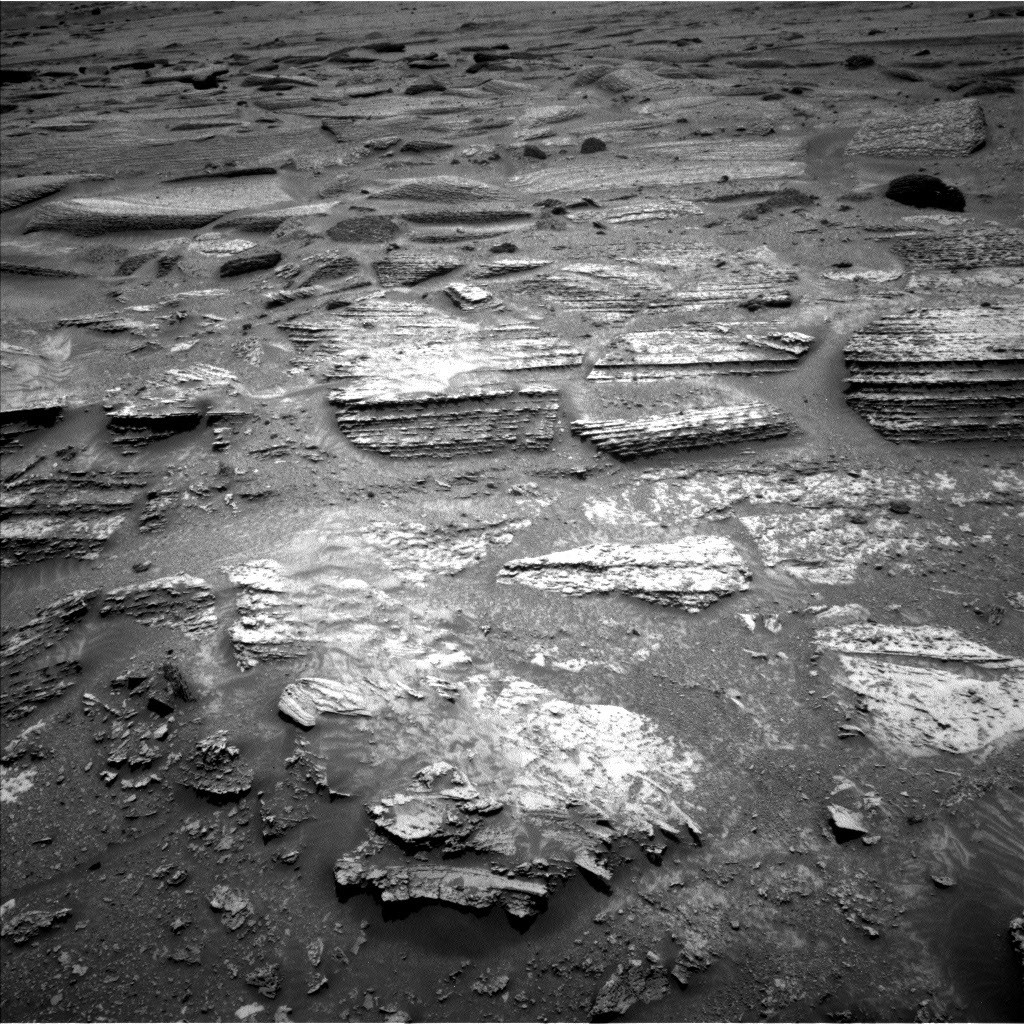
In the afternoon of Sol 4942, Curiosity traveled approximately 36 feet (about 11 meters) to the edge of the geological contact, capturing a post-travel panoramic mosaic with Navcam and Mastcam. These images showcased exposed bedrock outcrops featuring beautiful pinstripe layers. Navcam AEGIS observations were conducted for onboard selection of ChemCam laser spectroscopy targets, with soil and rock targets observed by ChemCam during Sol 4943‘s Mastcam documentation. The Navcam also filmed the Dust Devil movie, while Mastcam executed atmospheric dust observations.
On Sol 4944, two adjacent light rock targets, “Laguna Fair” and “Laguna Regia,” were chosen for DRT brushing, MAHLI imaging, and APXS X-ray spectroscopy to ascertain their composition. ChemCam laser spectroscopy, along with Mastcam documentation, aimed at a dark bulge in the rock formation “Horniros.” Despite plans for detailed imaging of “Hornilos,” it was deemed too rough for DRT brushing. The mast camera captured extensive mosaic imagery of the banded rock outcrop “Cerro Castillo,” as well as a smaller mosaic in a nearby valley. The ChemCam Telescope RMI targeted dark formations in the Butte Mountains, while the Navcam shot videos of dust devils and clouds on the horizon.
On Sol 4945, ChemCam will utilize Mastcam imaging to perform laser spectroscopic analysis of “Laguna Regia,” and the ChemCam RMI telescope camera will survey another location in the foothills of the Butte Mountains. This area shows signs that large stones could be remnants of glacial processes. The Navcam will conduct a dust devil survey and a dust image survey with Mastcam. In the afternoon, videos showcasing Navcam dust devil surveys, zenith observations, and horizon superclouds will be displayed, alongside Mastcam dust observations and a 20×4 mosaic image of Butte Mische Mokwa. Overnight, extensive APXS atmospheric observations will be executed.
During Sol 4945, ChemCam will perform laser spectroscopy on the target “La Puntilla” accompanied by Mastcam imaging. Following this, ChemCam will make passive sky observations. Curiosity will then travel about 56 feet (17 meters) towards a large, dark rock that may be a meteorite, where it will conduct post-trip imaging and Navcam sky flats.
The following morning will include atmospheric observations like Navcam zenith videos, above-the-horizon cloud visualizations, line-of-sight dust observations, and Mastcam dust “tau” observations.
Source: science.nasa.gov