


Even though it’s only mid-summer in the Northern Hemisphere, many regions in North America are already experiencing extreme heat. As the summer sun blazes on, temperatures have soared significantly.
Recently, a dominant ridge of high pressure settled over the northern Rocky Mountains during the weekend of July 11-12, 2026, intensifying heat levels. This meteorological event, known as a heat dome, traps warm air close to the ground.
This heat dome phenomenon inhibits convection, reducing cloud formation and precipitation. Consequently, sunlight readily reaches the Earth’s surface, exacerbating temperature increases. July’s heat dome led to unprecedented temperature records in Montana, Wyoming, and Utah.
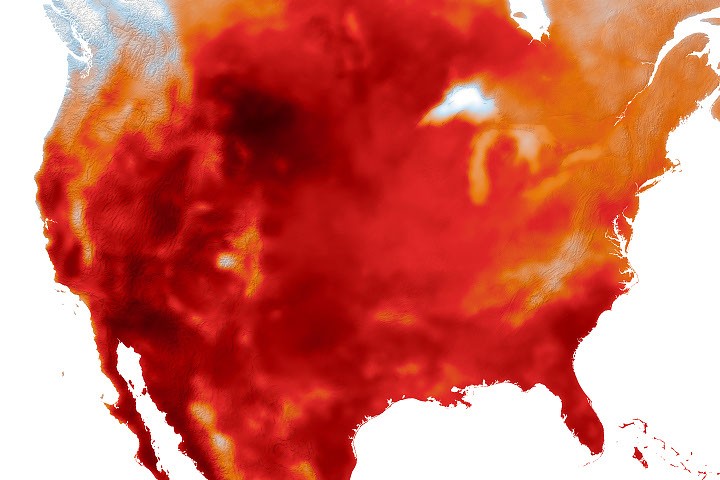
The above map displays temperatures across the United States at 2:00 PM Mountain Time on July 12, 2026. Modeled at 2 meters (6.5 feet) above ground level, it combines satellite data and temperatures predicted by the Geos (Goddard Earth Observing System) model, which uses mathematical equations to simulate atmospheric processes. The darkest red areas indicate temperatures nearing or exceeding 45°C (113°F).
According to a preliminary analysis by the National Weather Service office in Billings, temperature sensors across airports in Billings (111°F) and Miles City, Montana (115°F), and Sheridan, Wyoming (109°F), set new record highs on July 12. Each of these stations surpassed the previous record by at least two degrees, with Miles City exceeding it by four degrees, with records dating back to the 1930s for Montana and 1907 for Sheridan.
Utah also broke all-time temperature records, with significant peaks at Deseret (111°F), Salt Lake City (109°F, four degrees above the prior record), and Randolph (100°F, six degrees over its record). Observatories in Utah have been tracking temperatures since the 1890s.
Extreme heat poses serious health risks, especially for older adults. Intense heat can exacerbate common health conditions, including those affecting the heart, lungs, and kidneys. Data from the Centers for Disease Control and Prevention shows that mountain states experienced a tenfold increase in heat-related emergency room visits during the July heatwave, as tracked through their health monitoring data.
Researchers at NASA’s Goddard Space Flight Center have noted an uptick in heat waves across the United States over recent decades. Using the Mela-2 (Modern Retrospective Analysis for Research and Application-2) modeling system, a NASA team discovered that the occurrence of American summer heat waves has risen from an average of two to four per month between 1980 and 2023.
Forecasters anticipate that the heat dome will extend from the East into the Midwest, New England, and the Mid-Atlantic over the coming days, with temperatures in some regions possibly reaching triple digits. The United States is not isolated in facing this severe heat; regions in Western Europe, Central Asia, and East Asia are also grappling with similar heat waves.
Image by Michala Garrison, using Geos FP data from Global Modeling and Assimilation Office at NASA GSFC. Story by Adam Voiland.
- AccuWeather (July 13, 2026) “Steaming” pattern hits central and eastern regions as heat and humidity peak. Accessed July 14, 2026.
- NASA (May 8, 2025) Heat waves have increased in North America over the past 40 years. Accessed July 14, 2026.
- NASA Earth Observatory (2010, June 9) GEOS-5: High-resolution global atmospheric model. Accessed July 14, 2026.
- National Weather Service (July 14, 2026) Short term forecast. Accessed July 14, 2026.
- NOAA (July 12, 2026) Record Heat Southern Montana July 12, 2026. Accessed July 14, 2026.
- Royal Meteorological Society (August 11, 2021) What is a heat dome?? Accessed July 14, 2026.
- Centers for Disease Control and Prevention (2026) Daily heatstroke tracking. Accessed July 14, 2026.
- National Weather Service, via Facebook (July 13, 2026) Yesterday was historically hot.. Accessed July 14, 2026.
- Washington Post (July 14, 2026) One of the most powerful heat domes on Earth will soon scorch the East Coast. Accessed July 14, 2026.
Source: science.nasa.gov