


Lee Record in Spanish
aqua
.
How do black holes at the centers of galaxies form and evolve over time? Scientists aim to answer this critical question by studying supermassive black holes in distant regions of the universe. Recent research indicates that NASA’s Nancy Grace Roman Space Telescope, set to launch on August 30, 2026, could identify these ancient black holes, existing as far back as 11 billion years ago.
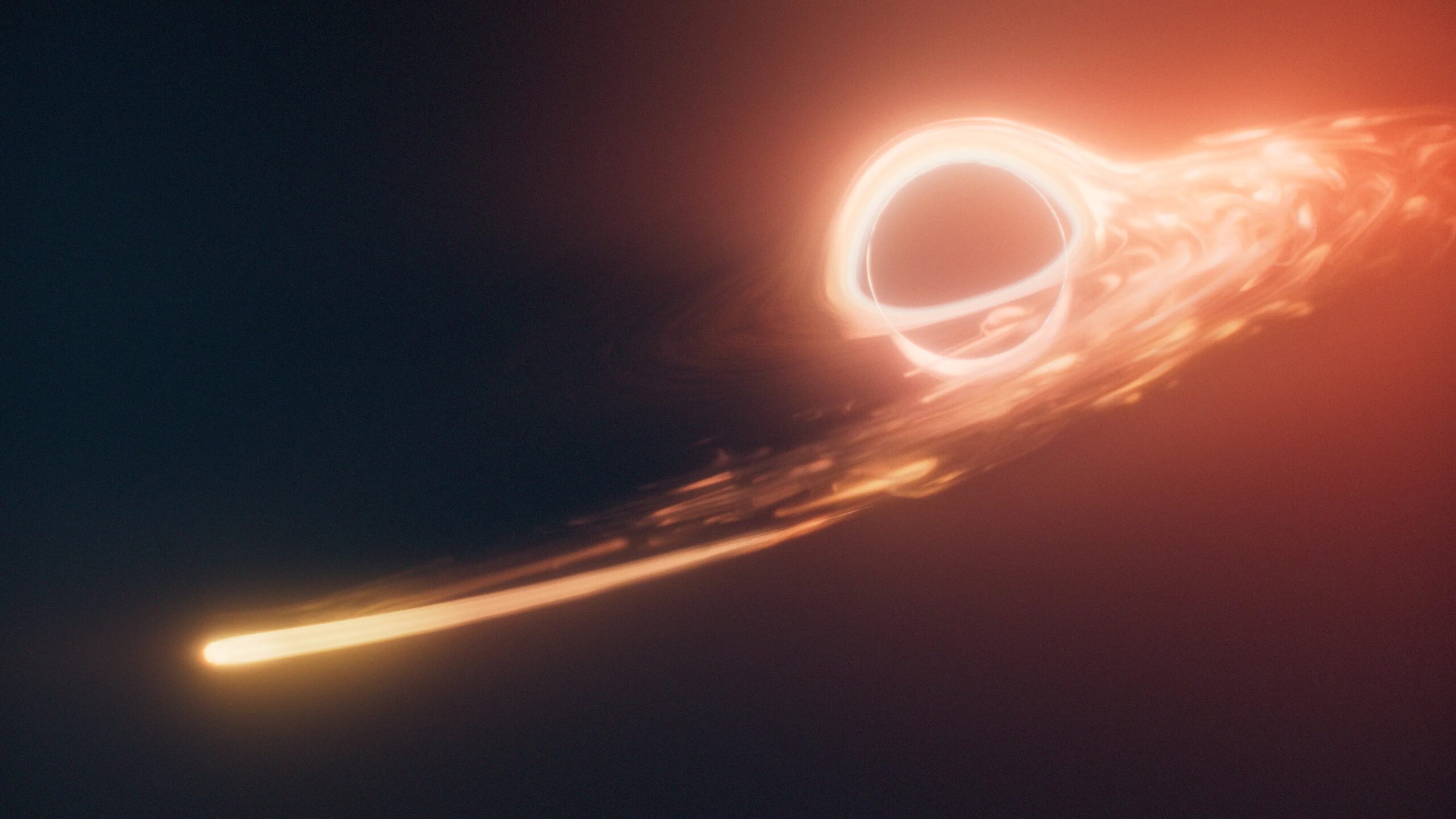
Black holes are primarily studied by detecting light from their accretion disks—the material swirling around before being consumed. Lighter supermassive black holes are challenging to observe due to lower luminosity. However, when they disrupt and consume an entire star, they can shine brightly enough to outshine their host galaxy, a phenomenon known as a tidal disruption event (TDE). By studying early populations of supermassive black holes and their evolution over billions of years, Dr. Roman will provide vital insights into their origins.
“The Roman Space Telescope will revolutionize transient science,” stated lead author Mitchell Kamen, a Johns Hopkins University graduate student and National Science Foundation Graduate Research Fellow. “With Roman’s high sensitivity, we can discover multiple tidal disruption events occurring much earlier in cosmic history than previously possible.”
A recent paper detailing this study was published on Tuesday in the Astrophysical Journal.
Roman’s High Latitude Timed Survey is one of its three core community surveys, particularly tailored for discovering and studying TDEs in the early universe. Covering approximately 18 square degrees of the sky—equivalent to 90 full moons—this survey enables astronomers to identify numerous transient phenomena, including TDEs, by conducting repeated observations of the same areas.
TDEs are unique to lighter supermassive black holes. A black hole exceeding a billion solar masses would consume an incoming star whole, while a lighter black hole, between 100,000 and 100 million solar masses, can shred a star before consuming it, resulting in a bright beacon that gradually fades over weeks.
The pace of TDEs varies with cosmic time. Previous studies suggested that TDE occurrences might decline with distance since young black holes are often too light to generate them. However, this recent study considers various evolving factors over time, including galaxy mergers and the density of stars at each galaxy’s center.
Kamen and his team, alongside observatories like the ground-based National Science Foundation’s Department of Energy, modeled these effects to estimate the number of TDEs that Roman could observe. The Vera C. Rubin Observatory and NASA’s James Webb Space Telescope will also contribute to this research. The team anticipates that as Roman observes greater distances and earlier epochs, astronomers will see an increase in TDEs until “cosmic noon,” around 11 to 12 billion years ago, when star formation peaked, followed by a decline.
Roman will observe near-infrared wavelengths. The light from distant TDEs is stretched to longer wavelengths due to the universe’s expansion, a phenomenon referred to as “cosmic expansion” or cosmological redshift. Consequently, Roman is effectively optimized to identify TDEs, where light requires 8 to 11 billion years to reach us.
While the Rubin Observatory will scan vast areas of the sky and detect numerous TDEs, its visible light observations will limit it to nearer events compared to Roman.
Research from Kamen’s team indicates that Rubin can detect thousands to tens of thousands of TDEs annually. In contrast, Roman is expected to discover up to 100 TDEs each year, benefiting researchers by focusing on objects further in cosmic history, crucial for understanding black hole origins.
“By counting the number of TDEs as a function of redshift, we can impose meaningful constraints on the existence of million-solar-mass black holes,” explained co-author Suvi Gezari, associate professor of astronomy at the University of Maryland. “Roman’s innovative design will allow us to investigate tidal disruption phenomena further afield, observing how TDE incidence changes over time.”
Astronomers have detected massive black holes very early in the universe’s history, which challenges current theories explaining their rapid growth. Proposals suggest these black holes must have started small and expanded over time—how small exactly remains uncertain.
One theory, the “light seed” model, posits that a black hole forms from a massive star’s death and can be several hundreds of times the Sun’s mass. Over time, these black holes combine and consume surrounding gas rapidly, indicating that all young galaxies might harbor massive black holes at their centers.
The “heavy seed” theory proposes that black holes can be born much larger, up to a million solar masses, via processes like direct collapse of gas clouds. However, this process is less common, potentially making supermassive black holes rare in early galaxies.
“The tidal disruption phenomenon is instrumental in exploring populations of light supermassive black holes and distinguishing between these models,” Kamen stated.
Ultimately, Roman’s catalog of tidal disruption events will assist researchers in tracking the global influences affecting black hole populations over time.
As Roman and Rubin embark on their scientific endeavors, the team eagerly anticipates comparing predictions with actual observational data.
“Just as Webb transformed our understanding of distant high-redshift galaxies, Roman is set to redefine our perspective on high-redshift transients,” Gezari noted.
The Nancy Grace Roman Space Telescope is managed by NASA’s Goddard Space Flight Center in Greenbelt, Maryland, with contributions from NASA’s Jet Propulsion Laboratory in Southern California, Caltech/IPAC in Pasadena, the Space Telescope Science Institute in Baltimore, and a collaborative scientific team from various research institutions. Key industrial partnerships include BAE Systems, Inc. in Boulder, Colorado, and L3Harris Technologies in Melbourne, FL.
Written by Christine Pulliam
Space Telescope Science Institute, Baltimore, Maryland
Media Contact:
Claire Andreoli
NASA’s Goddard Space Flight Center
Greenbelt, Maryland
301-286-1940
Source: www.nasa.gov