


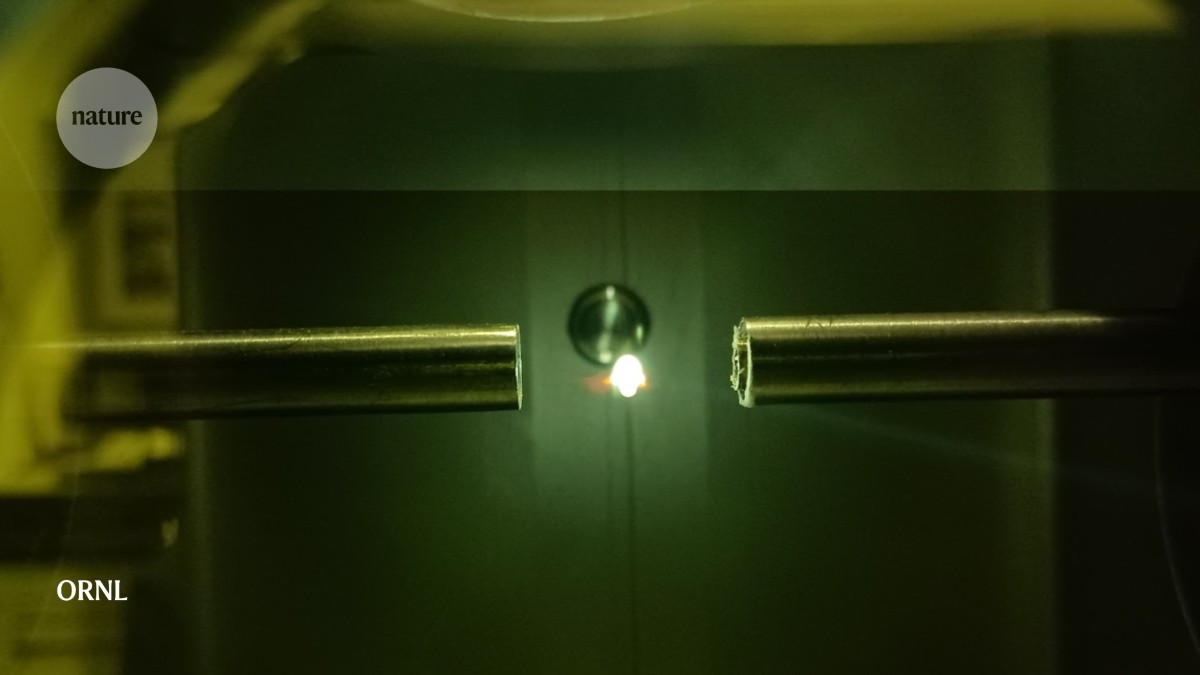
Light generated by microplasmas could help scientists monitor chemical reactions inside molten salt reactors.Credit: ORNL
New insights into graphite for nuclear reactors
Graphite is widely used in nuclear reactors because it can withstand extreme temperatures and prolonged exposure to neutron radiation. The carbon-based material supports reactor structures, forms part of some fuel coatings and acts as a moderator by slowing neutrons, helping sustain nuclear fission. Despite its importance, scientists still do not fully understand how graphite’s internal structure changes under irradiation. That uncertainty makes it challenging to develop longer-lasting and safer graphite components for future nuclear power plants.
Nature’s Perspective: Nuclear Power
Researchers led by nuclear physicist Boris Hajković of the Massachusetts Institute of Technology in Cambridge used X-ray scattering to examine graphite before and after exposure to different radiation doses and temperatures. Their goal was to determine how the material’s initial structure influences its performance. The team found that the size and distribution of pores within graphite play a major role in determining whether the material contracts or expands during irradiation.
Graphite initially becomes denser when exposed to radiation, but continued irradiation can cause it to expand. The material’s response depends on temperature, mechanical stress and graphite grade. Nuclear graphite typically contains crystalline regions in which carbon atoms are arranged in an orderly structure, a less-ordered binder-carbon matrix, and a network of pores and cracks. These structural differences affect how stress is distributed and how much the material contracts or expands inside an operating reactor. The researchers say that understanding the relationship between graphite porosity and radiation damage could help engineers design more durable materials for advanced nuclear reactors.
Interdisciplinary Materials. 4714–718 (2025)
Real-time monitoring of molten salt reactor chemistry
Molten salt reactors use liquid salt as fuel, coolant or both, and could offer important safety advantages over some conventional reactor designs. However, the chemical and isotopic composition of nuclear fuel dissolved in molten salt is highly complex. The environment can also be corrosive, making it difficult to monitor reactor conditions during operation. Researchers at Oak Ridge National Laboratory (ORNL) in Tennessee are developing analytical tools that could support the safe deployment of molten salt reactors.
Inside these systems, nuclear fuel, fission products and the molten salts can undergo unwanted chemical reactions that generate hazardous gases. Scientists analyze these gases to track changes inside the reactor. A complete assessment requires instruments that can identify chemical compounds while also measuring isotopes. Monitoring oxidation, corrosion, water vapour and other processes simultaneously has traditionally been difficult with a single analytical technique.
A team at ORNL led by Joanna McFarlane developed a system that uses high-energy laser pulses to convert gas into plasma. The plasma is then directed to three spectrometers, enabling simultaneous, real-time analysis of its elemental and isotopic composition. The researchers demonstrated the technique using molten sodium- and potassium-based salts containing protium and deuterium gases. They sampled the mixture by removing hydrogen isotopes from the surface and bubbling an inert gas through the liquid to capture dissolved material. This approach reveals how much gas the salt can dissolve and how quickly it moves through the molten salt.
The researchers hope comparable spectroscopic systems can eventually be integrated into molten salt reactors to provide continuous chemical and isotopic monitoring while the reactors are operating.
J. Am. Chem. Soc. 147910–917 (2025)
Study examines nuclear power plants and cancer mortality
Radiation is a recognized carcinogen, but the potential cancer risk for people living near nuclear power plants remains uncertain. Some studies in Spain and France have linked residential proximity to nuclear facilities with increased cancer risk, while other research has found no consistent association.
Researchers led by Petros Koutrakis, an environmental health professor at Harvard T.H. Chan School of Public Health in Boston, Massachusetts, conducted a large-scale analysis to investigate the issue in the United States. The country produces about 30% of the world’s nuclear energy. Earlier studies often focused on only one or a small number of facilities, which limited statistical power and made it harder to identify rare cancers. Some studies also used fixed distance cutoffs that may not fully capture risks among people living just beyond those boundaries.
Using data from the U.S. Centers for Disease Control and Prevention covering 2000 to 2018, the researchers reported that counties located closer to nuclear power plants had higher adult cancer mortality rates than counties farther away. The association was strongest among older adults, which the authors suggest could reflect the long latency period of cancers linked to environmental exposures.
The researchers emphasize that the findings have important limitations. The CDC data did not include childhood cancers, which are relatively rare. Geographic proximity was used as an indicator of radiation exposure, although it does not directly measure individual radiation doses. The analysis also did not account for differences among reactor types or other potential sources of radiation exposure. “Understanding the potential long-term health effects of nuclear power generation is particularly important given the renewed interest in nuclear energy as a low-carbon solution,” the authors write.
Nature Communications. 171560 (2026)
High-entropy alloys show resistance to nuclear radiation damage
High-entropy alloys may withstand radiation damage better than stainless steel, a material commonly used in nuclear reactor components. Researchers are now studying how these alloys change at the atomic scale to understand why they appear to be more durable under reactor conditions.
Conventional alloy steels are based mainly on iron, with smaller quantities of other elements added to improve strength, corrosion resistance and other properties. High-entropy alloys, developed over the past 25 years, contain several metals in relatively equal proportions. Their complex composition may help them tolerate the defects created by radiation.
Previous studies examined the effects of radiation on high-entropy alloys at room temperature. However, those results may not accurately represent nuclear reactors, where operating temperatures can reach several hundred degrees Celsius.
A team led by materials engineer Yanwen Zhang of Queen’s University in Kingston, Canada, irradiated an alloy containing chromium, iron, manganese and nickel at 400°C and 600°C. Using X-ray spectroscopy, imaging and other analytical techniques, the researchers tracked changes in the material’s atomic structure. Under the tested conditions, the high-entropy alloy sustained less radiation damage than steel.
The type of damage varied with radiation dose and temperature. Some conditions produced a greater number of structural defects, while others resulted in fewer but larger defects. Radiation also moved atoms through the alloy, reducing manganese in some regions and increasing the concentration of nickel in others. Understanding these nanoscale changes could help scientists develop radiation-resistant materials for advanced nuclear reactors.
J. Nucl. Mater. 615155940 (2025)
Assessing proliferation risks from advanced uranium fuels
Many advanced nuclear reactors use uranium fuels that differ from those used in conventional light-water reactors. This has raised questions about whether new security regulations are needed to prevent the fuel from being acquired by terrorist groups or states seeking to produce nuclear weapons. A paper by nuclear engineer Charles Forsberg of the Massachusetts Institute of Technology and nuclear consultant Andrew Kadak argues that existing safeguards are likely to be sufficient, provided they are applied appropriately.
High-temperature gas-cooled reactors often use TRISO fuel, which consists of poppy-seed-sized uranium particles coated with several layers of graphite and silicon carbide. These coatings protect the fuel and make fuel failure or meltdown highly unlikely at temperatures up to approximately 1,600°C. Because TRISO fuel contains relatively little uranium in a given volume, it generally uses uranium enriched in the more reactive uranium-235 isotope. Uranium containing 20% or more 235U is classified as highly enriched and could potentially be further processed for weapons applications. TRISO fuel typically uses high-assay low-enriched uranium, or HALEU, with enrichment levels between 5% and 20% 235U.
Some experts have warned that 1,000 kilograms of HALEU could potentially be used to produce nuclear weapons. Forsberg argues that terrorists would be unlikely to steal TRISO fuel and extract the uranium because removing the uranium from its protective coatings would require a highly complex chemical process. Material losses at each stage would make it difficult to recover such a quantity of HALEU. He describes the process as involving “the largest number of sequential chemical processes ever conceived for nuclear materials.” However, the authors argue that existing safeguards for other nuclear fuels should also cover TRISO fuel, because nation-states may possess the capability to extract and enrich nuclear material.
Source: www.nature.com