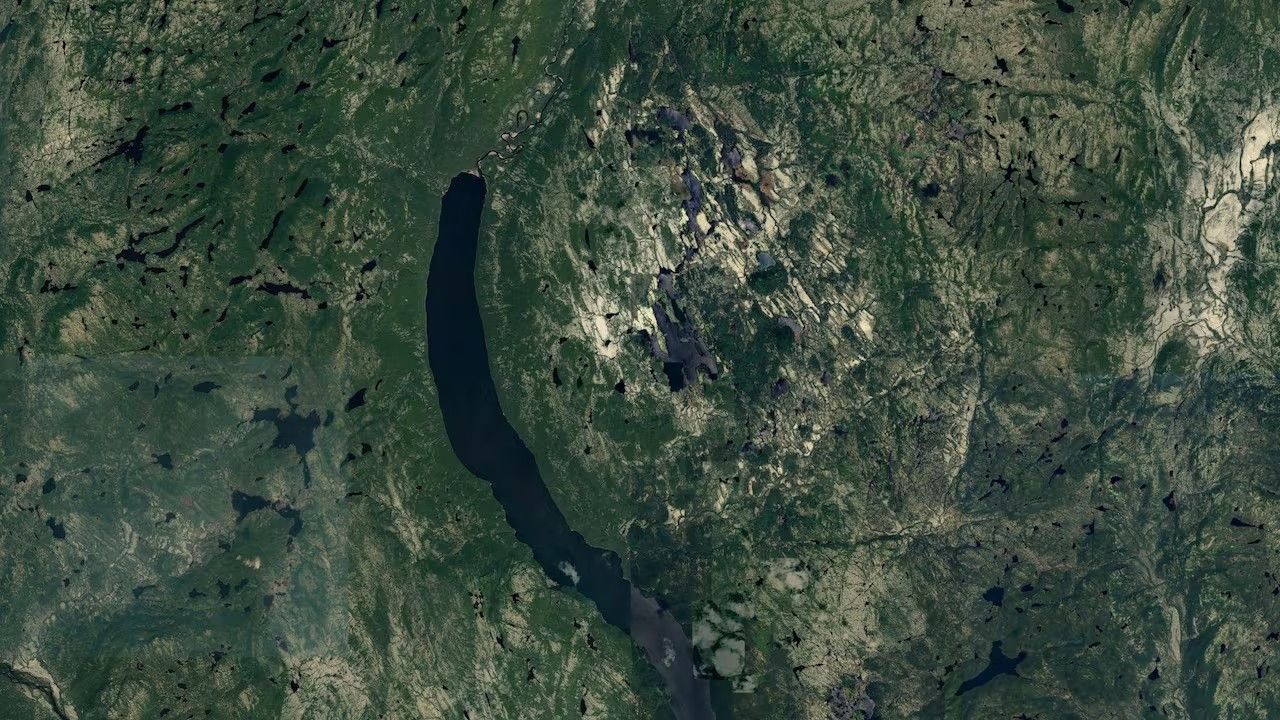
In 2024, amateur astronomers uncovered a 390-million-year-old meteorite impact crater using Google Maps, a finding confirmed by scientists.
While planning a camping trip in Quebec’s Côte-Nord region, Joel Lapointe stumbled upon a significant depression in the landscape. According to CBC, the hole is situated near Lake Marsal and spans approximately 25 kilometers (15.5 miles) in diameter, resembling a nearly perfect ring. This was not just an ordinary depression. Upon reaching out to French geophysicist Pierre Rochette, he noted that the surrounding topography suggested an impact crater.
Preliminary tests of samples from the crater revealed the presence of zircon, a mineral typically formed by meteorite impacts. However, this alone was not enough to validate the extraterrestrial origins of the crater. A dedicated scientific team then visited the site.
“We are searching for signs of shock metamorphism, which can only happen from extreme pressures resulting from an asteroid or comet strike,” stated Gordon Osinski, a planetary geology professor at Western University. “Most of these characteristics are microscopic and need laboratory analysis for confirmation.”
Osinski also pointed out a visible characteristic called shutter cones, grooves in the rock surface formed by shock waves that pass through the earth.
In October 2025, Osinski and a team of geologists explored the crater, which he described as one of the most challenging expeditions he had ever undertaken. The terrain was harsh, with numerous insects presenting additional challenges.
Ultimately, they found the anticipated shatter cone and large cliffs of impact-melted rock, generated by the intense temperatures and pressures of the meteorite impact. “A collision from a sufficiently large asteroid can literally melt tens of cubic kilometers of Earth’s crust,” Osinski mentioned to CBC.
Subscribe for the latest in fascinating discoveries straight to your inbox.
Samples collected from the site led to an estimation that the crater dates back 390 million years.
A) Shutter cone at the center of the structure. B) Melt rock located 4 km (2.5 miles) west of the crater’s center.
(Image credit: Gattacceca, J. et al.)
Osinski manages a website called Impact Earth, focusing on meteorite impact sites and often receives inquiries about unusual satellite images. “We’ve had countless messages from the public claiming they’ve found a crater, but 99 times out of 100, they are mistaken,” he explained. “This instance is a rare exception that demonstrates what’s possible.”
Currently, around 200 meteorite impact craters are identified on Earth, with 31 located in Canada. “Typically, we discover one or two craters a year, and these are usually smaller than 5 to 10 km (3 to 6 miles) in size,” noted Osinski. “Finding a crater of this magnitude is quite uncommon.”
The last confirmed meteor crater in Canada was discovered in 2010.
Following the confirmation of the crater’s meteorite origins, Oshinsky, Rochette, and their team named it Uhachatik Crater in consultation with the Ekuanitosit Innu Council, representing the region’s Indigenous peoples. Their findings are set to be presented at the Meteorological Society’s annual meeting in Germany next month.
Lapointe expressed joy over his discovery’s validation as a meteor crater. “It’s not every day the public finds a 390-million-year-old crater,” he shared. “Even if you’re not an expert, it’s wise to trust your instincts and observations.”
Oshinsky and his team will continue their analysis of the samples to uncover more about the impact site. “Every newly found crater enhances our understanding of how they form and their influence on Earth’s geology, biology, and climate,” he concluded in his interview with Live Science.