


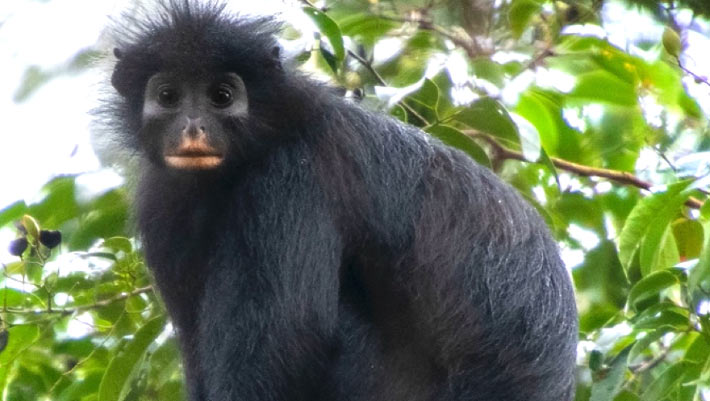
Researchers have formally described an exciting new species of African monkey known as colobus. This remarkable primate, residing in the remote regions of the Democratic Republic of the Congo, marks only the fifth new monkey species discovered on the continent in the last 75 years.
This newly identified species, named colobus congoensis, features distinctive black fur with striking orange-cream spots around its mouth and nose, an all-black mask-like face, and a prominent white spot near its tail.
Colobus congoensis inhabits the eastern basin of the Lomami River and the adjoining basin of the Upper Congo (Lualaba) River in the Democratic Republic of the Congo.
Dr. Junior Amboko, a student at Florida Atlantic University, expressed that “This discovery is both thrilling and deeply personal, underscoring the incredible biodiversity of my homeland that remains largely undocumented.”
“It was a privilege to name the species colobus congoensis. Acknowledging the remarkable natural heritage of the Congo Basin emphasizes its global significance and local pride,” he added.
The first photographic evidence of colobus congoensis was captured in 2008 by researchers exploring the Lomami Basin, though its significance was not recognized until later.
In 2018, park rangers photographing the animal noted its unique markings, which prompted further scientific inquiry.
Over subsequent months, rangers documented multiple sightings, and researchers like Amboko matched these observations with earlier photographs.
Despite living near several villages, local knowledge of the monkey was minimal. Of the 52 villages surveyed near its habitat, only eight accurately described the monkey’s characteristics, which contrasts with residents’ familiarity with other local primates.
The discovery of colobus congoensis is reshaping our understanding of African monkey evolution, according to Dr. Kate Detwiler, also from Florida Atlantic University.
Genetic and skeletal analyses reveal that colobus congoensis is closely related to the black colobus (colobus satana), a species discovered on Bioko Island, more than 1,200 kilometers away.
Mitochondrial DNA studies indicate that these two lineages diverged approximately 4 to 5 million years ago, the most significant divergence among sister species in the colobus genus, enhancing our understanding of evolutionary history.
Researchers also observed that while the calls of colobus congoensis share structural similarities with those of its distant relatives, marked differences in pitch and pattern exist.
Dr. Julia Arenson from Yale University noted, “We compared the skull and fur, and colobus congoensis shows similarities to other African colobinids, emphasizing its uniqueness.”
“Simultaneously, we demonstrated that they share dental, cranial, and facial features with other species, despite their smaller body size compared to other African colobins,” she added.
According to Christopher Gilbert, a professor at the City University of New York, “To name a new species, comprehensive evidence is required.”
“Leveraging extensive museum collections and comparative datasets allowed us to quickly and conclusively confirm colobus congoensis as a new species.”
Field surveys conducted between 2018 and 2022 recorded 114 sightings of colobus congoensis, indicating a limited estimated range of only 1,700 km2, which is surprisingly small compared to other colobus species whose ranges can exceed 60,000 km2.
The monkeys were typically observed in small groups, averaging around six individuals, often moving in conjunction with other monkey species in the tree canopy.
Based on its restricted habitat and population size, scientists have proposed a provisional classification of colobus congoensis as an endangered species for the IUCN Red List.
Dr. John Hart, a conservation scientist at the Lukuru Wildlife Research Foundation, remarked, “This discovery reaffirms that the Congo Basin remains one of the world’s last great frontiers for mammal discovery.”
“Even in scientifically studied areas, entirely new species continue to emerge.”
This finding underscores how much biodiversity remains undocumented in the Central Congo Basin, shaping our understanding of primate evolution and conservation.
For further reading, refer to the article published in PLoS ONE: here.
_____
JA Heart et al. 2026. Likweli: A remarkable new species of colobus monkeys in Lomami National Park, Democratic Republic of the Congo. PLoS ONE 21 (7): e0349857; doi: 10.1371/journal.pone.0349857
Source: www.sci.news