


The Hillsboro meteorite, recovered shortly after its fall on July 16, 2024, is providing NASA scientists with groundbreaking insights into ancient water, the chemical evolution of primordial asteroids, and the potential ingredients for the emergence of life in the early solar system.
This rapid recovery was initiated by an amateur astronomer in New Jersey, who quickly identified the meteorite’s scientific value upon its landing on his property. Equipped with protective gloves, he carefully collected the debris, storing it in aluminum foil and glass containers that safeguard delicate minerals and organic compounds often compromised by moisture and pollution.
As the meteorite descended through the atmosphere, cameras across New Jersey captured its fiery passage. Scientists analyzed these observations to reconstruct the fireball’s trajectory, recovered the meteorite, and combined this data with laboratory analysis to infer its probable origins within the solar system. A study published in the journal Scientific Progress revealed that ancient salt water influenced the mineralogy of the meteorite’s parent asteroid, preserving a unique assortment of minerals and rich organic compounds.
“The recorded fireball data and rapid recovery of this meteorite not only reveal its composition but also indicate its origin in the asteroid belt,” stated Peter Jenniskens, a meteor astronomer at NASA’s Ames Research Center and lead author of the study.
The Hillsboro meteorite, named after the town of discovery, belongs to the CM carbonaceous chondrites, a group of carbon-rich meteorites that contain some of the oldest material in the solar system, documenting the chemical processes that formed asteroids over 4.5 billion years ago.
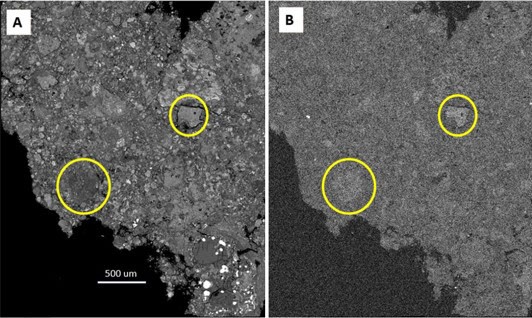
During the examination of this remarkably primitive meteorite, researchers identified a mosaic of small broken rocks, some exhibiting unexpectedly high concentrations of sodium. This significant finding led to an in-depth investigation using powerful electron microscopes, allowing scientists to analyze the meteorite from millimeter scales down to individual atoms. By integrating observations across various scales, researchers reconstructed the history of the minerals and the fluids that once permeated them.
These analyses unveiled microscopic cracks filled with sodium-rich material left behind by ancient brine. Unlike pure water, saltwater contains dissolved salts, which transport elements and chemically alter the rocks they encounter. In the case of the Hillsboro sample, these ancient fluids reshaped the asteroid’s mineralogy, leaving behind chemical evidence preserved for billions of years.
Scientists also successfully detected fragile sodium carbonate salts, which typically react with moisture in Earth’s atmosphere. Co-author Jangmi Han, a mineralogist at NASA’s Johnson Space Center, unearthed evidence of ancient brine preserved within microscopic cracks. Similar salts were identified in samples collected from asteroids Bennu and Ryugu by NASA’s OSIRIS-REx and JAXA’s Hayabusa2 missions. Notably, Hillsboro showcases sodium carbonate salts in CM carbonaceous chondrite meteorites for the first time, offering fresh insights into the surfaces of the primitive asteroids that generated these meteorites.
Collectively, these findings indicate that ancient saline waters were more prevalent in early solar system history, providing new avenues for scientists to compare how water impacted various asteroid bodies across the cosmos. primitive asteroids
“The saltiest fragments from this meteorite compare closely with the samples returned by Hayabusa2 and OSIRIS-REx missions,” noted Mike Zolensky, a meteorite researcher at NASA Johnson and co-author of the study. “While not identical, they exhibit intriguing similarities and some fascinating differences.”
Mike Zolensky
Meteorite Researcher
Given its classification as a CM carbonaceous chondrite, scientists anticipated the Hillsboro meteorite to be rich in organic compounds. Its swift recovery allowed for study before long-term exposure to Earth’s environment could alter the samples.
“When we analyzed fragments of the Hillsboro meteorite, I was surprised by the complexity of the amino acids and organic compounds present,” said Danny Glavin, a senior scientist at NASA’s Goddard Space Flight Center.
The diversity and complexity of the organic compounds rival those of the Murchison meteorite, a 100-kilogram carbonaceous chondrite that fell in Australia in 1969, which has since set the standard for extraterrestrial organic chemistry.
“This further supports the theory that the chemical building blocks of life may have been delivered to Earth by material from these carbonaceous asteroids, with ongoing deliveries today,” said Glavin, who also leads an international team exploring organic compositions in samples returned from asteroid Bennu in 2023.
Understanding the Hillsboro meteorite necessitated interdisciplinary collaboration.
Astronomers mapped the meteorite’s journey and determined that it likely originated from the Erigone asteroid family in the Inner Asteroid Belt, home to asteroid Donald Johansson, visited by NASA’s Lucy spacecraft in 2025. Meanwhile, mineralogists analyzed evidence of ancient brine, while organic chemists studied the meteorite’s amino acids and organic compounds.
“These combined efforts are contributing to one of the clearest understandings of how primitive asteroids like Erigone have chemically evolved over billions of years,” Jenniskens said.
Researchers are continuing to investigate the Hillsboro meteorite, unveiling new details about how water transformed primordial asteroids and sculpted the early solar system.
By tracing the evolution of water in primordial asteroids, scientists are gaining insights into how the essential components of water and life were distributed across the early solar system.
“Tracking water through the solar system is akin to tracking life,” said Zolensky. “Understanding the history of water is crucial for deciphering the origins of life.”
To learn more about NASA’s research and exploration of celestial materials, click below.
Karen Fox / Molly Wasser
Headquarters, Washington
240-285-5155 / 240-419-1732
[email protected] / [email protected]
Victoria Segovia
NASA Johnson Space Center, Houston
281-483-5111
[email protected]
Source: science.nasa.gov