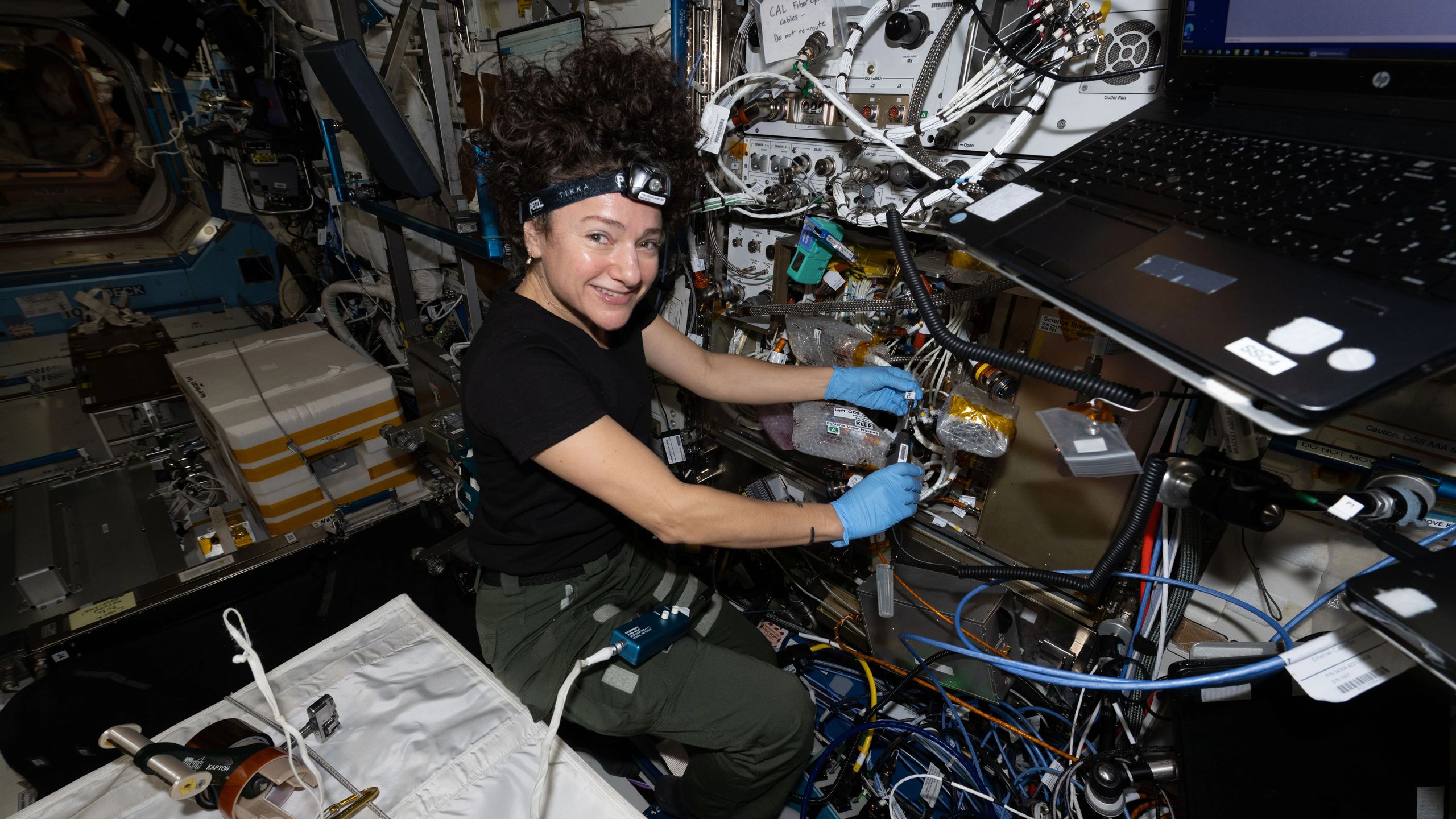
NASA has announced significant upgrades to the International Space Station’s (ISS) quantum laboratory, enhancing its ability to explore atomic behavior in unprecedented detail.
By utilizing the ISS’s advanced “cold atom laboratory” in the unique environment of near-weightless low-Earth orbit, scientists aim to understand the characteristics of “ultra-cold” atoms in conditions that cannot be accurately replicated on Earth. This mission focuses on observing the behavior of atom clouds at temperatures nearing absolute zero (minus 459.67 degrees Fahrenheit or minus 273.15 degrees Celsius), the lowest temperature where atoms lose all kinetic energy.
“At these incredibly cold temperatures, matter exhibits behaviors that are fundamentally different from our everyday experiences,” stated Jason Williams, a Project Scientist at NASA’s Jet Propulsion Laboratory’s Cold Atom Lab in Southern California, which developed the facility. He added in a statement. “The dominance of matter’s wave-like nature leads to unexpected behaviors, allowing for precision measurements of time, gravity, and motion. Our newly upgraded lab provides a wealth of tools to explore the universe’s mysteries.”
Particles Defying Conventional Behavior
Atoms and their subatomic particles operate under quantum mechanics, which reveals behaviors markedly different from classical physics. Notably, quantum mechanics allows particles to exist in multiple locations at once (quantum superposition) and can lead to linked behaviors over vast distances (quantum entanglement). Instead of merely traversing space and time as waves, they act like solid objects.
These quantum behaviors, however, are notoriously challenging to observe. Atoms are minuscule; for context, if an atom were the size of a golf ball, a person would stand at the height comparable to the distance from the Earth to the Moon. Additionally, heat and gravitational energy interfere with accurate measurements of these quantum behaviors on Earth.
To tackle these issues, the ISS’s Cold Atom Laboratory—approximately the size of a small refrigerator—employs lasers to cool rubidium and potassium gases just above absolute zero. At these extreme temperatures, atoms create a state of matter known as a Bose-Einstein condensate, where they function collectively as a single quantum wave.
This innovative setup not only permits scientists to observe quantum behavior across broader scales but also enables the waves of condensed matter to expand and evolve undisturbed for extended durations compared to conditions on Earth.
Stay updated on the world’s most fascinating discoveries—subscribe to our newsletter!
This marks the fourth significant upgrade to the Cold Atom Laboratory since its arrival on the ISS in 2018. The latest improvements include a redesigned magnetic trap for better atomic cloud confinement, enhanced atomic sources, and increased measurement capabilities, as reported by NASA.
These upgrades were launched to the ISS in April 2026, successfully installed, and are now facilitating cutting-edge measurements. These advancements are not just vital for fundamental physics research but are also critical in paving the way for future space-based high-precision quantum technologies related to navigation, timing, and gravity sensing. Such technologies could potentially enable astronauts to navigate the Moon, creating a detailed map of Earth’s gravitational field in the absence of GPS. No GPS.
“The quantum revolution transformed technology in the last century with innovations like lasers, cell phones, and MRIs for medical imaging,” noted Ethan Elliott, a Deputy Project Scientist at NASA’s Jet Propulsion Laboratory in California. “We are now implementing Quantum 2.0, enabling direct manipulation of large-scale quantum states, and our goal is to advance this science in orbit, resulting in similar breakthroughs in quantum technology.”