


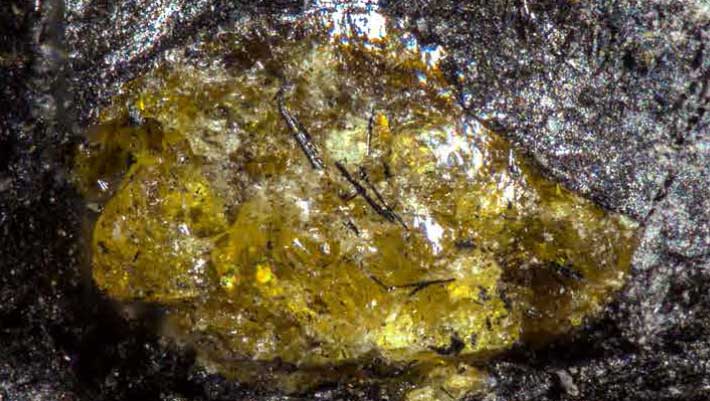
Chinese paleontologists have made a groundbreaking discovery by identifying what is believed to be the oldest amber on record. This fossilized resin dates back approximately 385 million years (Middle Devonian), surpassing previous findings by 65 million years. This remarkable discovery indicates that resin production in plants evolved long before the emergence of seed plants.
Image of Fusielsite amber from the Middle Devonian period. Scale bar – 0.2 mm inches (AD) and 0.1 mm inches (EG). Image credit: Lu et al., doi: 10.1126/sciadv.aeh1266.
Dr. Cihang Luo from the Nanjing Institute of Geology and Paleontology at the Chinese Academy of Sciences and the Senckenberg Institute and Museum of Natural History, stated, “Fossilized amber, particularly its resin, is considered one of the exudates from ancient seed plants.”
He further explained, “Typically, seed plants secrete resin through specialized tissues or through complex endocrine systems associated with bark and wood.”
“These resins comprise a mixture of terpenoid and phenolic compounds, aiding plants in recovery from various biotic and abiotic stresses like pests, pathogens, and wildfires.”
“The resin subsequently hardens into amber due to diagenetic and degenerative processes under high pressures and temperatures.”
“This sticky resin can entrap organisms, thus preserving them in amber as fossils, which offer crucial insights into the evolution of terrestrial ecosystems.”
In their study, Dr. Luo and colleagues analyzed around 10 kg of coal from the Hujasite seam near Hokstulgay, Xinjiang Uyghur Autonomous Region of China.
By employing ultraviolet light, they located tiny amber fragments in the coal, ultimately extracting 241 pieces, mostly ranging from 0.1 to 0.5 mm in diameter, under a microscope.
Typically, amber appears translucent to opaque and varies in color from pale yellow to dark brown.
Some fragments contain air bubbles, and the fossils exhibit a bright blue fluorescence under ultraviolet light.
The amber layers from the Fusielsite Formation are calculated to be around 385 million years old, residing in the Middle Devonian age.
Prior to this, the oldest confirmed amber dates back to the late Carboniferous period, approximately 320 million years ago.
“Amber serves as a unique archive of environmental, diagenetic, and biological data; however, its presence isn’t consistent throughout Earth’s history,” the researchers remarked.
“Before the Permian, only two notable amber records exist, both from the Carboniferous period: one from the Late Carboniferous in the United States (320 million years ago) potentially produced by Cordaitales, and the other from the latest Carboniferous in Canada (300 million years ago) associated with fern seeds.”
Using Fourier transform infrared spectroscopy along with gas chromatography and mass spectrometry, the team discovered that the chemical make-up of fusielsite amber bears more resemblance to resins from modern and fossil conifers than to those from flowering plants.
This is significant, as seed plants had not yet emerged when this resin formed.
The authors speculate that the resin was likely produced by pregymnosperms—an extinct group of seedless plants that led to seed plants—or by woody lycopsids, a prehistoric lineage of vascular plants.
Both plant groups have been identified in the Hoosier site formation. As amber does not preserve plant tissue, the exact source remains undetermined.
This discovery suggests that the biochemical mechanisms needed to produce complex terpenoid-based resins had evolved in non-seed plants by the mid-Devonian.
The researchers propose that primitive resins were likely used for wound sealing and to prevent fungal infections, rather than deterring insect feeding, as significant evidence for insect damage does not surface until the Carboniferous period.
They also highlight that ancient wildfires, prevalent during this era, may have influenced the evolution of wound-sealing resins.
“Our chemically verified fusielsite amber is the earliest amber ever identified,” the researchers concluded.
It shares a comparable chemical composition with conifer amber and sheds light on the early evolution of terpenoid resin biosynthesis in vascular plants.
“With its mid-Devonian age, Fusielsite amber most likely originates from non-seed plants.”
“Previously, all documented fossil resins were obtained from seed plants (spermatophytes), a lineage that encompasses pterophytes (seed ferns), gymnosperms, and angiosperms.”
“Seed plants made their first appearance and proliferated in the Late Devonian (Famennian, 372 to 359 million years ago), later than the timeframe of Fusielsite amber from the Middle Devonian.”
“Thus, while the chemical profiles of Hoosiersite amber and gymnosperm resins are similar, it’s improbable that spermatophytes are the source plants.”
“If this hypothesis is accurate, Hujasite amber would mark the oldest known fossil resin generated by non-seed plants.”
The team’s research paper was published in an online journal on July 15 Scientific Progress.
_____
Jihan Lu et al. 2026. The oldest amber from the Middle Devonian period in China. Scientific Progress 12(29); doi: 10.1126/sciadv.aeh1266
Source: www.sci.news