


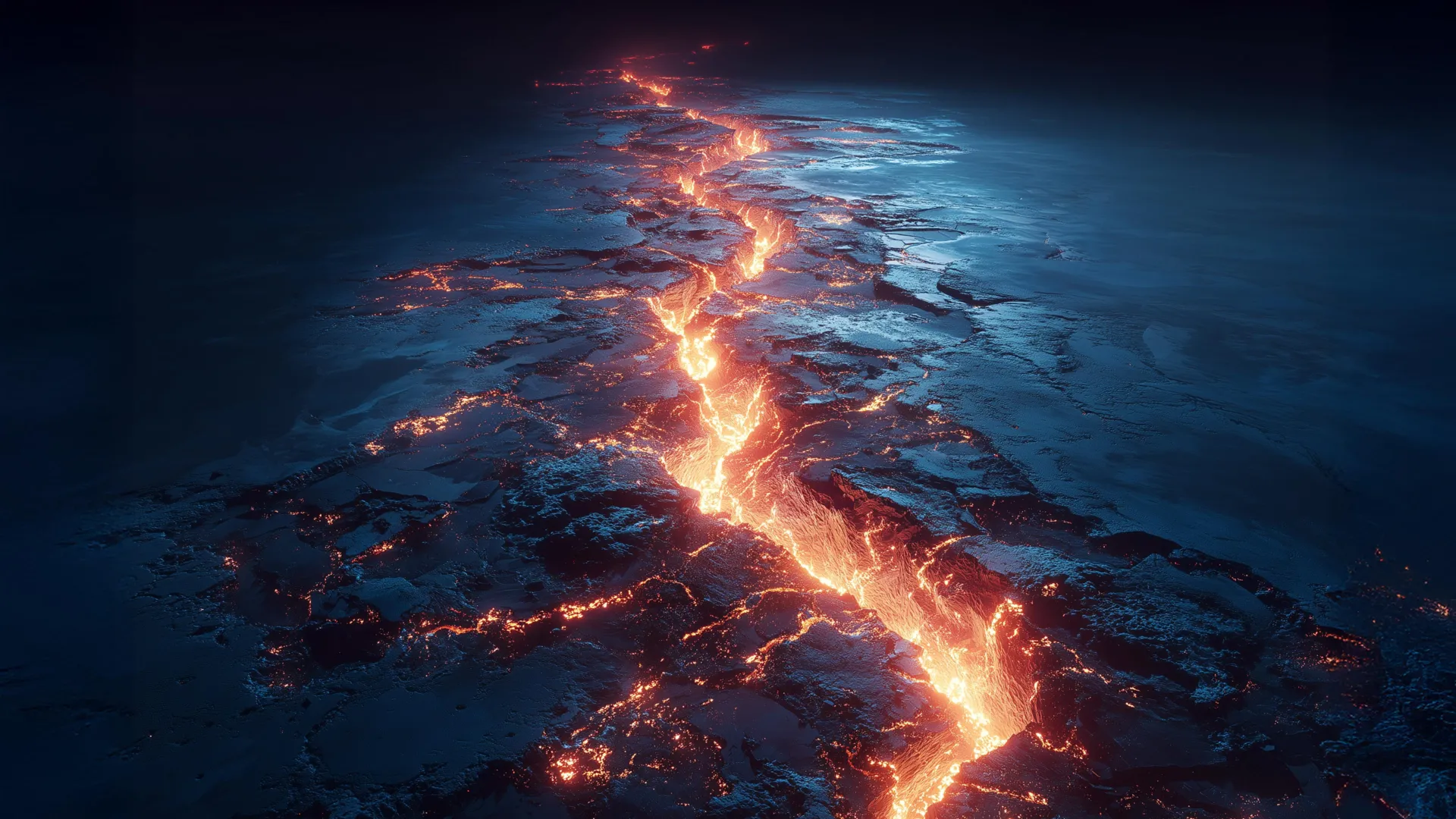
Recent scientific research reveals that one of the most significant volcanic events in Earth’s history not only led to the formation of a vast underwater plateau but also fundamentally altered the structure and chemistry of the oceanic plate beneath.
A dedicated research team, spearheaded by Lecturer Azusa Shido from Okayama University of Science, in partnership with Associate Professor Akira Ishikawa of Tokyo University of Science and Professor Masako Yoshikawa of Hiroshima University, utilized seismic wave analysis to explore the deep geological features of the Ontong Java Plateau. Their findings indicate that substantial magma flows penetrated the pre-existing plate, creating a network of vertical intrusions and chemically transforming the surrounding rocks.
The findings are published in Geophysical Research Letters.
Uncovering Hidden Structures beneath the Ontong Java Plateau
The oceanic plate located beneath the Ontong Java Plateau (OJP) reveals a complex internal structure, deviating from the simpler formation typically expected of oceanic plates. Researchers discovered a complicated interior comprising horizontal layers interspersed with swarms of vertical magma channels.
These vertical formations, known as embankments, arise when molten rock pushes through fissures, cooling within them. Large collections of these intrusions, referred to as dykes, preserve the historical records of intense volcanic activity for extended periods after solidifying.
Additionally, the research team observed unusually low seismic wave velocities in the plates. This suggests that the magma rising from the Earth’s depths did not merely pass through, but may also have altered the chemical composition of the plates.
The World’s Largest Oceanic Plateau
The Ontong Java Plateau (OJP), positioned beneath the western Pacific Ocean, is recognized as the largest oceanic plateau on the planet. This geological formation is created by a significant buildup of lava through volcanic eruptions.
Formed during a period of extraordinary submarine volcanic activity approximately 110 to 120 million years ago, the OJP represents the largest known volcanic eruption in Earth’s history.
Scientists assert that the eruption released vast quantities of heat, gases, and volcanic materials, severely impacting the Earth’s environment, altering ocean chemistry, climate, and oxygen levels in seawater, potentially contributing to a mass extinction event.
Recent studies propose that this volcanic activity may originate from thermochemical plumes ascending from deep within the mantle. A mantle plume consists of a column of exceptionally hot material that moves upwards through the Earth’s interior, with thermochemical plumes differing chemically from the surrounding mantle and potentially carrying materials recycled from ancient oceanic crust.
These plumes are capable of generating tremendous magma quantities, yet scientists still seek to understand how this magma influences the oceanic plate above.
Seismic Waves Illuminate the Interior of Oceanic Plates
To examine the layer below the OJP, researchers analyzed high-frequency seismic signals known as Po waves and So waves. These waves were captured by underwater seismometers positioned around the plateau, as well as instruments located on nearby oceanic islands.
Po and So waves traverse through the oceanic plate itself, rather than merely through the surrounding mantle. The speed and amplitude of these waves depend on the type of rocks they encounter, enabling the identification of hidden layers, fractures, and other structures deep beneath the ocean floor.
Typically, Po and So waves are produced when P and S waves scatter through layered structures within oceanic plates. This repeated scattering enables signals to travel vast distances.
However, waves recorded in the OJP area displayed unexpected behaviors. Po waves propagated efficiently through the region, while So waves experienced significant weakening.
This disparity offered crucial insights, indicating that the plate below the plateau possesses a more intricate internal structure than most oceanic plates.
Ancient Magma Channels Traversing Oceanic Plates
Employing seismic waveform modeling, scientists determined the types of structures that could account for the observed waveform patterns.
The results indicated that the plate features dyke complexes (vertical intrusions) and intersecting layered structures (horizontal stacking). Horizontal layers allow certain seismic waves to travel extensive distances, whereas vertical intrusions disrupt and weaken other seismic waves.
The discovery provides compelling evidence that magma once ascended through a pre-existing oceanic plate via multiple pathways, collectively forming an extensive underground network beneath the growing plateau.
Magma’s Impact on Plate Chemistry
Researchers identified another significant distinction between the OJP and standard oceanic plates. Both Po and So waves traversed more slowly beneath the plateau than expected.
Seismic waves generally decelerate when passing through hotter, less rigid, more fractured, and chemically distinct rocks compared to typical mantle material. The team concluded that structural aspects alone cannot fully account for the observed low speeds.
They hypothesize that magma from a thermochemical plume rose through the plate, forming dykes while reacting chemically with surrounding mantle rocks. This process likely resulted in the chemical modification (or re-fertilization) of the plates.
Reduction occurs when magma returns chemical constituents lost during partial melting to mantle rocks. The bulk of the mantle consists of a rock type called peridotite, which, when partially melted, loses certain elements. Magma can reintroduce these components, altering the mineral composition and physical properties of the rock.
Giant Eruptions: A Catalyst for Change in Oceanic Plates
The study’s findings indicate that extensive volcanic activity can result in more than mere deposits of lava on the ocean floor. Magma rising from deep within the Earth can disrupt oceanic plates, create vast dyke networks, and alter the chemical makeup of the plates themselves.
This model of physicochemical modification broadens scientific understanding of how oceanic plates evolve and how significant volcanic regions reshape the Earth’s interior.
The complete study is available in Geophysical Research Letters.
Summary of Main Findings
- The oceanic plate beneath the Ontong Java Plateau (OJP) features a complex structure with horizontal layers intersected by dykes.
- The slow seismic wave speeds suggest that magma from a thermochemical plume has chemically altered the plates.
- This study reveals that extensive volcanic activity has the potential to significantly change both the physical structure and chemical composition of oceanic plates.
Precautionary Notes
Thermochemical plume:
A mantle plume rising from deep within the mantle, chemically different from the surrounding mantle and potentially containing components sourced from ancient oceanic crust.
Reference:
Peridotite in the mantle loses melt components during partial melting. This process, by which melted components are reintroduced into depleted peridotite, is termed illumination.
Source: www.sciencedaily.com