


This article is fully accessible through your institution.
Hello Nature Readers! Would you like to receive daily briefings right in your inbox? Sign up here for free updates!
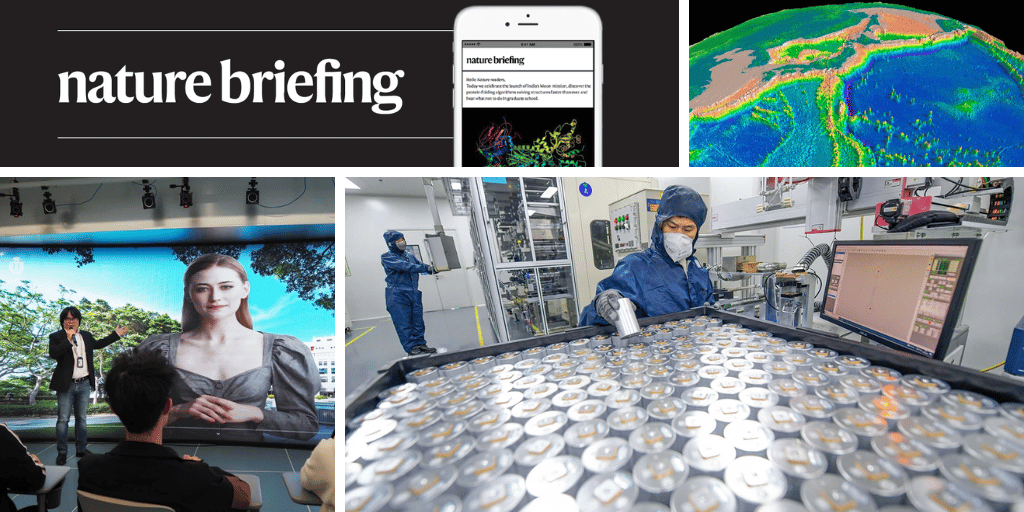
Computer scientist Pan Hui with a digital educational avatar utilized at the Hong Kong University of Science and Technology in Guangzhou.
Credit: Zhao Yawei
AI avatars are revolutionizing sectors from medical assistance to university lectures across China. The Cyberspace Administration of China has recently implemented regulations governing virtual digital humans. These new measures require individuals to consent to the use of their personal information, appearance, and voices. Additionally, businesses are restricted from offering virtual relatives or intimate relationships to minors, as well as from creating addictive virtual human services.
Nature | 7 min read
Reference: Administrative measures regarding digital virtual human information services (draft for public comments) (in Chinese)
Approximately 550 million years ago, a flat, segmented creature known as Spriggina flounder navigated the muddy ocean floor of the Ediacaran from right to left, according to recent research. Over 100 studies of Sprigina in South Australia reveal that, at the time of its death, twice as many were turning clockwise rather than counterclockwise. “The occurrence of handedness throughout various functional asymmetries, especially so early in the fossil record, offers insightful and significant information,” noted evolutionary biologist Russell Bicknell.
Smithsonian Magazine | 5 min read
Reference: Scientific Report paper
This Week’s Infographic

Many countries struggle to maintain independent regulatory drug approval processes, often depending on assessments from other nations, particularly the U.S. Food and Drug Administration. “Since the 1980s, this model has proved beneficial for governments, their citizens, and pharmaceutical companies,” explains pharmacy practice researcher C. Michael White. However, changes initiated during President Trump’s administration, such as job losses and efforts to expedite drug approvals, could endanger the FDA’s integrity and global standing.
Features and Impressions
Sodium-ion batteries are poised to be cheaper, safer, and more environmentally friendly alternatives to the existing lithium-ion batteries that dominate electric vehicle technology. Leading battery producer CATL has declared plans to commence mass production of sodium-ion batteries by year’s end, resolving long-standing durability issues.
Nature | 10 min read

Innovative technologies are nearing breakthroughs in understanding the mysteries of the deep sea floor. Hydrophone data can provide expedited tsunami warnings, while systems that utilize optical cables to detect seismic events over vast distances are gaining traction. Scientists also plan to drill into the Earth’s crust at the Mohorovičić discontinuity to retrieve pristine samples of the underlying mantle.
Nature | 7 min read
Would you consider borrowing $1.2 million? That’s the record price for a rare pen that secured the return of Neil Armstrong and Buzz Aldrin from the moon. This pen is currently up for auction as I write this.
This emphasizes my commitment to always carrying a pen, despite my rare need to write by hand. Share with us the items you never leave home without (watches, wallets, and keys are exempt), and send any feedback regarding this newsletter to [email protected].
Thank you for reading,
Flora Graham, Nature Briefing Editor-in-Chief
Contributed by Jacob Smith
• Nature Briefing: Careers — insights, advice, and award-winning journalism to enhance your career.
• Nature Briefing: Microbiology – Explore microorganisms, the most prevalent life forms, and their roles in health, environment, and food systems.
• Nature Briefing: The Anthropocene — Stay informed on climate change, biodiversity, sustainability, and geoengineering.
• Nature Briefing: AI and Robotics — Every piece is 100% human-written, of course.
• Nature Briefing: Cancer — A weekly newsletter tailored for cancer researchers.
• Nature Briefing: Translational Research — Covering biotechnology, drug discovery, and pharmaceuticals.
Source: www.nature.com